
Personal Finance · Featured
How to Calculate Net Worth: Formula and Worked Example
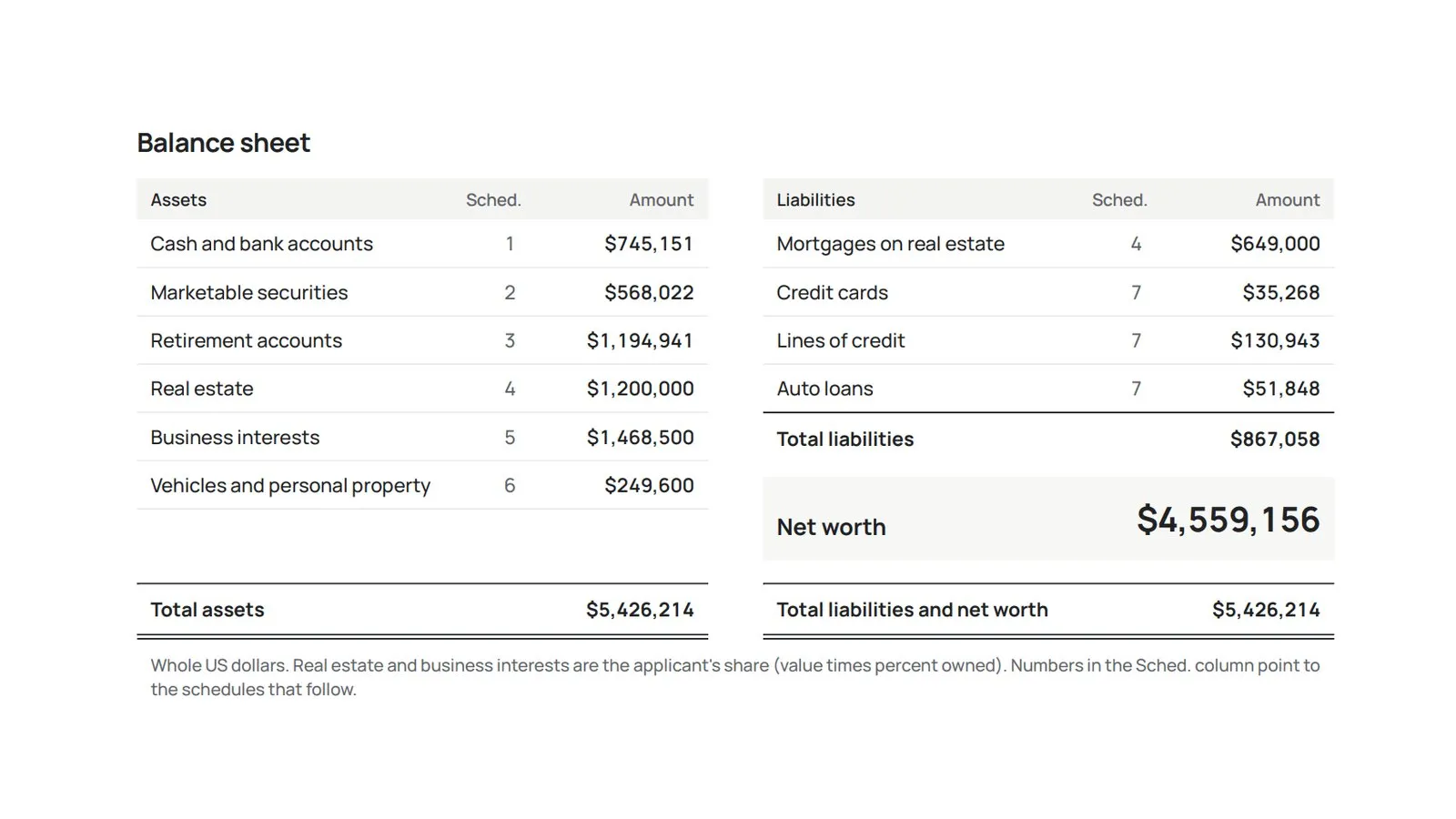
How to calculate net worth: total assets minus total liabilities. Seven steps, a worked household example, and the four values people most often get wrong.
Personal financial statements, SBA lending, commercial real estate, and the paperwork behind each one. Every post is checked against the form, the rule, or the data it describes, and most end with the questions readers type into search.
How to calculate net worth: total assets minus total liabilities. Seven steps, a worked household example, and the four values people most often get wrong.
Total liabilities and net worth is what you owe plus what's yours, and it must equal total assets. How the line works on SBA Form 413 and bank forms.
SBA SOP 50 10 8.1 starts October 1, 2026. The new SBA rules for buyers: 1.25x coverage on real earnings, a firm 10% for new owners, a 90-day Form 413, new fees.
With no revenue the weight of the file shifts to you. The 2026 SBA rules, the equity and credit bars, and which programs fund pre-revenue startups.
SBA disaster loans are not forgiven. The relief SBA does offer, what a charge-off means for your balance, and what happens once Treasury has the debt.
Seller discretionary earnings is the owner-benefit cash flow a small business is priced on. See which add-backs an SBA lender credits and which it strips.
The Illinois financial affidavit is the sworn disclosure required under 750 ILCS 5/501. A walkthrough of all 13 sections of form ATJ 251.5.
A 7(a) loan prepayment penalty applies only above a 15-year maturity, and a 504 carries a separate debenture premium. What each one actually costs.
A capital stack is the layers of debt and equity funding a deal, ranked by repayment priority. Senior debt to common equity, and what each layer costs.
A UCC filing is the public notice a lender files to claim your business assets. What it covers, how long it lasts, and how it affects your next loan.
A financial affidavit is a sworn court filing with an expense schedule. A personal financial statement is a lender's balance sheet. Which one you owe, and when.
A loan covenant is a promise in your loan agreement that outlives closing. Breaching one can put you in default while every payment is current.
The loan-to-cost ratio is your loan divided by total project cost. It sets how much equity you bring to a construction or SBA 504 deal.
Debt yield is net operating income divided by the loan amount. On many commercial deals it caps the loan below what LTV and DSCR would allow.
What happens if you default on an SBA loan: the lender accelerates, SBA honors its guaranty to the bank, and the unpaid balance follows you to Treasury.
Seller financing for a business can cover half your SBA equity injection, but only if the note sits on full standby for the life of the loan.
A rent roll lists every unit, tenant, and rent at a property. Underwriters apply their own vacancy floor to it before they size your loan.
A mortgage gift letter documents that your down payment is not a loan. What Fannie Mae, Freddie Mac, and FHA require, and the paper trail behind it.
A letter of explanation answers one underwriting question in writing. What triggers the request, what each agency actually requires, and how to write one.
Fannie Mae and Freddie Mac asset depletion guidelines side by side: divisors, LTV caps, eligible assets, and Freddie's August 2026 rewrite of Section 5307.1.
An asset depletion loan turns a documented asset balance into qualifying monthly income. The divisors, the haircuts, and which assets actually count.
IRS Form 4506-C lets your lender pull your tax transcripts through IVES. What it authorizes, what the lender sees, and the 120-day clock that kills deals.
Free schedule of real estate owned (SREO) template in Excel and PDF, plus what lenders require on one and how it ties back to SBA Form 413.
A bank statement loan qualifies self-employed borrowers on 12 to 24 months of deposits instead of tax returns. How the expense factor works, and the trade-offs.
SBA Form 159 discloses what your broker or packager is paid on a 7(a) or 504 loan. Who counts as an agent, who signs, and which fees the SBA prohibits.
Every line on a profit and loss statement, top to bottom, and how an underwriter turns your net income into the cash flow figure behind the loan decision.
SBA Form 1919 is the borrower information form every 7(a) applicant signs. What each field and question asks, and the 2026 eligibility changes to know.
How to build a business debt schedule lenders accept: which columns to fill, what to leave off, and how to reconcile the total to your balance sheet and DSCR.
The 10 types of SBA loans in 2026: 7(a), 504, Express, WCP, CAPLines, MARC, export, microloan, and disaster, with amounts, terms, and Form 413 rules.
The benefits of an SBA loan include 10% down payments, 25-year terms, and capped rates. Weigh them against the fees and personal guarantee before you apply.
The 10 types of business loans compared: SBA 7(a) and 504, term loans, lines of credit, equipment, factoring, and MCAs, plus which need a Form 413.
The 10 types of commercial real estate loans compared: bank, SBA 504/7(a), agency, CMBS, life company, DSCR, bridge, construction, and mezzanine.
Which business loans you can get without a personal guarantee, which always require one (every SBA loan does), and how to qualify to skip it.
How a commercial real estate construction loan works: draw schedules, the interest reserve, LTC vs LTV, the perm take-out, and the SBA 504 construction path.
The 10 documents lenders require for a business loan: personal financial statement, tax returns, bank statements, and the SBA forms, plus how to prep each.
The 7 types of liabilities (current, long-term, contingent, secured, unsecured, joint, and tax) and where each one lands on a personal financial statement.
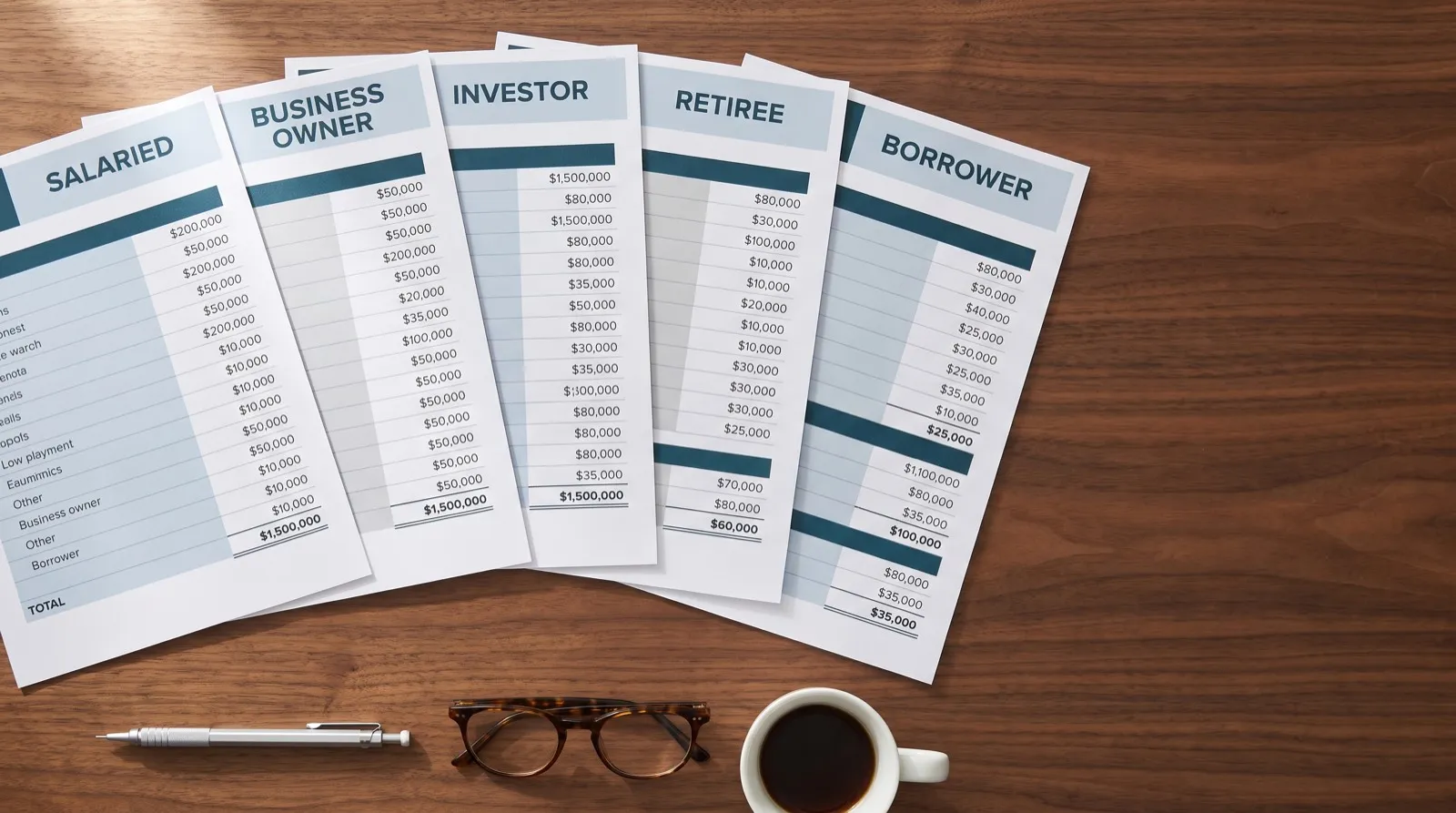
Five net worth statement examples with real numbers: W-2 earner, business owner, investor, retiree, and SBA borrower, plus what a lender reads first.
A complete list of assets and liabilities with 50+ examples, organized the way lenders read them on a personal financial statement.
Commercial real estate loan qualifications come down to DSCR, LTV, debt yield, and your personal balance sheet. Here is exactly what lenders check.
How an SBA 504 loan finances owner-occupied commercial real estate: the 50-40-10 stack, the fixed-rate CDC debenture, 25-year terms, and why it beats a 7(a).
SBA 504 loan requirements for 2026: the 50-40-10 structure, the 51% occupancy rule, the job-creation test that changed, and the Form 413 every owner files.
An SBA loan is a small-business loan the government partly guarantees. Covers the 7(a), 504, and microloan programs, 2026 rates, and the documents you prepare.
SBA 7(a) and 504 loans can't finance a passive rental property; the owner-occupancy rule blocks it. What qualifies instead, and the DSCR alternative.
DSCR loan pros and cons for investors: qualify on rent instead of income and skip the 10-property cap, but pay 20–25% down, a higher rate, and a prepay penalty.
A DSCR loan down payment usually runs 20–25% (75–80% LTV), but your DSCR ratio, credit score, and property type move it. The 2026 breakdown, by scenario.
A DSCR loan for investment property qualifies on the rental's cash flow instead of your income, so you can scale past the conventional 10-property wall.
A personal guarantee makes you repay a business loan from your own assets if the company defaults. Here is who signs, what it binds, and how to limit it.
The New York Statement of Net Worth is the sworn financial disclosure every divorcing spouse files under DRL 236. How to complete it right.
SBA loan down payment rules in 2026: the 10% equity injection on 7(a) startups and business purchases, the 504 50/40/10 split, and which funds count.
Commercial real estate loan terms cover term length, amortization, LTV, DSCR, recourse, and rate. What each one means before you sign.
Excel's built-in gallery has budget and net worth templates, but no lender-style personal financial statement. What to download instead.
A net worth statement lists what you own minus what you owe on one dated page. What goes on it, who asks for it, and how it differs from a PFS.
SBA 7(a) loan requirements for 2026: eligibility, equity, credit, citizenship, the October 1 SOP 50 10 8.1 changes, and the Form 413 every owner files.
SBA 7(a) vs. 504 loan, compared for 2026: structure, rates, down payment, fees, and eligible uses, plus which program fits owner-occupied real estate.
How to calculate DSCR step by step: build NOI, total your annual debt service, divide, and reverse the formula to find the maximum loan your property supports.
A DSCR loan qualifies you on your rental property's cash flow, not your personal income or tax returns. How the ratio works, and what lenders want.
A personal financial statement helps first-time homebuyers size up net worth, DTI, and cash to close before a lender ever opens the application.
Net worth for an SBA loan is total assets minus total liabilities on Form 413. How to calculate it, value each line, and what lenders do with it.
Personal financial statement signature requirements for SBA Form 413: who signs, when a spouse signs, the 90-day dating rule, and e-sign vs. wet ink.
SBA 504 personal guarantee requirements explained: who must sign an unlimited guaranty, how the bank and CDC differ, and when a guarantee can be limited.
How the self-employed build a personal financial statement, and how lenders rebuild Schedule C net profit into the qualifying income that backs the loan.
The common SBA Form 413 mistakes that get a personal financial statement returned in underwriting, and how to fix each one before you submit.
A net worth statement lists what you own, values it at today's market price, and subtracts your debts. How to build yours in 20 minutes.
A personal financial statement Excel template is free and works for one filing. See where it breaks on repeat lender requests, and when PFS software wins.
Who must submit a personal financial statement (SBA Form 413) for a 7(a) loan, the 20% guaranty trigger, spousal rules, and what underwriters check.
A personal financial statement is a point-in-time snapshot. Refresh it within 90 days for an SBA 7(a)/504 loan, yearly otherwise, and after a major change.
A personal financial statement for divorce inventories every asset and debt before you sign the court's sworn disclosure. How to build one right.
A DSCR loan qualifies the property; a personal-income mortgage qualifies you. What each one asks for, what it costs, and when to choose which.
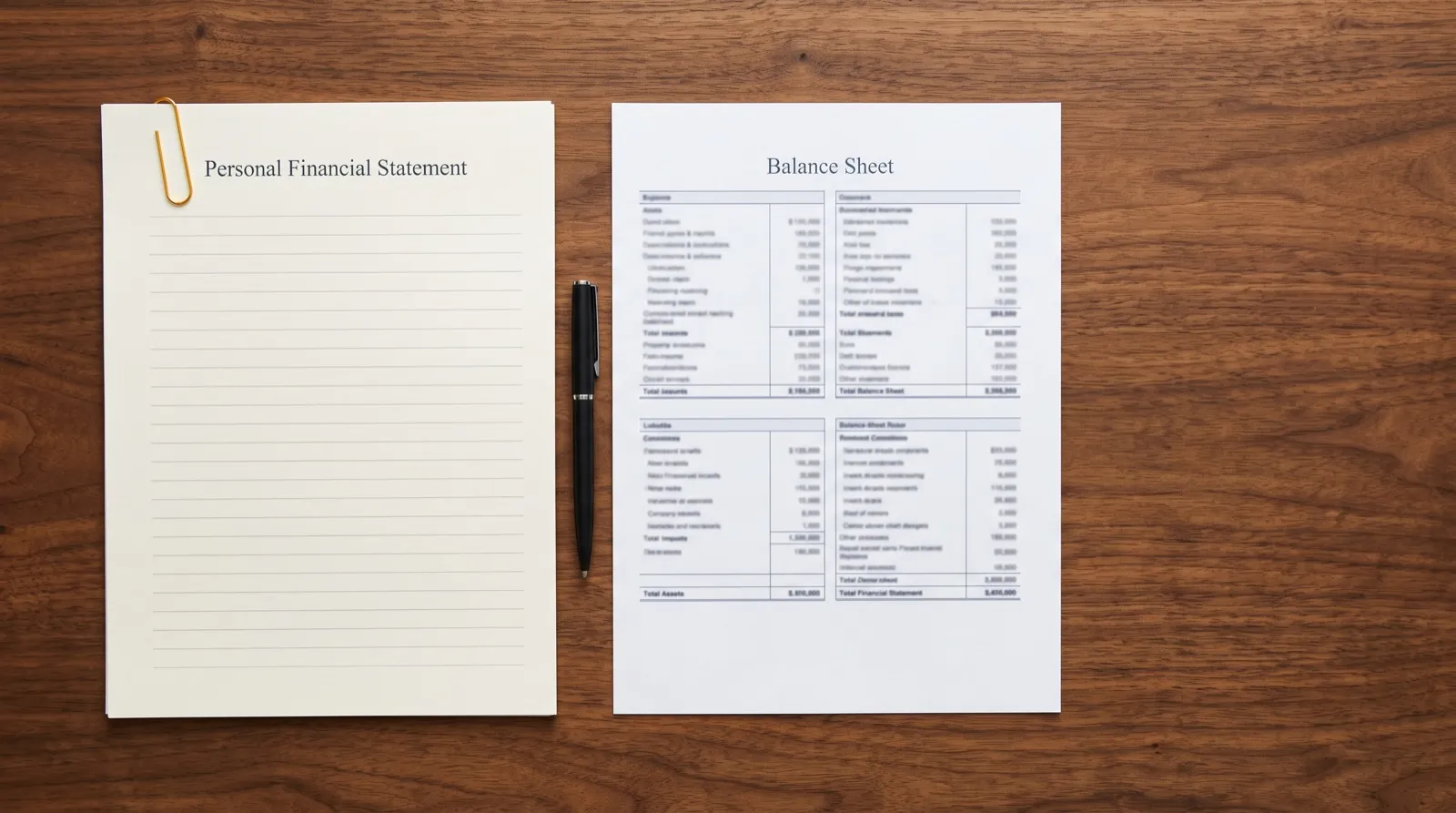
A personal financial statement and a balance sheet both subtract what you owe from what you own. What each one shows, and which a lender asks for when.
A personal financial statement is a dated snapshot of your assets, liabilities, and net worth. What goes on one, who needs it, and how lenders read it.
On the current SBA Form 413, contingent liabilities sit beside Section 1, not in Section 5. What counts on each of the four lines.
DSCR loan requirements in 2026: the minimum ratio, FICO, down payment, and reserves most lenders set, plus the borderline cases that still get funded.
What every business-loan lender, SBA or conventional, actually looks at on your personal financial statement, plus the thresholds underwriters quietly use.
SBA Form 413 is the personal financial statement every 20%+ owner of an SBA 7(a) or 504 borrower submits. How to fill out each section, line by line.
A personal financial statement template captures your assets, liabilities, and net worth on a short balance-sheet form. What each section needs.
A real example of a completed SBA Form 413 for a hypothetical 7(a) applicant, with every line annotated — what underwriters see and why it matters.
Free for 7 days. No credit card.
Questions about your statement? I can help.
Connect your banks and export the PDF your lender needs. About 8 minutes the first time.
Start my free trial7 days free · No credit card required