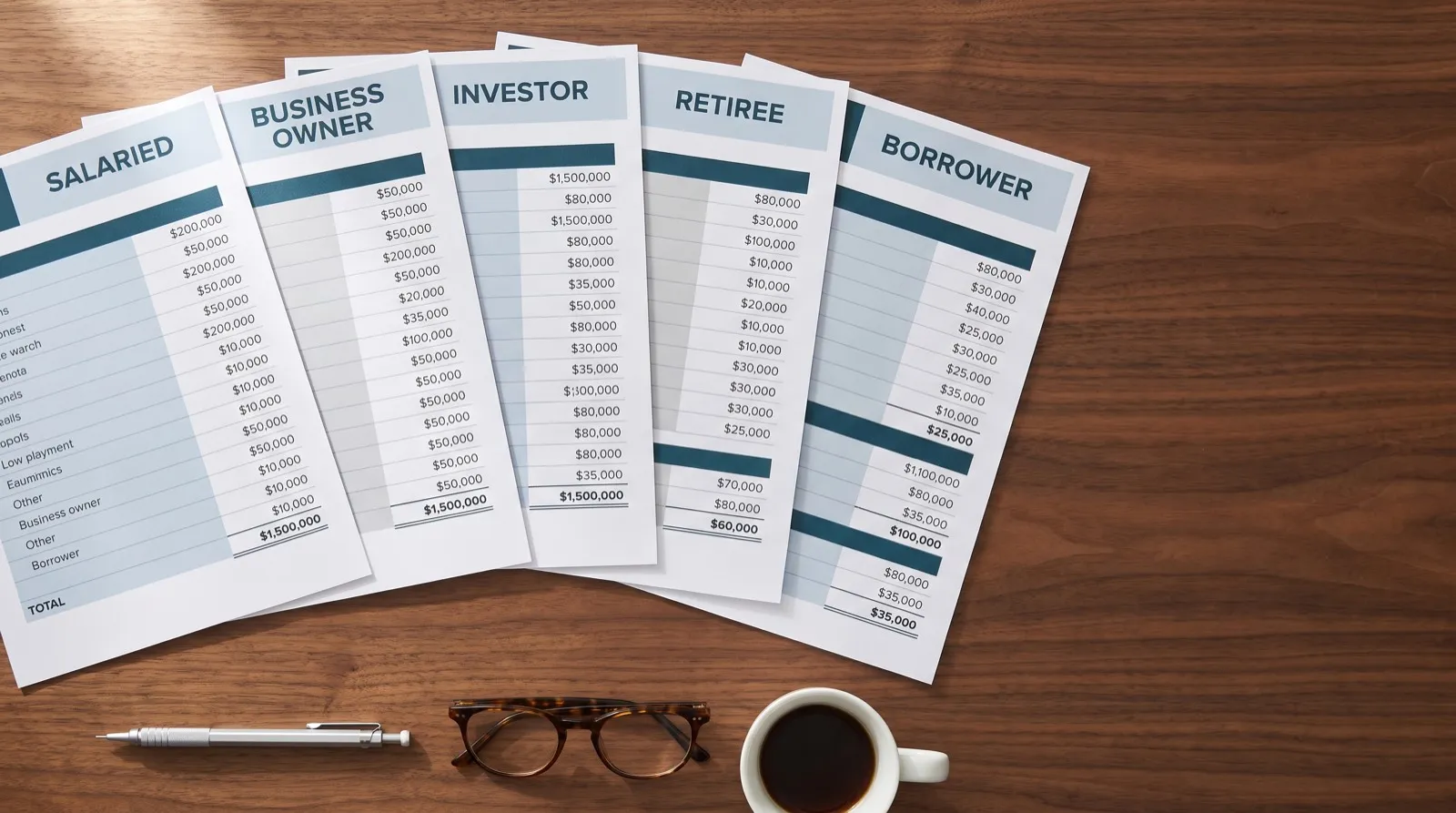


Here is the full list of assets and liabilities lenders expect to see on a personal financial statement: eight asset categories, six liability categories, and 50+ line-item examples inside them. Every example below maps to a real line on a lender-facing form, so you can move straight from this list to a statement a loan officer can underwrite.
Assets are the things you own that hold monetary value, from a checking account to a rental property, and they are reported at what they would sell for today, not what you paid. Liabilities are your financial obligations to someone else, from a credit card balance to a mortgage. The difference between the two totals is your net worth, and a document that shows all three is a personal financial statement.
The full list at a glance
| # | Category | Side | Where it lands on a PFS |
|---|---|---|---|
| 1 | Cash and cash equivalents | Asset | “Cash on hand and in banks” / “Savings accounts” |
| 2 | Stocks, bonds, and brokerage accounts | Asset | “Stocks and bonds” + a per-holding schedule |
| 3 | Retirement accounts | Asset | “IRA or other retirement account” |
| 4 | Life insurance cash value | Asset | “Life insurance, cash surrender value only” |
| 5 | Money owed to you | Asset | “Accounts and notes receivable” |
| 6 | Real estate | Asset | “Real estate” + a per-property schedule |
| 7 | Vehicles and personal property | Asset | “Automobiles” / “Other personal property” |
| 8 | Business interests and other assets | Asset | “Other assets” |
| 9 | Credit cards and revolving debt | Liability | “Installment account (other)” or the notes schedule |
| 10 | Auto and other installment loans | Liability | “Installment account (auto)” |
| 11 | Student loans | Liability | “Installment account (other)” |
| 12 | Mortgages and real estate debt | Liability | “Mortgages on real estate” |
| 13 | Notes payable and unpaid taxes | Liability | “Notes payable to banks and others” / “Unpaid taxes” |
| 14 | Contingent liabilities | Liability | The contingent liabilities block |
The category order above follows SBA Form 413, the personal financial statement the SBA requires for 7(a) loans, 504 loans, disaster loans, and surety bond guarantees. Most bank PFS forms use the same order, so a list organized this way transfers to nearly any lender’s paperwork.
Assets: what you own
$215,900
Median U.S. family net worth in the 2025 Survey of Consumer Finances — assets minus liabilities
1. Cash and cash equivalents
The first line every underwriter reads, because it answers the liquidity question: can this borrower make the down payment and survive a slow quarter?
- Checking account balances
- Savings account balances
- Money market accounts
- Certificates of deposit (CDs)
- Physical cash on hand
- Health savings account (HSA) balances
Report the balance as of your statement date, and use the same “as of” date for every account. Mixed dates are one of the first inconsistencies a lender questions.
2. Stocks, bonds, and brokerage accounts
Marketable securities count at their current market value, which usually means yesterday’s close, not what you paid for them.
- Individual stocks
- Bonds (corporate, municipal, Treasury)
- Mutual funds
- Exchange-traded funds (ETFs)
- Taxable brokerage account balances
- Employer stock and vested RSUs
- Cryptocurrency held on an exchange or in a wallet
A front-page total needs a schedule behind it. If your statement shows $42,000 in stocks and bonds, the supporting schedule has to show which holdings make up the $42,000. I have watched underwriters call borrowers over exactly this gap, and the walkthrough in how to fill out SBA Form 413 shows how the per-holding detail should look.
3. Retirement accounts
Retirement balances are assets even though they are hard to touch, and lender forms include a dedicated line for them.
- 401(k) and Roth 401(k) balances
- Traditional and Roth IRAs
- SEP-IRA and SIMPLE IRA balances
- 403(b) and 457 plans
- Vested pension benefits
Report the current vested value, not your contribution history. An outstanding 401(k) loan cuts the reportable balance and shows up again on the liability side.
4. Life insurance cash value
The line borrowers most often get wrong. Only the cash surrender value counts, which is the amount the insurer would pay you to cancel today.
- Whole life policy cash surrender value
- Universal life policy cash surrender value
Term policies report zero. A $2 million term policy has a $2 million death benefit and no cash value, so it adds nothing to the asset column.
5. Money owed to you
Personally held receivables belong on your statement when you can document them.
- Personal loans you made to family or friends, with a written note
- Seller-financed notes from a property or business you sold
- Court-ordered amounts owed to you
Business receivables stay off your personal statement. Invoices owed to your company belong on the company’s balance sheet, and mixing the two is a common reason a lender sends a PFS back.
6. Real estate
Property is the largest asset for most American households. In the Federal Reserve’s 2025 Survey of Consumer Finances, families that owned a home had a median net housing value of $230,000, and the Fed’s Z.1 Financial Accounts put owner-occupied real estate at $48.7 trillion of household assets as of Q1 2026.
- Primary residence
- Rental and investment properties
- Vacation or second homes
- Raw land
- Fractional interests in commercial property or syndications
List market value on the asset side and the mortgage on the liability side; the form nets them for you. Each property gets its own row in the supporting schedule, with the value, the debt, and the monthly payment. Real estate investors tracking several properties can see how this scales in the real estate net worth tracker use case.
7. Vehicles and personal property
- Cars and trucks (current market value, not purchase price)
- Boats, RVs, and motorcycles
- Jewelry and watches
- Art, collectibles, and precious metals
- Furniture and household goods
- Equipment and tools you own personally
Keep personal property conservative. Lenders typically discount this category heavily or ignore it in a credit decision, so a padded number buys no borrowing power and costs credibility. A $25,000 “furniture” line on an otherwise modest statement reads as inflation, and underwriters notice.
8. Business interests and other assets
- Ownership in an LLC, partnership, or S corporation
- Sole proprietorship equity
- Intellectual property that produces income
- Anything of value that fits nowhere else
Business ownership rises with income: the Fed’s 2025 survey found that more than 15 percent of all families owned a privately held business, including 40 percent of families in the top tenth by income and 8 percent of those in the bottom half. Value private business interests the way you would defend them in underwriting — a recent appraisal, a buy-sell agreement price, or a conservative multiple, with the method noted on the statement.
Liabilities: what you owe
$183.0 trillion
U.S. household net worth in Q1 2026 — total assets of $204.5T minus liabilities of $21.6T
Source: Federal Reserve Z.1 Financial Accounts, June 2026 release
9. Credit cards and revolving debt
- Credit card balances (actual outstanding balance, not the minimum payment)
- Store card balances
- Buy-now-pay-later plan balances
- Personal lines of credit
Disclose every revolving balance somewhere, even at zero utilization. Lenders pull credit anyway, and a balance that appears on the credit report but not on your statement raises a documentation question you then have to answer in writing.
10. Auto and other installment loans
- Auto loans and leases with a purchase obligation
- Personal installment loans
- 401(k) loans
- Loans against a life insurance policy
Pair every installment balance with its monthly payment. The payment column feeds the lender’s cash-flow math, and leaving it blank is the most common omission I see on first-draft statements.
11. Student loans
- Federal student loans
- Private student loans
- Parent PLUS loans you signed for
Income-driven repayment does not shrink the balance you report. List the full outstanding principal, with the actual monthly payment beside it.
12. Mortgages and real estate debt
Home mortgages are the largest household liability in the country, at $13.8 trillion of the $21.6 trillion total in the Fed’s Q1 2026 accounts.
- Primary residence mortgage
- Rental and investment property mortgages
- Home equity loans and HELOC balances
- Construction or bridge loans
Every mortgage on the liability side must match a property on the asset side. An underwriter reconciles the two schedules line by line, and an orphaned mortgage is an automatic follow-up question.
13. Notes payable and unpaid taxes
- Promissory notes you owe to banks or individuals
- Margin loans against a brokerage account
- Past-due federal or state income tax
- Property tax due and unpaid
- IRS installment agreement balances
“Unpaid” is broader than “delinquent.” An IRS payment plan in good standing still belongs on the statement. The tax line trips up more self-employed borrowers than any other, and the self-employed PFS guide covers how lenders read it.
14. Contingent liabilities
Contingent liabilities are amounts you may owe depending on a future event. Under IAS 37, the international accounting standard, a contingent liability is a possible obligation whose existence will be confirmed only by an uncertain future event.
- Personal guarantees on business or SBA debt
- Co-signed loans and leases
- Pending lawsuits against you
- Federal tax audits in progress
Guarantees count even when the underlying loan is current. If you guaranteed your company’s $400,000 loan, that guarantee belongs in the contingent block; the dedicated post on Form 413’s contingent liabilities section covers the edge cases.
Build your personal financial statement in minutes
StatementsReady syncs bank balances read-only through Plaid, fills SBA Form 413, and exports a lender-ready PDF on demand.
- SBA Form 413 with every section filled
- Bank sync through Plaid, read-only
- 7 days free, no card
Putting the list on a personal financial statement
A list is raw material. A lender wants it organized on one page, with the math done:
Total assets − total liabilities = net worth.
Specifically, real median net worth increased 2 percent to $215,900 and real mean net worth rose 7 percent to $1,241,500 (table 2).
Three habits make the assembled statement hold up in underwriting:
- One “as of” date for everything. Pick a date, pull every balance as of that date, and write the date on the statement. SBA lenders check recency against the window printed on the current Form 413, so a statement assembled from months-old balances can age out mid-application.
- Every front-page total reconciles to a schedule. The stocks line matches the holdings schedule, the real estate line matches the property schedule, the mortgage line matches the same properties. Reconciliation failures, more than valuation debates, are what typically get statements kicked back.
- Joint ownership is split, not doubled. Jointly held accounts and property are usually divided between the two statements according to ownership share, a rule the SBA applies explicitly in its certification programs.
You can run the subtraction in our free net worth calculator, and if you want the categories above pre-organized into a lender-ready document, the personal financial statement template starts with every line in this list already in place. Applying for an SBA loan specifically? The SBA Form 413 guide walks the same categories in the SBA’s own layout, and what is a net worth statement covers the simpler one-page version.
More posts on organizing your financial picture live in the personal finance archive.
Skip the spreadsheet
A lender-ready personal financial statement from synced balances, in about 8 minutes.
- 7 days free
- No credit card
- PDF, SBA Form 413, Word, or Excel
Build your personal financial statement in minutes
StatementsReady syncs bank balances read-only through Plaid, fills SBA Form 413, and exports a lender-ready PDF on demand.
- SBA Form 413 with every section filled
- Bank sync through Plaid, read-only
- 7 days free, no card