How to Fill Out SBA Form 1919: A Field-by-Field Guide
SBA Form 1919 is the borrower information form every 7(a) applicant signs. What each field and question asks, and the 2026 eligibility changes to know.

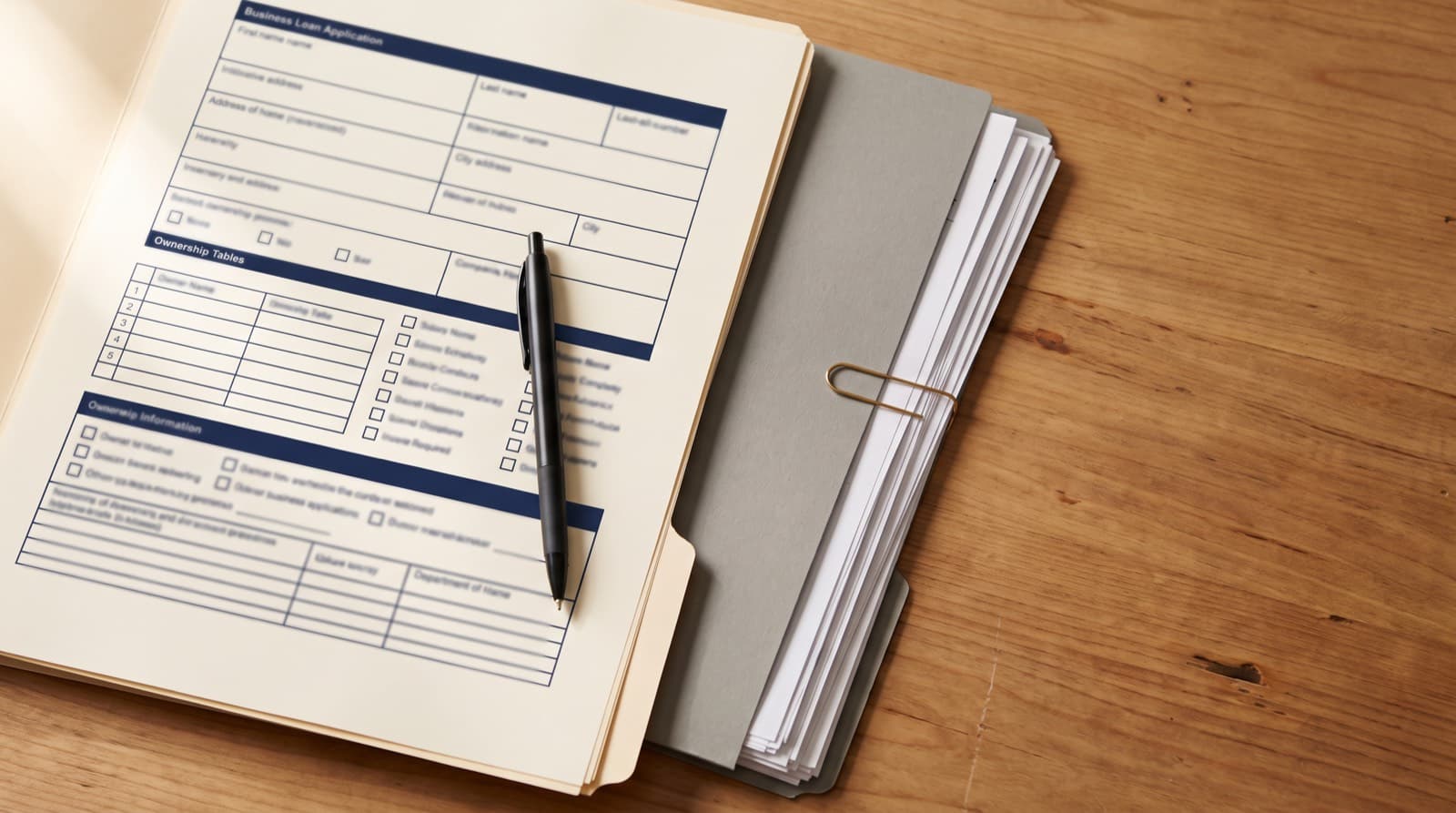
SBA Form 1919, the 7(a) Borrower Information Form, is the application form the business itself signs on every SBA 7(a) loan. The current revision (02/2025, posted March 2025 and expiring June 30, 2027) runs seven pages, but the parts you fill in are three: a business-identification block, an ownership table, and thirteen yes-or-no questions, followed by a certification list one authorized representative signs. This walkthrough goes field by field through the current form, including the March 2026 citizenship rule change that the printed form has not caught up with yet.
Definition
is the SBA 7(a) Borrower Information Form, required from the applicant business on every 7(a) loan. It collects information about the company, its owners, the loan request, and existing government debt, and it carries the certifications that make the application legally binding on the business. It is the business-level companion to SBA Form 413, the personal financial statement each 20%+ owner files individually.
Before you start
Plan on SBA's printed estimate of 31 minutes for a single-entity business with a clean cap table, and closer to an hour if entity owners or a second co-applicant form are involved. Gather these before you open the PDF:
- Your most recent business tax return. The NAICS code you enter must match the business activity code on your IRS filings; the form's instructions say so explicitly, and a mismatch is a common underwriting callback.
- Your formation documents and cap table, including any entities in the ownership chain and the natural persons behind them, with each owner's TIN and home address.
- Your SAM.gov Unique Entity ID, if the business has one. The field says "if any," so most first-time borrowers leave it blank.
- Statements for any existing federal debt: prior SBA loans, USDA, FSA, or FHA loans, or federal loans the business has guaranteed.
- A list of every other business the applicant or any owner holds an interest in, with TINs and ownership percentages. Question 3 requires all of it on an attachment.
- Any fee agreements with a loan packager, referral agent, or broker. Question 6 asks about them directly.
The current form looks nothing like the version most online guides describe. Before September 2023, Form 1919 was divided into numbered sections, and every 20%+ owner, officer, and director completed and signed their own copy. Per SBA Information Notice 5000-852422, the restructured form is completed and signed by a single authorized representative of the applicant, and SBA also eliminated Form 1920 (the old lender's application) effective August 1, 2023. If a guide tells you each owner signs their own 1919, it is describing the retired layout.
$37 billion
in SBA 7(a) loans guaranteed in FY2025 across roughly 77,600 approvals, the most capital the program has ever delivered in a fiscal year. Form 1919 is required on every 7(a) application, so every one of those files started here.
Source: U.S. Small Business Administration, FY2025 announcement
Business identification fields
The top of page one identifies the applicant:
- Applicant Business Legal Name, with OC/EPC checkboxes. Use the exact legal name from your formation documents and tax returns. If the loan uses an Eligible Passive Company structure (a real-estate holding entity leasing to your operating business), check EPC on the holding company's form and OC on the operating company's form, and complete a separate Form 1919 for each.
- Operating Business Legal Name (OC). Filled when the applicant is an EPC; it names the operating company that occupies the property.
- DBA or trade name. Only if the business operates under a name other than its legal name.
- Business TIN. The EIN for entities; a sole proprietor without an EIN uses their SSN.
- Primary Industry / NAICS Code. Six digits, and it must match the business activity code on your IRS income tax filings. This code also drives the size-standard check under 13 CFR 121.201, so an offhand guess here can misroute the whole eligibility analysis.
- Unique Entity ID (SAM.gov), year began operations, business phone.
- Entity type. Check one: sole proprietor, partnership, C-corp, S-corp, LLC, or other.
- Special ownership type. Check all that apply: ESOP, 401(k) or ROBS 401(k) trust, cooperative, or Native-American tribal-owned business. ROBS-funded businesses check the 401(k) box; the certifications later in the form include a compliance representation specific to ESOP and 401(k) plan structures.
- Business address and project address. Street addresses only; the form bars P.O. boxes in both fields. The project address matters when the loan finances real estate at a different location than the main office.
- Primary contact and email.
- Employee counts. Three lines: existing employees (including owners and all employees of domestic and foreign affiliates, not converted to FTE), FTE jobs retained because of the loan, and FTE jobs created because of the loan. Count owners in all three where applicable.
Purpose of the loan
The purpose block is a set of checkboxes with dollar amounts: acquisition or installation of equipment, purchase or construction of commercial real estate, working capital, inventory, business acquisition (change of ownership), debt refinancing, and two "other" lines. Check every category that applies and put a dollar figure next to each.
Two rules make this block more load-bearing than it looks:
- The amounts must sum to the loan request. The form's instructions require the purpose amounts across all Forms 1919 (applicant plus any co-applicants) to equal the total loan request. On an EPC/OC deal, the real-estate dollars typically sit on the EPC's form and the working-capital dollars on the OC's form, and the two must add up to the number your lender is underwriting.
- Debt refinancing triggers its own certification. The certification list includes a representation that any debt being refinanced was used exclusively for the business, including business credit cards and HELOC proceeds on the applicant's balance sheet. Expect the lender to ask for a business debt schedule documenting each obligation being paid off.
If you are still sizing the request, the SBA loan calculator estimates the monthly payment and guaranty fee on a 7(a) or 504 structure before you commit a number to the form.
Applicant Ownership and demographic information
The ownership table is mandatory, and its scope is precise. The form directs you to identify all entities that own at least 20% of the applicant, including the natural persons who own those entities, and at least 51% of the applicant's beneficial owners as defined in SOP 50 10. For each owner listed: legal name, title, ownership percentage, TIN, and home address (again, no P.O. boxes).
"Beneficial owner" reaches through entity layers. SBA's own example in Notice 5000-852422: if Jane Doe owns 100% of Jane Doe, Inc., and Jane Doe, Inc. owns 50% of the applicant, Jane Doe is the beneficial owner of 50% of the applicant. If no individual owns 20%, you keep listing owners until the table accounts for at least 51% of the beneficial ownership.
While the old SBA Form 1919 required 100% of ownership to be reflected, the new SBA Form 1919 requires only specific owners to be disclosed.
The demographic block that follows (veteran status, sex, race, ethnicity) is optional, collected for program reporting only, and the form states that disclosure has no bearing on the credit decision. One demographic section per individual holding 20% or more of the beneficial ownership.
The ownership table is also where Form 1919 hands off to the personal side of the file. Every individual it lists at 20% or more will separately complete a personal financial statement on SBA Form 413, with the recency and signature rules covered in our Form 413 walkthrough and the program-level detail in the SBA 7(a) personal financial statement requirements post. If you would rather build that statement from a structured template than a blank PDF, the SBA Form 413 template matches the official section numbering.
| Form 1919 | Form 413 | |
|---|---|---|
| Who completes it | The applicant business, via one authorized representative | Each 20%+ owner, individually |
| What it covers | Business identity, ownership, loan request, eligibility questions | Personal assets, liabilities, net worth, income |
| Copies per application | One per applicant entity (EPC and OC each file their own) | One per required individual |
| Recency rule | None printed on the form | Dated within 120 days of submission for 7(a) and 504 |
Build your personal financial statement in minutes
StatementsReady syncs with your bank accounts, auto-populates SBA Form 413, and generates a lender-ready PDF on demand. No spreadsheets, no manual updates.
- SBA-compliant Form 413 generation
- Bank sync via Plaid (read-only)
- Always current — no stale snapshots
The 13 yes-or-no questions
The question block spans pages two and three. Any yes answer requires details to the lender in a separate attachment. The questions group into four clusters.
Questions 1 through 4: character and federal-debt screening.
- Question 1 asks whether the applicant (both the EPC and OC in a two-entity structure) or any Associate is presently suspended, debarred, proposed for debarment, declared ineligible, excluded from federal transactions, or in bankruptcy. A yes on the bankruptcy prong means providing the filing and discharge paperwork.
- Question 2 asks whether the applicant, any Associate, or any business owned by them or any affiliates is currently delinquent or has ever defaulted on a direct or guaranteed federal loan (SBA, USDA, B&I, FSA, FHA, EDA), or guaranteed such a loan. Lenders check this answer against CAIVRS, the federal credit-alert database, so answer from records, not memory. A prior loss to the government generally makes the applicant ineligible under SOP 50 10 8.
- Question 3 asks whether the applicant or any owner owns any other business. A yes requires an attachment (the form calls it addendum A) listing every such business with its TIN, ownership percentage, and relationship. This attachment is the raw material for the lender's affiliation and size-standard analysis, so an incomplete list surfaces later as a callback.
- Question 4 asks whether the applicant or any Associate is currently incarcerated, serving a sentence, or under indictment for a felony or a crime involving financial misconduct or a false statement. A yes makes the applicant ineligible. This question replaced the old form's three historical criminal-history questions (former questions 17, 18, and 19) when SBA aligned the form with its revised character regulations, and it is the one answer the representative must separately initial, with an original or acceptable electronic initial rather than a typed one.
Questions 5 through 7: program and revenue screens.
- Question 5 covers exports: whether the applicant exports directly or indirectly, plans to as a result of the loan, or is applying under the Export Working Capital Program. A yes routes into sub-questions on estimated export sales and principal countries.
- Question 6 asks whether the applicant has paid or committed to pay a fee to the lender or a third party for preparing the application, or a fee to a referral agent or broker. A yes requires the name and amount, and the form reminds you that the applicant is not required to obtain or pay for unwanted services. Fee arrangements disclosed here typically also show up on SBA Form 159, the compensation agreement the lender and any agent execute.
- Question 7 asks whether any revenue comes from gambling, loan packaging, lending activities, lobbying activities, or sexually prurient products or performances, all of which carry eligibility restrictions under 13 CFR 120.110.
Questions 8 through 12: government conflict-of-interest screens. These ask whether anyone with a 10% or greater interest, or their household members, holds one of five government roles. Questions 8 through 10 cover an SBA employee, a former SBA employee separated less than a year, and a member of Congress or a legislative or judicial branch official. Questions 11 and 12 cover a federal employee or service member at GS-13 or higher, and a SCORE volunteer or Small Business Advisory Council member. Each cites its regulation in 13 CFR Part 105. Note the threshold shift: these questions reach down to 10% owners, below the 20% line the ownership table uses.
Question 13: litigation. Whether the applicant, any owner, or any business they own is presently involved in any legal action, explicitly including divorce. A pending divorce matters to the lender because it can move ownership interests and personal guarantees mid-loan, so disclose it with a short factual summary rather than hoping it stays out of view.
Certifications and signature
Everything after Question 13 is certification text, and signing adopts all of it on behalf of the business. The block opens with a compliance certification covering the Loan Program Requirements in 13 CFR 120.10, 120.100, 120.110, and 121.301, then runs through roughly twenty bulleted representations. The ones that most often matter in practice:
- False-statement penalties. Knowingly making a false statement to obtain an SBA-guaranteed loan is punishable by up to five years and $250,000 under 18 U.S.C. 1001 and 3571, and up to thirty years and $1,000,000 under 18 U.S.C. 1014 when submitted to a federally insured institution.
- Child support. No holder of 50% or more of the applicant or OC is more than 60 days delinquent on a child support obligation.
- Taxes. The applicant and OC are current on all federal, state, and local taxes, including payroll taxes, and will stay current.
- Size. The applicant, with all affiliates, qualifies as small under the applicable size standard in 13 CFR 121.201, which is where the Question 3 addendum feeds back in.
- Partner buyouts. For a Standard 7(a) loan over $500,000 financing a complete partner buyout where loan proceeds cover more than 90% of the purchase price, the remaining owners must certify they have actively participated in the business and held the same or increasing ownership for at least the past 24 months.
- Negative covenants. The applicant agrees not to distribute assets in a way that harms its financial condition, change its ownership structure during the term of the loan, or sell or encumber assets outside the ordinary course, in each case without the lender's prior written consent. Founders planning an equity grant or a partial sale a year after closing routinely discover this clause after they have signed it. Read it before you sign, and plan capital-structure moves through your lender.
The signature block takes one signature: the authorized representative of the applicant, with printed name, title, and date. There is no per-owner signature page on the current form, and the lender keeps the signed original in its file while keying the data into E-Tran.
The citizenship certification has not caught up with the 2026 rules
The printed certification on the current 02/2025 form states that the applicant is at least 51% owned and controlled by U.S. citizens or lawful permanent residents. That text is now two rule changes out of date, and this is the trap for anyone filling out the form in 2026.
SBA Procedural Notice 5000-876626 took effect March 1, 2026. It requires that 100% of the direct and indirect owners of the applicant, plus SBA-required guarantors, be U.S. citizens or U.S. nationals whose principal residence is in the United States, its territories, or possessions. Lawful permanent residents are no longer eligible owners at any percentage, and the short-lived 5% exception from December 2025 is rescinded. A six-month lookback also applies: a loan is ineligible if any owner or required guarantor was an ineligible person during the six months before the SBA loan number is issued, unless that person fully divested first. The rules apply to delegated loans that receive their SBA loan number on or after March 1, 2026, and to non-delegated applications that enter R1 status in E-Tran on or after that date.
Because the form still carries the old 51% language, lenders are collecting supplemental citizenship and residency certifications alongside Form 1919 until SBA reissues it. SBA has already signaled the revision: a February 2026 Federal Register notice proposes adding each owner's date of birth, citizenship status, entity type for entity owners, and the spouse's legal name where the spouse is also an owner. Practical reading: signing the printed certification alone no longer establishes eligibility, so have every owner's citizenship documentation ready and expect an addendum from your lender. The broader 2026 program picture, including the fee and equity-injection changes, is in our SBA 7(a) loan requirements for 2026.
What happens after you submit
The lender does not forward Form 1919 to SBA. It keys the information into E-Tran, SBA's loan-processing system, and retains the signed form in its file, per Notice 5000-852422. The form's data then drives the eligibility screens, the affiliation analysis, and the fraud checks that run before an SBA loan number is issued.
The callbacks that most often send a Form 1919 back to the borrower, roughly in order of frequency:
- NAICS mismatch. The code on the form disagrees with the business activity code on the tax return the lender is holding.
- An ownership table that does not tie out. The percentages disagree with the operating agreement or cap table, an entity owner is listed without the natural persons behind it, or the table stops short of 51% of beneficial ownership.
- Purpose amounts that do not sum. Especially on EPC/OC deals where the two forms' purpose blocks were filled out on different days and no one reconciled them to the loan request.
- A thin Question 3 addendum. Missing TINs or a business interest the lender finds on Schedule E of an owner's return.
- A typed initial on Question 4. The form requires an original or acceptable electronic initial, and a typed one gets bounced.
- Citizenship documentation gaps. Post-March 2026, any owner whose status cannot be documented as U.S. citizen or U.S. national stalls the file at the supplemental certification stage.
Each is fixable in one round if caught early. The pattern behind most of them is filling out the form from memory instead of from documents; nearly every field on Form 1919 has a source document, and matching against it is faster than repairing a mismatch in underwriting.
Form 1919 is one document in a larger stack. The full checklist, from tax returns through the debt schedule, is in documents needed for a business loan, and the personal-statement side lives in the SBA Form 413 guide. If you are still deciding whether a 7(a) is the right structure at all, start with what an SBA loan is or the business loan applications use case. More posts on SBA mechanics are in the SBA lending archive.
Skip the spreadsheets
Generate a lender-ready personal financial statement in minutes with StatementsReady.
- Free to start
- No credit card required
- Used by SBA-preferred lenders
Frequently asked questions
Build your personal financial statement in minutes
StatementsReady syncs with your bank accounts, auto-populates SBA Form 413, and generates a lender-ready PDF on demand. No spreadsheets, no manual updates.
- SBA-compliant Form 413 generation
- Bank sync via Plaid (read-only)
- Always current — no stale snapshots
Keep reading

IRS Form 4506-C: Why Your Lender Wants You to Sign It
IRS Form 4506-C lets your lender pull your tax transcripts through IVES. What it authorizes, what the lender sees, and the 120-day clock that kills deals.

SBA Form 159: The Fee Disclosure Nobody Explains
SBA Form 159 discloses what your broker or packager is paid on a 7(a) or 504 loan. Who counts as an agent, who signs, and which fees the SBA prohibits.
7 Common SBA Form 413 Mistakes (and How to Fix Them)
The common SBA Form 413 mistakes that get a personal financial statement returned in underwriting, and how to fix each one before you submit.