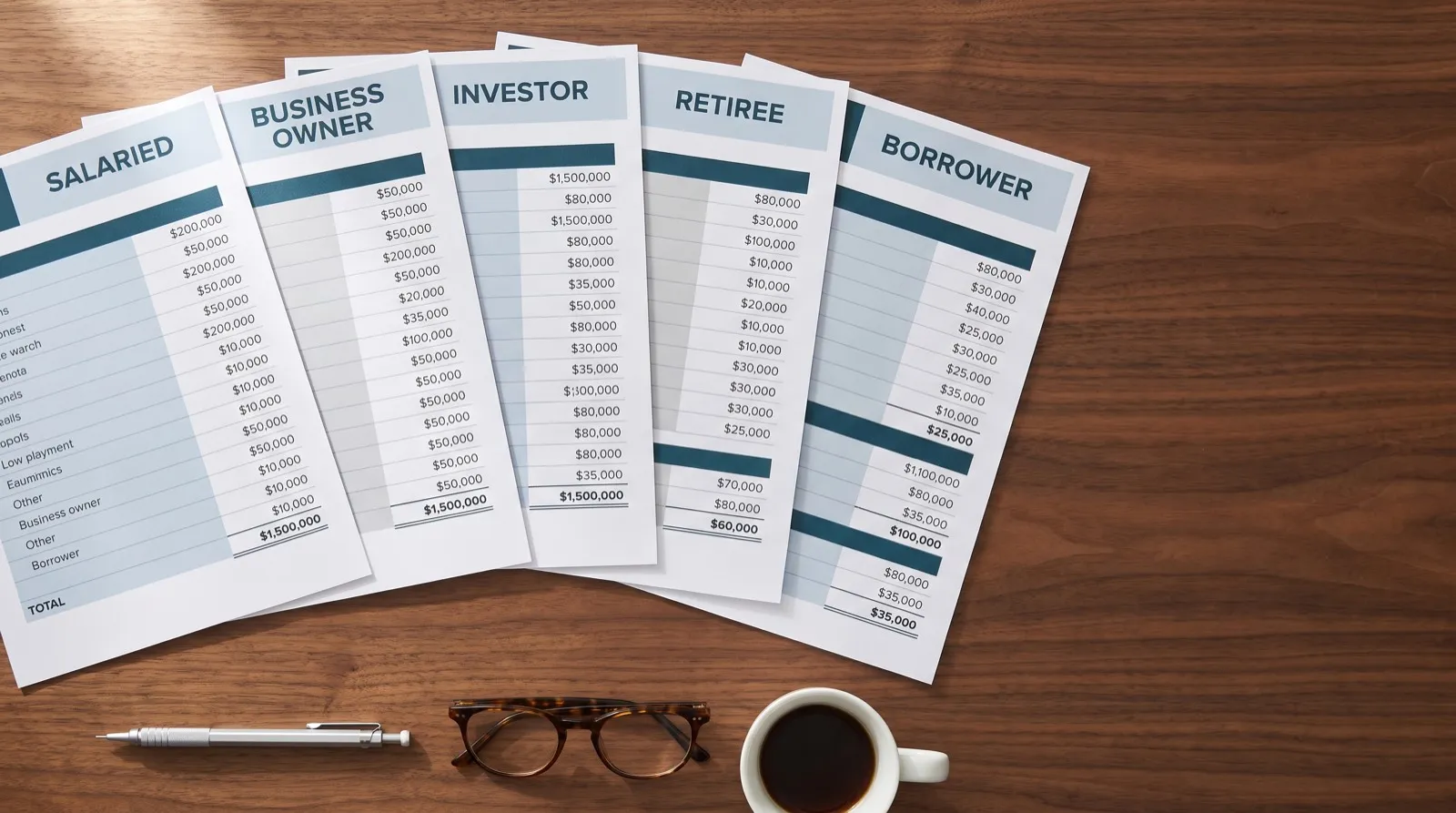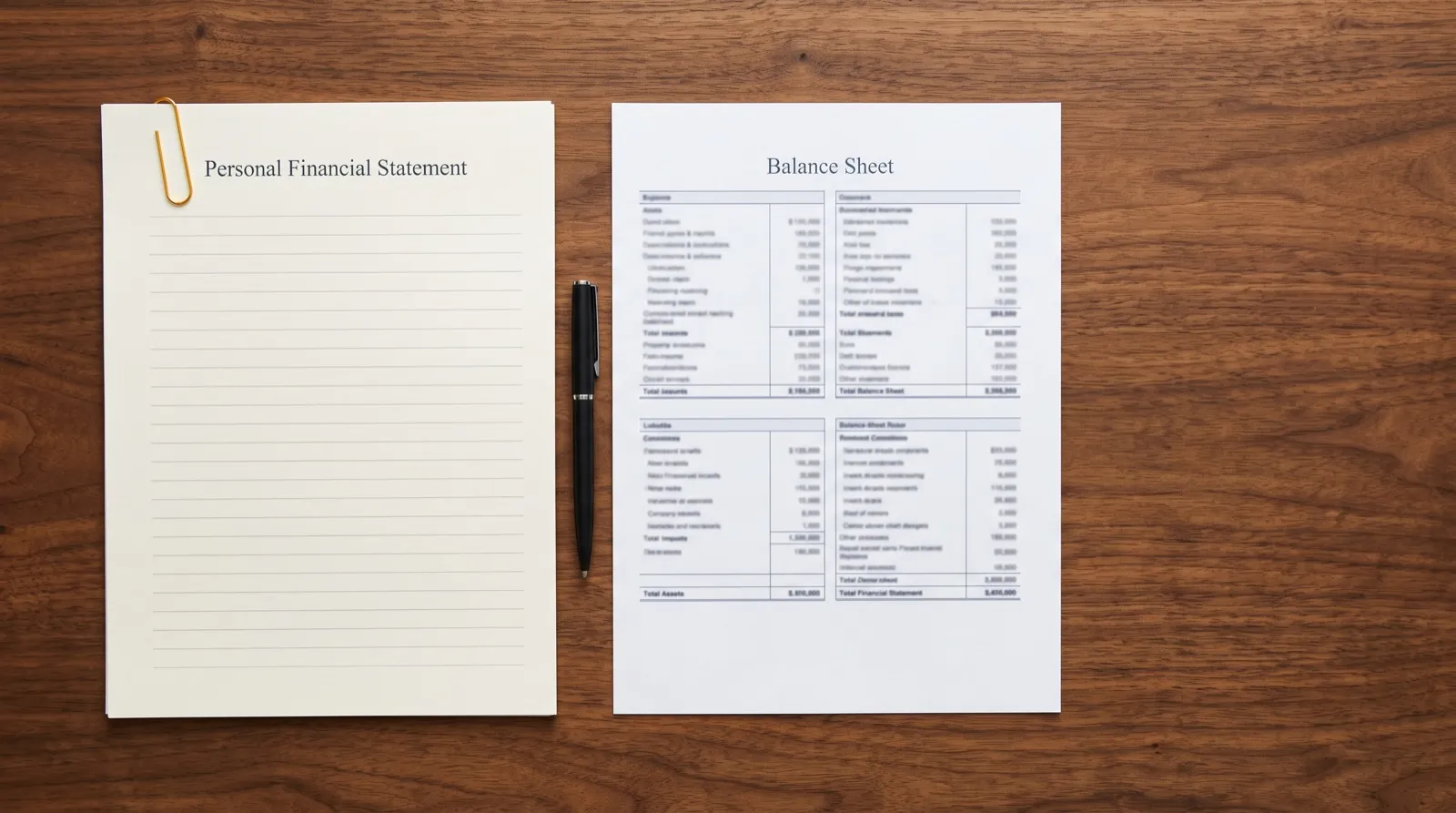


If you have ever opened a blank personal financial statement template and stared at it, this guide walks you through the seven steps that get a clean PFS done in about thirty minutes. The template structure is the same one the U.S. Small Business Administration uses on Form 413, which is the personal financial statement required from every 20%+ owner applying for a 7(a) or 504 loan.
Skip the blank page
A personal financial statement in Excel and PDF, a net worth statement, and the SBA Form 413 walkthrough. Or connect your accounts and StatementsReady fills the form for you.
- PFS template, Excel and PDF
- SBA Form 413, filled from synced balances
- Net worth statement template
What is on a personal financial statement template
Every credible personal financial statement template, including SBA Form 413, has the same core layout.
is a snapshot of your personal assets, liabilities, and net worth as of a specific date, captured on a single balance-sheet page and supported by detail schedules for real estate, securities, debts, contingent liabilities, and life insurance. Lenders use it to size up your liquidity and personal risk before extending credit.
The template has three parts:
- The assets column. Cash, savings, retirement accounts, brokerage holdings, real estate, vehicles, life-insurance cash surrender value, and any other personal property.
- The liabilities column. Accounts payable, notes payable, installment debt, mortgages, unpaid taxes, and any loans secured by your life insurance.
- The net worth line. Total assets minus total liabilities. This is the number underwriters read first.
The Federal Reserve’s 2022 Survey of Consumer Finances gives a sense of where most filers land before they touch the form.
$192,900
Real median U.S. family net worth, 2022. A 37% jump from 2019 and the largest three-year increase in the modern SCF's history.
Source: Federal Reserve, Changes in U.S. Family Finances 2019–2022
Below the main page, the SBA template has eight numbered schedules:
| Section | What it captures |
|---|---|
| 1 | Source of income (salary, investment, real estate, other) plus contingent liabilities (as endorser or co-maker, legal claims and judgments, provision for federal income tax, other special debt) |
| 2 | Notes payable to banks and others |
| 3 | Stocks and bonds |
| 4 | Real estate owned (parcel-by-parcel) |
| 5 | Other personal property and other assets |
| 6 | Unpaid taxes |
| 7 | Other liabilities |
| 8 | Life insurance held |
If you are working from a generic template instead of Form 413, look for these same eight categories. They are the categories a commercial lender, an SBA-preferred lender, or a mortgage underwriter will all expect to see broken out.
Before you start
Plan on twenty to forty-five minutes if you have a single bank account, a primary residence, and a 401(k). Multi-entity holdings, several brokerage accounts, or a real-estate portfolio push the time to ninety minutes or more.
Gather these six documents before you open the template:
- Your most recent statement for every checking and savings account you own.
- Your most recent statement for every retirement and brokerage account (401(k), IRA, taxable brokerage).
- The most recent mortgage statement for every property you own, with current principal balance and monthly payment.
- The most recent statement for every installment loan (auto, student, personal) and the current balance on every credit card.
- Life insurance policies showing face amount and cash surrender value (term policies have no cash value and are not listed in the asset column).
- Documentation for any contingent liabilities: personal guarantees on a business loan or a commercial lease, co-signed obligations, pending IRS tax bills.
Having these on the desk is the difference between a thirty-minute task and a two-hour scavenger hunt across statements and login screens.
Step 1. Pick your “as of” date
The personal financial statement is a snapshot. The “as of” date at the top of the form anchors every value below it.
- Pick today’s date if you are filing right away.
- Pick the last day of the prior month if you want all of your statements (bank, brokerage, mortgage) to reconcile cleanly to month-end balances.
- Do not back-date to a more flattering moment. Lenders pull a current credit report and may compare your PFS against the reported debt balances; the PFS has to be defensible against what the lender is going to find anyway.
Write the same “as of” date on every supporting attachment. If your bank statement is dated April 30 and your PFS is dated May 26, attach a screenshot of the May 26 balance, not the April 30 statement.
Step 2. Gather six documents
You already pulled these in the “Before you start” section. Now stack them in the order the template asks for the data:
- Bank and savings statements (cash column).
- Retirement and brokerage statements (IRA / 401(k) and stocks and bonds).
- Mortgage statements (real estate and mortgages-on-real-estate).
- Loan and credit card statements (installment debt and notes payable).
- Life insurance policies (assets and any policy loans).
- Contingent-liability documentation (the contingent liabilities section).
The point of the stack is to keep you from tab-switching to a banking app every two minutes. Every value you write on the PFS should already be visible on a piece of paper in front of you.
Step 3. Fill in the assets column
Work top to bottom in the assets column. The SBA template lists the line items in this order:
- Cash on hand and in banks. Sum your checking and on-hand cash balances.
- Savings accounts. List savings account balances on this separate line. Form 413 splits them out from checking.
- IRA or other retirement account. Use today’s vested value, not the contribution basis.
- Accounts and notes receivable. Money other people owe you, with documentation.
- Life insurance, cash surrender value only. Term policies are zero here.
- Stocks and bonds. Use yesterday’s market close, not the cost basis.
- Real estate. Use the current market value, not the original purchase price. For a borrower-prepared estimate, an online valuation tool like Zillow or Redfin can be a starting point; your lender may ask for a broker price opinion or appraisal later.
- Automobile (present value). Kelley Blue Book or Edmunds trade-in value, not what you paid.
- Other personal property. Jewelry, art, boats, RVs. Itemize anything over a few thousand dollars in Section 5. Marine and RV lenders read this line closely when a boat or RV loan involves a trade-in.
- Other assets. Business interests, private equity, carried interest. Describe in Section 5.
Total the column. That is your assets number.
Step 4. Fill in the liabilities column
Work the same way, top to bottom:
- Accounts payable. Open invoices you personally owe.
- Notes payable to banks and others. Detail each note in Section 2 (lender name, original balance, current balance, monthly payment, security).
- Installment account (auto). Current balance + monthly payment.
- Installment account (other). Credit cards, personal loans, student loans. Current balance + monthly payment.
- Loan on life insurance. Any borrowing against the cash value of a whole-life or universal-life policy.
- Mortgages on real estate. Current principal balance for every property. Detail each one in Section 4 (address, current balance, monthly payment, mortgage holder).
- Unpaid taxes. Any past-due federal, state, or property tax. Detail in Section 6. An IRS payment plan with a current status still counts.
- Other liabilities. Detail in Section 7. Note that on SBA Form 413, personal guarantees and co-signed obligations belong in the contingent liabilities portion of Section 1 (as endorser or co-maker), not in Section 7. Use Section 7 for actual other liabilities your lender directs you to list there.
Total the column. That is your liabilities number.
Step 5. Reconcile and write your net worth
Net worth is one subtraction:
Net worth = Total assets − Total liabilities
If the assets column totals $625,000 and the liabilities column totals $310,000, net worth is $315,000.
Two reconciliation checks before you move on:
- Total liabilities + net worth = total assets. SBA Form 413 prints the equation on the form. If your “Total” cell does not match your assets column, one number is wrong.
- Net worth makes intuitive sense for your situation. If you have owned a paid-off rental property for fifteen years and the number is negative, something is missing.
If you would rather have the calculator do this work, the free net-worth calculator returns the same number and exports a clean breakdown you can paste into the template.
Build your personal financial statement in minutes
StatementsReady syncs bank balances read-only through Plaid, fills SBA Form 413, and exports a lender-ready PDF on demand.
- SBA Form 413 with every section filled
- Bank sync through Plaid, read-only
- 7 days free, no card
Step 6. Complete sections 2 through 8
The schedules on the back are where most lender callbacks live. The asset and liability column totals are the lender’s first read; the schedules are how the lender verifies the totals.
- Section 1, Source of income and contingent liabilities. Salary, net investment income, real estate income, and other recurring income (pensions, child support, alimony, social security). The bottom half of the same section captures contingent liabilities: amounts owed as endorser or co-maker, legal claims and judgments, provision for federal income tax, and other special debt.
- Section 2, Notes payable to banks and others. Lender name, original balance, current balance, payment amount, frequency, type of collateral.
- Section 3, Stocks and bonds. Number of shares, name of security, cost, current market value, exchange.
- Section 4, Real estate owned. One row per parcel: type of property, address, date purchased, original cost, current market value, mortgage holder, mortgage balance, payment.
- Section 5, Other personal property and other assets. Describe each item and, if pledged as security, name the lien holder.
- Section 6, Unpaid taxes. Type, payable to, when due, amount, any lien.
- Section 7, Other liabilities. Describe in detail.
- Section 8, Life insurance held. Face amount, cash surrender value, insurance company, beneficiary.
The pattern: anything you put in the column gets explained in the matching section. If you put $42,000 in “stocks and bonds” but Section 3 is blank, the underwriter calls.
Every owner with 20% or greater ownership must complete a Personal Financial Statement with full supporting documentation. This includes account statements, retirement account summaries, real estate documentation, and listed liabilities. Getting these materials current and organized early helps avoid unnecessary delays later.
Step 7. Sign, date, and store
The signature block goes at the bottom of page two. A few rules SBA-preferred lenders enforce in practice:
- Owning spouse signs a full guaranty and PFS when ownership interests of both spouses and any minor children combine to 20% or more (SBA SOP 50 10 8, effective June 1, 2025). A non-owner spouse generally does not provide a full guaranty; they sign collateral documents only for jointly held assets like a primary residence.
- Ask your lender about e-signatures. Some lenders accept e-signature on the intake PFS; some packages require wet signatures on the SBA-funded copy. Confirm the lender’s policy before you sign.
- Store the signed PDF and the supporting attachments together. When the lender asks for a refreshed PFS three months later, you want to update one file, not rebuild the package.
What done looks like
A finished personal financial statement looks like this:
- A clean main balance-sheet page with totals that reconcile, plus completed Section 1 through Section 8 schedules.
- A signed signature block dated within the lender’s freshness window.
- Sections 1 through 8 filled out for every line that has a non-zero value in the column.
- A separate PDF or folder of supporting documents (bank statements, brokerage statements, mortgage statements) all dated as of the same date as the PFS.
- A copy stored somewhere you can find it next quarter without rebuilding the math.
If you are submitting to an SBA-preferred lender, the SBA Form 413 walkthrough covers the lender-side mechanics in more depth: what the underwriter is looking at on each page, which lines drive callback rates, and how the 20% and spousal-guaranty rules interact with the form.
Free templates and tools
A few starting points depending on the use case:
- The on-site personal financial statement template is a clean, generic version designed to mirror the SBA Form 413 categories.
- If your lender specifically asks for SBA Form 413, use the SBA-specific template. It matches the section numbering exactly.
- If you only need the net-worth number (for a mortgage prequalification, divorce disclosure, or personal records), the net worth statement template is a shorter version that drops the income and contingent-liability sections.
- For deeper background, what is a personal financial statement covers the use cases beyond SBA.
- If you are weighing Excel versus dedicated software for repeat use, see PFS software vs. Excel for an honest side-by-side.
For an active borrower or broker who is going to refresh the PFS every quarter, doing this by hand in a spreadsheet is slow. StatementsReady syncs balances from your bank accounts read-only through Plaid (no credentials stored by StatementsReady; see Plaid’s privacy and security page for how Plaid handles credentials), auto-fills the Form 413 layout, and regenerates the PDF with the current “as of” date in a few clicks. More on the workflow lives in the business loan applications use case and the first-time homebuyer use case, which both rely on the same PFS underneath.
More posts on the same topic are in the personal finance archive.
Skip the spreadsheet
A lender-ready personal financial statement from synced balances, in about 8 minutes.
- 7 days free
- No credit card
- PDF, SBA Form 413, Word, or Excel
Build your personal financial statement in minutes
StatementsReady syncs bank balances read-only through Plaid, fills SBA Form 413, and exports a lender-ready PDF on demand.
- SBA Form 413 with every section filled
- Bank sync through Plaid, read-only
- 7 days free, no card