
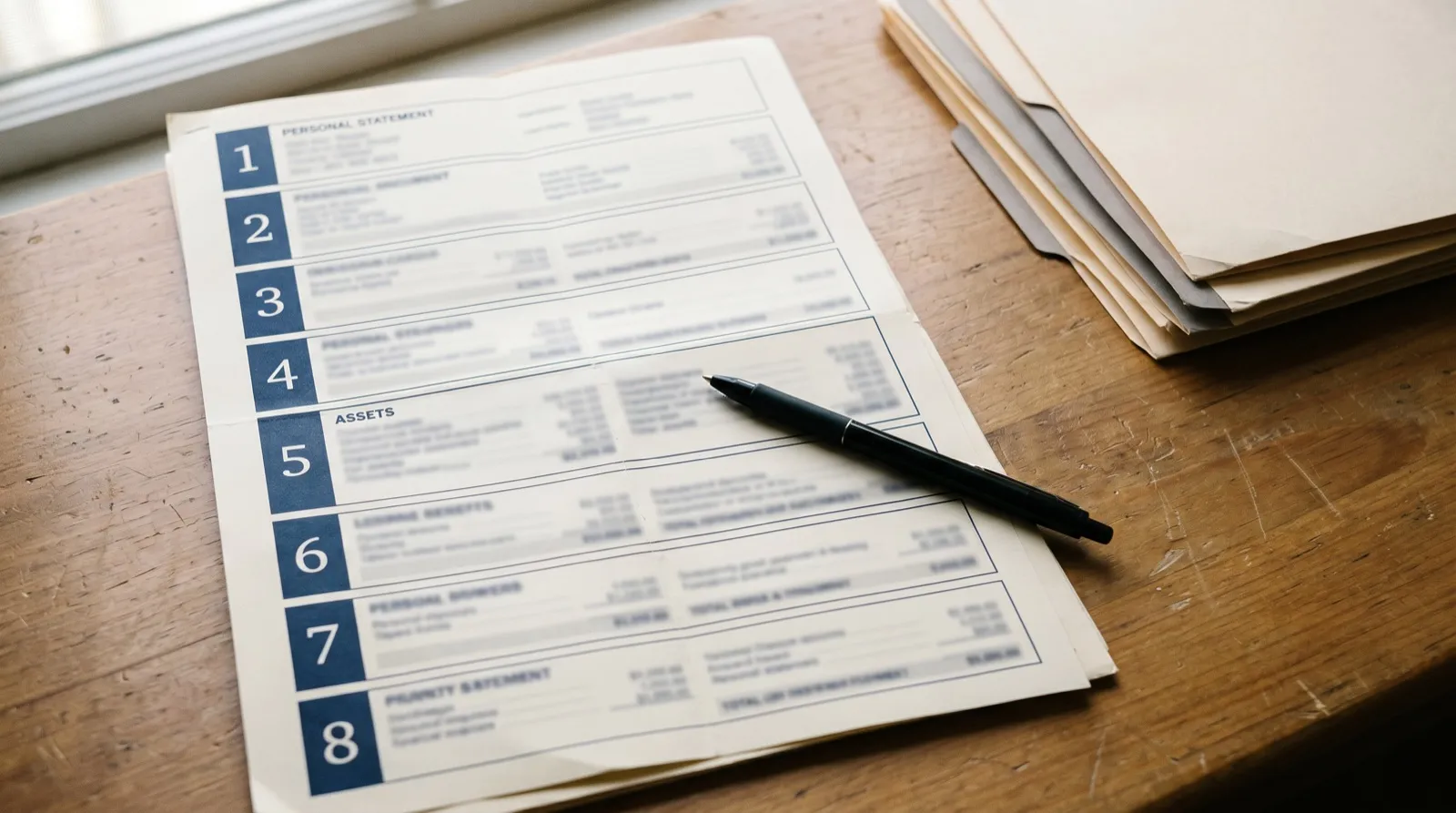
SBA Form 413 is the personal financial statement the U.S. Small Business Administration requires from every 20%+ owner of a 7(a), 504, surety bond, 8(a) Business Development, or WOSB applicant. (Disaster loan applicants use the parallel Form 413D.) This walkthrough goes line by line through the current revision of the form so the file gets through underwriting on the first round instead of coming back for a Section 1 contingent-liability callback or a stale signature date.
Before you start
Plan on thirty to ninety minutes per Form 413 depending on how many accounts, properties, and contingent liabilities are in the picture. Multi-entity holdings, several brokerage accounts, or a co-owned LLC with its own debt all push the time up.
Gather these documents before you open the form:
- Most recent statement for every checking and savings account you own personally.
- Most recent statement for every retirement account (401(k), IRA, 403(b)) and taxable brokerage account.
- Most recent mortgage statement for every property you own, with current principal balance and monthly payment.
- Current balance and monthly payment for every installment loan (auto, student, personal) and every credit card.
- Life-insurance declarations pages showing face amount, cash surrender value, insurer, and beneficiaries.
- Documentation for every contingent liability: personal guarantees on business loans or leases, co-signed obligations, and any pending tax bills.
- The lender’s intake checklist if you have it. Most SBA-preferred lenders ask for IRS Form 4506-C, three years of personal tax returns, and a personal resume alongside Form 413.
The point of the stack: every value you write on Form 413 should already be visible on a piece of paper in front of you. Tab-switching to a banking app while filling out the form is where errors creep in.
$5M
Maximum SBA 7(a) loan size per borrower across all 7(a) loans. The 20% personal-guaranty rule that triggers Form 413 applies at any loan size, from a $25,000 working-capital line through the $5M ceiling.
Source: SBA 7(a) Loans program page
The top of the form: your “as of” date and identification
The top block asks for your name, residence address, the business name being financed, and the date as of which the financial information is true. The “as of” date anchors every value below it.
- Pick today’s date if you are filing right away.
- Pick the last day of the prior month if you want all the supporting statements (bank, brokerage, mortgage) to reconcile cleanly to month-end balances.
- Use the same “as of” date on every supporting attachment. If your bank statement is dated April 30 and your Form 413 is dated May 26, attach a screenshot of the May 26 balance, not the April 30 statement.
Do not back-date to a more flattering moment. Lenders pull a current credit report and verify balances during underwriting; a back-dated form is a misrepresentation problem, not a freshness problem.
The assets column, line by line
Work top to bottom on page one. The current revision lists these line items in order:
- Cash on hand and in banks. Sum every checking and savings balance as of the “as of” date.
- Savings accounts. If your version of the form separates savings from checking, break it out; otherwise fold it into cash.
- IRA or other retirement account. Vested value as of the “as of” date, not the contribution basis. A 401(k) loan against the account reduces the balance.
- Accounts and notes receivable. Money other people personally owe you, with documentation. Business receivables do not belong here.
- Life insurance, cash surrender value only. Term policies have no cash value and report zero. Whole-life and universal-life policies report the cash surrender value, not the death benefit.
- Stocks and bonds. Yesterday’s market close, not the cost basis. The per-holding detail goes in Section 3.
- Real estate. Current market value for every property you own, not the purchase price. The parcel-by-parcel detail goes in Section 4. SBA-preferred lenders accept an automated valuation from a credible source (Zillow, Redfin, the county-assessor estimate) as a starting value, and may require a current appraisal for the property securing the loan.
- Automobile (present value). Kelley Blue Book or Edmunds trade-in value, not what you paid.
- Other personal property. Itemize anything over a few thousand dollars in Section 5.
- Other assets. Privately held business interests, partnership interests, carried interest, art, collectibles. Describe in Section 5.
Total the column. That is your total-assets number, and the free net-worth calculator returns the same number if you want a second pass on the math.
The liabilities column, line by line
Same approach, top to bottom on the right side of page one:
- Accounts payable. Open personal invoices you owe.
- Notes payable to banks and others. Detail each note in Section 2 (noteholder name, original balance, current balance, monthly payment, security).
- Installment account (auto). Current balance and the monthly payment.
- Installment account (other). Credit cards, personal loans, student loans, BNPL balances. Current balance and monthly payment for each.
- Loan on life insurance. Money borrowed against the cash surrender value of a whole-life or universal-life policy.
- Mortgages on real estate. Current principal balance for every property. Each one is detailed in Section 4.
- Unpaid taxes. Past-due federal, state, or property tax. Detail in Section 6. An IRS installment-plan balance still counts.
- Other liabilities. Detail in Section 7. Personal guarantees on a co-owned LLC’s debt are primarily disclosed in Section 1 under “as endorser or co-maker”; Section 7 picks up residual obligations and cross-references where the lender expects to see contingent items in both locations.
Total the column. The form reconciles by subtracting total liabilities from total assets to arrive at net worth, and the front page prints all three lines:
Net worth = Total assets − Total liabilities
If the three numbers do not reconcile, one of them is wrong. The numbered schedules later in the form are where the lender verifies which.
Build your personal financial statement in minutes
StatementsReady syncs bank balances read-only through Plaid, fills SBA Form 413, and exports a lender-ready PDF on demand.
- SBA Form 413 with every section filled
- Bank sync through Plaid, read-only
- 7 days free, no card
Section 1. Source of Income and Contingent Liabilities
Section 1 is split into two sub-blocks: a Source of Income block on the left and a Contingent Liabilities block on the right. The form combines them on a single page because the underwriter reads them together.
The Source of Income sub-block has four lines:
- Salary. Gross annual W-2 wages, plus any guaranteed payments from the business being financed.
- Net investment income. Interest, dividends, and capital gains, annualized.
- Real estate income. Net rental income from real estate you personally own. Use the net figure from your Schedule E after typical add-backs (depreciation, mortgage interest); the lender will normalize the number their own way during underwriting.
- Other income. Pensions, Social Security, child support, alimony.
The form notes that alimony and child-support payments are not required to be disclosed unless the borrower wants those amounts considered for repayment ability. Most borrowers include them; they support the income side of the analysis.
Worked example for the income side: a $135,000 W-2 base salary, $18,000 in net real estate income from a rental duplex, $4,200 in net dividend and interest income, and $0 in “other income” for a borrower with no alimony or child support obligation.
Common mistake: confusing the salary line with the business’s net profit. Use the W-2 figure or the guaranteed-payment K-1 figure, not the business’s bottom line.
The Contingent Liabilities sub-block has four named lines:
- As endorser or co-maker on someone else’s note.
- Legal claims and judgments with quantifiable exposure.
- Provision for federal income tax not yet due.
- Other special debts the borrower wants to disclose.
Personal guarantees on a co-owned LLC’s loan, co-signed obligations, and pending lawsuits land here on the current revision of the form. The “as endorser or co-maker” line is where most personal guarantees on business debt belong. The underwriter cross-checks these against the personal and business credit reports during review.
Section 2. Notes Payable to Banks and Others
Every note from the front-page “Notes Payable” line gets exploded into a row in Section 2:
- Name and address of the noteholder.
- Original balance.
- Current balance as of the “as of” date.
- Payment amount and frequency (monthly, quarterly, annually).
- How the note is secured, or whether it is unsecured.
Worked example: a personal line of credit at the local credit union, original balance $50,000, current balance $40,000, $850 monthly minimum payment, unsecured.
Common mistake: omitting credit-card balances entirely or reporting only minimum-payment amounts instead of actual outstanding balances. Different revisions of the form route revolving balances either through Section 2 (as a “note”) or through the front-page “Installment Account (Other)” line. When in doubt, list every revolving balance in Section 2 with a brief note — the underwriter wants to see them disclosed somewhere.
Section 3. Stocks and Bonds
Section 3 explodes the front-page “Stocks and Bonds” line into individual holdings:
- Number of shares.
- Name of the security.
- Cost basis.
- Current market value.
- Date of the market-value quotation.
- The exchange where the security trades.
For a brokerage account that holds twenty positions, copy the current holdings statement, attach it as a continuation page, and write “Attachment to Section 3 of SBA Form 413 of [your name], dated [date]” at the top. Sign the attachment.
Worked example: 200 shares of XYZ Corp common stock, cost basis $35 per share ($7,000), current market value $180 per share ($36,000), quotation date 2026-05-22, NYSE. A single-row attachment from your brokerage’s holdings page satisfies the format.
Common mistake: reporting a brokerage account’s total balance on the front-page line and leaving Section 3 blank. If $42,000 appears in “Stocks and Bonds” on the front, Section 3 has to show what makes up the $42,000; otherwise the underwriter calls.
Section 4. Real Estate Owned
Section 4 is the longest section for most borrowers. Each parcel of real estate gets its own row:
- Type of property (primary residence, vacation home, rental, vacant land, commercial).
- Address.
- Date purchased.
- Original cost.
- Present market value.
- Mortgage holder name and address.
- Mortgage account number.
- Mortgage balance.
- Monthly payment.
- Status (current, delinquent, in workout).
Worked example: a 2018 purchase of a duplex at 1023 Maple St, original cost $310,000, present market value $475,000 per a recent county-assessor estimate, first mortgage with Local Community Bank, account #12345, current balance $228,000, monthly principal-and-interest $1,540, status current.
The “present market value” line is where SBA-preferred lenders push back hardest. A primary residence valued at $850,000 with a credible automated valuation in the $710,000 range will trigger a callback. Use the conservative number unless you can support a higher one with a recent comparable-sale analysis or a current appraisal.
Section 5. Other Personal Property and Other Assets
Section 5 is the catch-all for assets that do not fit cash, retirement, stocks and bonds, real estate, or vehicles:
- Privately held business interests (membership units in your LLC, stock in a closely held S-corp).
- Partnership interests and carried interest in private partnerships.
- Art, jewelry, and collectibles over a few thousand dollars.
- Boats, RVs, aircraft, and other titled non-auto assets.
- Restricted stock units, deferred-compensation balances, and stock-option positions.
For each item, describe the asset and state the current value. If the item is pledged as collateral somewhere else, name the lien holder, lien amount, and payment terms.
Worked example: 50% membership interest in 1023 Maple LLC (a real-estate-holding entity), current value $95,000 based on the enclosed business balance sheet; not pledged. The co-owner and ownership-percentage detail go in the description.
Common mistake: leaving the borrower’s ownership interest in the business being financed entirely off the form. The interest belongs in Section 5 as an “Other Asset” with a brief description (e.g., “100% membership interest in [LLC Name]; value supported by the enclosed business financial statements”).
Section 6. Unpaid Taxes
Federal, state, and local tax obligations that have not been paid yet:
- Type of tax (federal income, state income, property, payroll, sales).
- To whom payable (IRS, state revenue department, county treasurer).
- When due.
- Amount.
- Any property that a tax lien attaches to.
An IRS installment plan in good standing still counts. So does a property-tax bill that is due next quarter. The line reads “unpaid taxes,” not “delinquent taxes.”
Worked example: federal income tax estimated payment for Q2 2026, payable to the U.S. Treasury, due June 15 2026, amount $4,800, no lien attaches. A 1099 earner who pays quarterly typically has one of these on the form.
Common mistake: omitting estimated taxes for the current year. A 1099 earner who has not paid Q2 estimated tax yet has an obligation that belongs in Section 6.
Section 7. Other Liabilities
Section 7 is the catch-all “Other Liabilities” schedule. It picks up personal obligations that do not fit Section 2 (Notes Payable), Section 4 (Real Estate), or Section 6 (Unpaid Taxes). It works in tandem with the Contingent Liabilities sub-block in Section 1, which is where named contingent items, including personal guarantees and pending lawsuits, primarily belong. Common Section 7 entries:
- Outstanding child-support obligations with future periodic payments.
- Outstanding alimony obligations with future periodic payments.
- Sworn obligations under a divorce decree or a separation agreement (for example, a lump-sum equalization payment due in eighteen months).
- Long-term lease commitments (residential or equipment) where the lender wants the present-value exposure called out.
- Cross-references to Section 1 contingent-liability items when the lender expects them disclosed in both locations. A personal guarantee on a co-owned LLC’s debt primarily belongs in Section 1 under “as endorser or co-maker”; some SBA-preferred lenders also ask for a Section 7 line that references it. Co-signed loans and pending lawsuits follow the same pattern: primary disclosure in Section 1 (under “as endorser or co-maker” or “legal claims and judgments”), with an optional Section 7 cross-reference.
is a financial obligation that becomes payable only if a specific event occurs. The most common version on Form 413 is a personal guarantee on someone else’s debt: if the primary borrower defaults, the guarantee converts into a direct obligation of the guarantor. The current form captures named contingent items in Section 1 and catches the rest in Section 7.
Worked example: a $250,000 personal guarantee on the operating LLC’s working-capital line at First Community Bank, with the LLC currently servicing the debt and the guarantor’s exposure capped at the outstanding principal. The exposure is disclosed in Section 1 under “as endorser or co-maker” with the LLC named as the primary obligor, and a one-line cross-reference goes in Section 7 so the underwriter sees it in both places.
Every owner with 20% or greater ownership must complete a Personal Financial Statement with full supporting documentation. This includes account statements, retirement account summaries, real estate documentation, and listed liabilities. Getting these materials current and organized early helps avoid unnecessary delays later.
Section 8. Life Insurance Held
For every life-insurance policy you personally own:
- Face amount.
- Cash surrender value.
- Insurance company name.
- Beneficiaries.
Term policies have a face amount and zero cash surrender value. Whole-life and universal-life policies have both. Group-life coverage through an employer counts only if the policy is owned by the insured rather than by the employer.
Worked example: one whole-life policy with Insurer XYZ, face amount $500,000, current cash surrender value $48,000, beneficiary the spouse. The $48,000 flows to the front-page “Life Insurance, Cash Surrender Value Only” asset line; the $500,000 face amount stays inside Section 8 and is not added to total assets.
The cash surrender value totals here have to tie to the front-page asset line. If $48,000 appears on the front and Section 8 totals $30,000, the file comes back.
Signing and dating
The signature block sits at the bottom of page two. Three rules SBA-preferred lenders enforce in practice:
- Sign and date within the form’s freshness window. The current SBA Form 413 (05-24) instructions specify that the statement “must be within 90 days of submission for Disaster or within 120 days of submission for 7(a)/504/SBG/8(a) BD/WOSB.” For 7(a) and 504 loans submitted from October 1, 2026, SOP 50 10 8.1 overrides that with 90 days. Some SBA-preferred lenders enforce a tighter internal window of 60 days on top of SBA’s requirement. If underwriting drags past your signature date, the lender will ask for a refreshed copy with current balances.
- Non-owner spouses sign the owner’s form when spousal assets are included in the owner’s statement, which the certification block requires for any 20%-or-more owner whose spouse’s assets appear. A separate spousal Form 413 is only required for the 8(a) Business Development program, where the form’s own instructions direct that “if married, the spouse must complete a separate SBA Form 413, except when the individual and the spouse are legally separated.” When both spouses are 20%+ owners (or otherwise required filers), each files their own form and divides jointly held assets and liabilities between the two statements per the form’s note to “divide all jointly owned assets and liabilities, as appropriate with spouse or others.”
- Electronic signatures are accepted when they meet the SBA’s Identity Assurance Level 2 (IAL2) standard set by SOP 50 10 7 (effective August 1, 2023) and carried forward into the current SOP. Some SBA-preferred lenders still require wet signatures on the funded copy at closing, so confirm the lender’s policy before signing.
Each attachment to the form (continuation sheets for Section 3 holdings, Section 4 properties, Section 7 obligations) also needs a signature and the line “Attachment to SBA Form 413 of [name], dated [date]” at the top.
The certification immediately above the signature reads “I authorize the SBA/Lender/Surety Company to make inquiries as necessary to verify the accuracy of the statements made and to determine my creditworthiness.” The signature is given under penalty of criminal prosecution under 18 U.S.C. §§1001 and 3571, 18 U.S.C. §1014, and 15 U.S.C. §645. Treat the form like the legal document it is.
What happens after you submit
The lender reads Form 413 in the first pass alongside the business tax returns, the year-to-date P&L and balance sheet, the personal credit report, and the lender’s intake checklist. Typical underwriter callbacks tied specifically to Form 413:
- Contingent-liability omissions. A personal guarantee on a co-owned LLC’s bank debt or commercial lease that did not make it onto Section 1’s “as endorser or co-maker” line (the primary disclosure location) but shows up on the business credit report. Section 7 carries the cross-reference some lenders also expect.
- Real-estate value mismatch. A primary residence valued $100K above the credible automated-valuation range, or a rental property valued without an attached comparative-market analysis.
- Stale signature date. The form was signed five months ago, the underwriter took three weeks to get to the file, and SBA’s 90-day window (or the lender’s stricter 60-day internal window) has passed.
- Schedule totals that do not tie to the front-page totals. The numbered schedules exist to support the summary on the front page. When they disagree, the underwriter assumes the summary is wrong.
- Missing spousal signature. The 20%+ owner files a Form 413 that includes joint or spousal assets but forgets to have the spouse sign the second signature line that the certification block requires whenever spousal assets are reported. Or two 20%+ owners are married to each other and only one Form 413 was submitted instead of two.
Each of these is fixable in a single round. A clean Form 413 closes the underwriter’s loop on personal financial capacity in five minutes; an unclean one consumes two to three weeks of back-and-forth.
For a worked example with concrete numbers, see the companion SBA Form 413 example for a $350K 7(a) applicant, which walks the same sections line by line with a filled-in hypothetical. Before you sign, run the form past the seven most common Form 413 mistakes that send a package back to the applicant. For the broader walkthrough of how the lender uses Form 413 alongside the rest of the package, see the business loan applications use case. If you would rather start from a structured template than from a blank PDF, the SBA Form 413 template matches the section numbering exactly, and the generic personal financial statement template is the same layout without the SBA-specific labeling. For a step-by-step on the underlying personal financial statement (rather than the SBA-specific form), see the personal financial statement template guide. Foundational background on what a personal financial statement is and when it is required lives in what is a personal financial statement.
More posts on SBA mechanics are in the SBA lending archive.
Skip the spreadsheet
A lender-ready personal financial statement from synced balances, in about 8 minutes.
- 7 days free
- No credit card
- PDF, SBA Form 413, Word, or Excel
Build your personal financial statement in minutes
StatementsReady syncs bank balances read-only through Plaid, fills SBA Form 413, and exports a lender-ready PDF on demand.
- SBA Form 413 with every section filled
- Bank sync through Plaid, read-only
- 7 days free, no card