
Total liabilities and net worth is everything you owe plus your net worth, and on a correct personal financial statement it always equals total assets. It sits at the bottom of the liabilities column as a check. If it and total assets differ by even a dollar, a line above them is wrong.
Key takeaways
- Total liabilities and net worth adds your debts and your net worth together. It always equals total assets on a statement that is right.
- SBA Form 413 prints it as a plain “Total” under Net Worth, with the note “Must equal total in assets column.”
- Chase, Bank of America and Truist print the full label on their own forms. U.S. Bank’s form skips the line and only subtracts.
- When the totals don’t match, the fix is in the lines above. Never type a net worth that makes them match.
- Contingent liabilities stay out of the total. Forms list them in a separate box.
What is total liabilities and net worth?
Total liabilities and net worth is the bottom line of the right-hand column of a personal financial statement: your total liabilities plus your net worth. Because net worth is total assets minus total liabilities, the sum always equals total assets. The line exists so the reader can confirm, at a glance, that the statement balances.
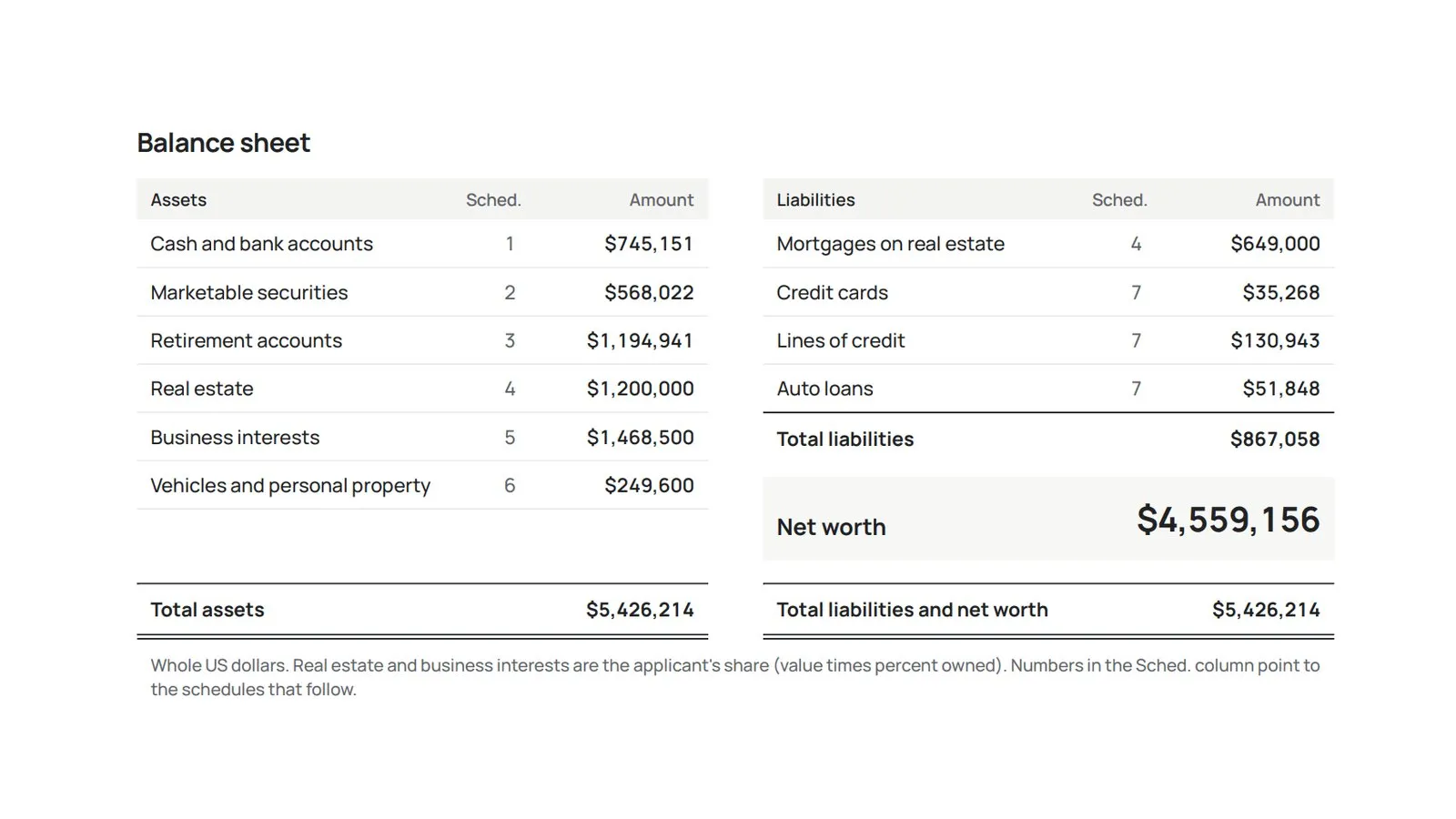
The sample statement in the image at the top of this page works out like this:
| Line | Amount |
|---|---|
| Total assets | $5,426,214 |
| Total liabilities | $867,058 |
| Net worth ($5,426,214 − $867,058) | $4,559,156 |
| Total liabilities and net worth ($867,058 + $4,559,156) | $5,426,214 |
The last line is the first line again, reached from the other side. If you calculate net worth correctly, the total can’t come out any other way. A mismatch means someone typed a number instead of calculating it, or left a line out.
A simpler version: you own a truck worth $40,000 and still owe $15,000 on it. You owe $15,000, and $25,000 of the truck is yours. Owed plus yours is $40,000, the value of the truck.
Why it always equals total assets
Accountants call this the accounting equation. The SEC’s small-business guide to balance sheets puts it in one sentence:
The balance sheet gets its name because an entity’s total assets must equal the total of its liabilities and equity, so it balances.
A business balance sheet calls the leftover equity. A personal financial statement calls it net worth. The PFS vs. balance sheet comparison covers the other differences between the two documents.
Net worth itself can be any size. The Federal Reserve’s 2022 Survey of Consumer Finances found:
$192,900
Median U.S. family net worth in 2022, in 2022 dollars (the mean was $1,063,700). Whatever your number is, total liabilities plus net worth still has to equal total assets.
Source: Federal Reserve, Changes in U.S. Family Finances from 2019 to 2022
Where the line appears on the forms you’ll use
Forms that print the check put it at the bottom of the liabilities column, and the label changes from bank to bank. These are the exact words on each form’s first page, read from the PDFs themselves:
| Form | What the balancing line says | Source |
|---|---|---|
| SBA Form 413 (05-24 edition) | Total Liabilities, then Net Worth, then “Total,” marked “Must equal total in assets column.” | SBA Form 413 PDF |
| Chase personal financial statement | “TOTAL LIABILITIES AND NET WORTH” | Chase PFS |
| Bank of America personal financial statement | “Total Liabilities + Net Worth” | Bank of America PFS |
| Truist personal financial statement | “TOTAL: LIABILITIES AND NET WORTH” | Truist PFS |
| U.S. Bank personal financial statement | No balancing line; Net Worth is shown as “Total Assets Less Total Liabilities” | U.S. Bank PFS |
For SBA 7(a) and 504 loans, Form 413’s own instructions say to complete it for each proprietor, general partner, LLC managing member, 20%-or-more owner and anyone guaranteeing the loan. Its page 1 heads both columns “(Omit Cents),” so every figure is in whole dollars. The SBA 413 guide walks the whole form, and how to fill out SBA Form 413 goes section by section.
Build your personal financial statement in minutes
StatementsReady syncs bank balances read-only through Plaid, fills SBA Form 413, and exports a lender-ready PDF on demand.
- SBA Form 413 with every section filled
- Bank sync through Plaid, read-only
- 7 days free, no card
Who needs to check it
- SBA borrowers and guarantors. Everyone on the Form 413 list above fills one out and signs it.
- Guarantors on commercial real estate loans. The lender reads your statement to decide whether your guaranty is worth anything.
- Brokers and loan officers who assemble packages. A statement that doesn’t balance is likely to come back to you before it reaches credit.
- Anyone signing a bank’s own PFS, for a line of credit, a business acquisition or a business loan application.
When the two totals don’t match
A mismatch always traces back to a specific line. The usual causes:
- A loan netted out of an asset. You list your $900,000 house minus its $400,000 mortgage, so real estate shows $500,000. Then you also list the $400,000 mortgage as a liability, and the debt gets subtracted twice. List the full value as the asset and the loan as the liability; the net shows up in net worth, where it belongs. The schedule of real estate owned is where each property’s value and loan get paired up.
- A debt that lives in a schedule but never reaches page 1. We hit this one in our own software this year. A user entered a car loan on the vehicle itself, the vehicle schedule showed the loan, and the liabilities total left it out. Assets were right, liabilities were $51,848 short, and net worth came out $51,848 too high. The PDF still balanced, because net worth is calculated from the other two lines, which is why this kind of error is hard to see. Walk every schedule and confirm each debt appears once in total liabilities.
- Net worth typed by hand. On a paper form or a spreadsheet, people carry net worth over from last year’s statement or round it. Calculate it fresh every time: total assets minus total liabilities, on today’s numbers.
- Different ownership shares on each side. You own 50% of a rental worth $600,000 with a $300,000 mortgage. If the asset goes on at your $300,000 share and the mortgage goes on at the full $300,000, net worth is understated by $150,000. Use the same share on both sides.
- Rounding. Form 413 wants whole dollars. Rounding each line separately can leave the totals $1 or $2 apart. Round the line items, then add the rounded numbers.
Contingent liabilities are not on this list on purpose. A loan you co-signed, a guaranty or a pending lawsuit goes in a separate box, outside total liabilities. On Form 413 that’s the Contingent Liabilities box beside Section 1. Adding one to the liabilities column overstates your debt and understates your net worth.
More of these errors are in common SBA Form 413 mistakes.
Total liabilities and net worth vs. total liabilities
The two lines sit one above the other, so they’re easy to mix up.
| Total liabilities | Total liabilities and net worth | |
|---|---|---|
| What it adds up | Only what you owe | What you owe plus your net worth |
| On the sample statement | $867,058 | $5,426,214 |
| What it should equal | Nothing else; it’s its own number | Total assets, to the dollar |
| What a lender uses it for | Debt load, debt-to-asset ratio | Proof the statement balances |
If a lender asks for your liabilities, they mean the first column. The second one mostly exists to be checked. The types of liabilities guide covers what belongs in the first number, and the list of assets and liabilities is a line-by-line checklist for both sides.
How to get it right
Build the statement from the schedules up. Fill in each schedule (bank accounts, securities, real estate, notes payable) first, then carry each schedule’s total to the front page. That order is how Form 413 is laid out, and it makes a missing debt obvious, because every schedule total has to land somewhere on page 1.
Calculate net worth last, as total assets minus total liabilities, and then add liabilities back to confirm the total. If you want a second pass, the free net worth calculator runs the same subtraction, and how to calculate net worth for an SBA loan shows a full worked example.
Use one “as of” date for every figure. A brokerage balance from March next to a mortgage balance from August can still balance on paper, but it won’t match the statements the lender pulls.
When software builds the statement, the totals balance automatically because net worth is calculated, never typed. That protects you from a typo. It won’t catch the missing debt in cause 2 above, so the schedule walk still matters. More reading in the personal finance and SBA lending categories.
Skip the spreadsheet
A lender-ready personal financial statement from synced balances, in about 8 minutes.
- 7 days free
- No credit card
- PDF, SBA Form 413, Word, or Excel
Build your personal financial statement in minutes
StatementsReady syncs bank balances read-only through Plaid, fills SBA Form 413, and exports a lender-ready PDF on demand.
- SBA Form 413 with every section filled
- Bank sync through Plaid, read-only
- 7 days free, no card