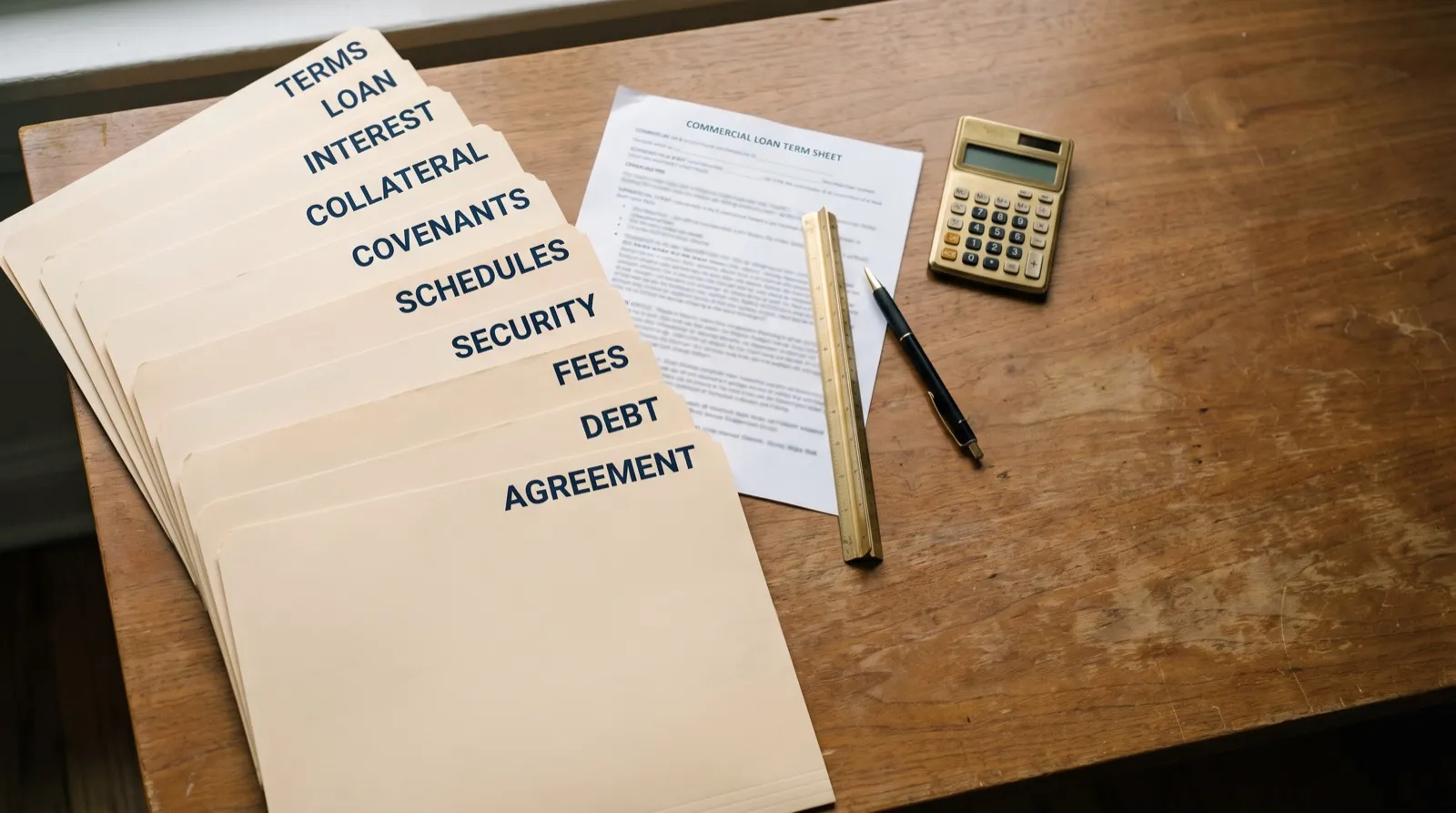

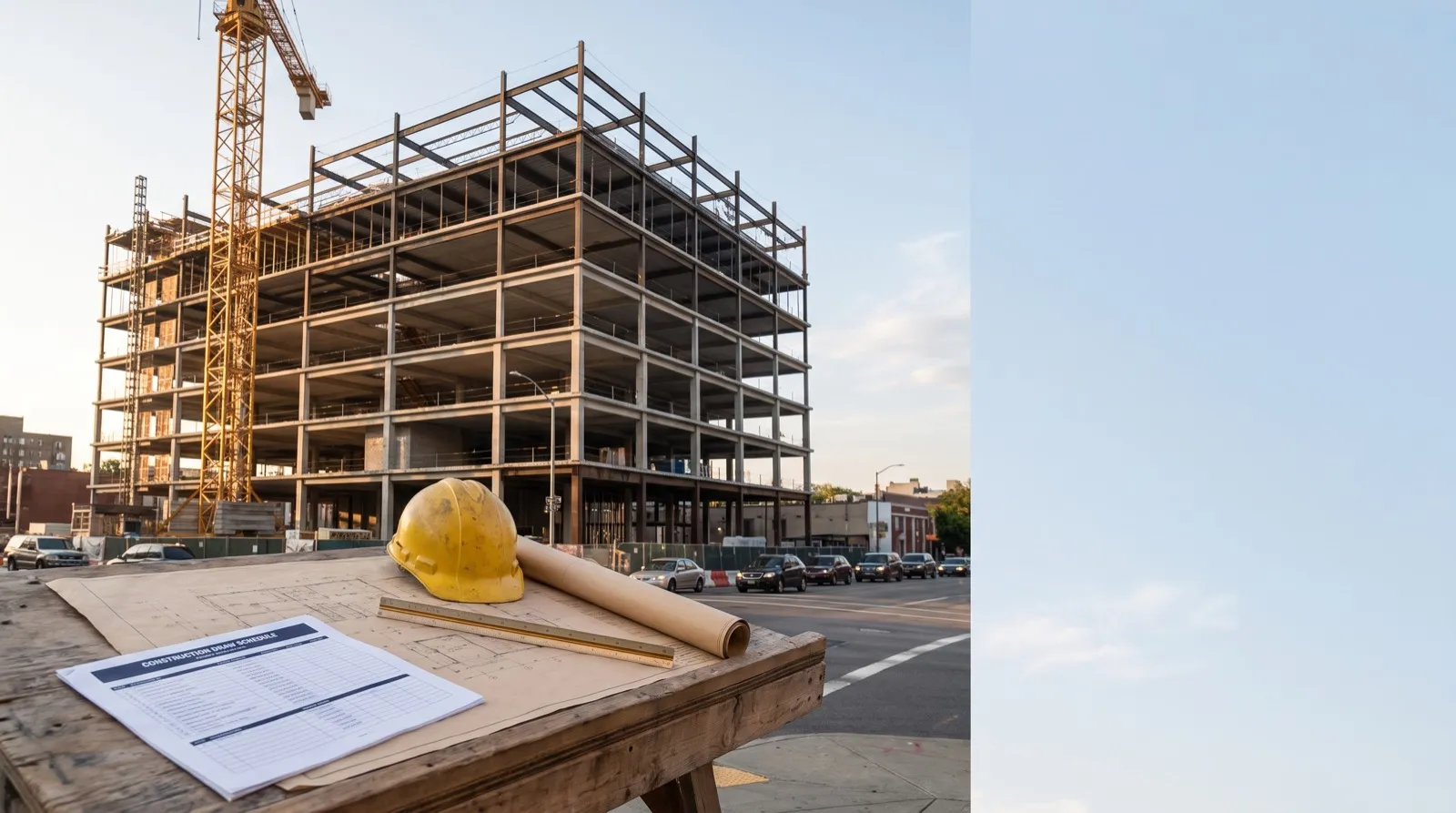
A commercial real estate construction loan pays for a building that doesn’t exist yet, so it works nothing like a normal mortgage. The money comes out in stages as the building goes up, and you pay interest only. The whole facility is short-term, typically 12 to 36 months, because it’s designed to be replaced by permanent financing the day construction finishes. The two things that trip up first-time borrowers are how the cash actually reaches the contractor (the draw schedule) and how you pay interest on a property earning nothing (the interest reserve). This guide walks both, plus the two ratios that size your loan, the take-out to permanent financing, and the SBA 504 construction path for owner-occupied projects.
Key takeaways
- A construction loan is short-term (12–36 months), interest-only, and floating-rate, funded in draws against documented work rather than disbursed all at once.
- The draw schedule governs how cash reaches the project: the contractor bills for completed work, an inspector verifies it, and the lender funds it minus retainage of 5–10%.
- The interest reserve is loan proceeds set aside to pay interest during the build. Running it dry before completion is the most common way a project runs short of cash mid-stream.
- Lenders size the loan to the lower of loan-to-cost (LTC) and loan-to-value (LTV): in 2026, roughly 65–75% LTC and 60–70% LTV. The rest is your equity.
- The take-out matters as much as the construction loan: a standalone construction loan needs a separate permanent refinance, while a construction-to-permanent loan converts automatically, but only if the finished building hits the underwritten DSCR.
- For owner-occupied projects, the SBA 504 path funds construction with as little as 10% down, using bank interim financing during the build and a fixed-rate CDC debenture that takes out its portion after the certificate of occupancy.
What a commercial real estate construction loan is
A commercial real estate construction loan is short-term financing (typically 12 to 36 months) used to build or substantially renovate a commercial property. Rather than disbursing at closing, the lender funds the loan in periodic draws against construction work verified as complete. The loan is interest-only during construction, usually carries a floating rate priced over SOFR, and is designed to be repaid at completion by permanent financing, either through automatic conversion (a construction-to-permanent loan) or a separate refinance (the take-out).
The core reason a construction loan behaves so differently from a term loan is that the lender is underwriting a plan and a budget as much as a property. There is no finished building to appraise on an as-is basis and no rent roll to underwrite, so the lender releases money only against verified progress and prices in the risk that the project doesn’t get built on budget. That’s why these loans are short, floating, and heavily monitored. Once the building is up and leased, it converts into the kind of financing covered in commercial real estate loan terms: long amortization, fixed or fixed-reset rate, underwritten on real income (you can model that permanent payment in our commercial real estate loan calculator).
Construction loan vs. permanent loan: head to head
The clearest way to understand a construction loan is against the permanent loan that replaces it. They finance the same building at different points in its life, and almost every ground-up deal uses both in sequence.
| Dimension | Construction loan | Permanent loan |
|---|---|---|
| Term | 12–36 months | 5–30 years |
| Disbursement | In draws, against verified work | Lump sum at closing |
| Payments | Interest-only, from a reserve | Amortizing principal + interest |
| Rate | Floating, over SOFR | Fixed or fixed-reset |
| Sized on | Loan-to-cost / as-completed value | Stabilized income (DSCR, LTV) |
| Underwrites | A budget and a plan | An operating property |
| Collateral value | Projected (as-completed) | Actual (as-is / stabilized) |
The “as-completed value” line is the one that surprises people: because there’s no finished building yet, the appraiser produces a projected value for what the property will be worth once it’s built and stabilized. That as-completed number, not today’s dirt-and-plans value, is what the lender tests LTV against.
The draw schedule: how the money actually comes out
You don’t get a construction loan the way you get a mortgage check. The lender approves the full amount and holds the cash, releasing it in chunks, called draws, as the project hits agreed milestones.
The monthly cycle on a typical commercial deal:
- The contractor bills for completed work. The general contractor submits a pay application (commonly the AIA G702/G703 forms) showing the percentage complete on each line of the schedule of values (foundation, framing, mechanicals, finishes, and so on).
- The lender verifies it. A third-party inspector or the lender’s construction consultant confirms the work is physically in place and matches the request. The lender also collects lien waivers from subcontractors and updates the title so no unpaid party can file a mechanic’s lien.
- The lender funds the draw, minus retainage. The lender releases the approved amount but holds back retainage, commonly 5 to 10% of each draw, until the project reaches substantial completion. Retainage protects the lender if the job has to be finished by someone else, and it gives the contractor an incentive to actually complete the punch list.
Plan on roughly 5 to 10 business days from a clean draw request to funding. The single most useful thing to know here: interest accrues only on the money that’s actually been drawn, not on the full loan commitment. Early in the project, when only the foundation is funded, your interest cost is small; it climbs as the draws climb.
The interest reserve: paying interest with no income
A building under construction produces zero revenue, so you have no cash flow to make interest payments from. Construction loans solve this with an interest reserve: a portion of the loan proceeds set aside at closing to cover interest as it accrues. In effect, the lender lends you the money to pay itself interest until the property is finished and can service its own debt.
The Office of the Comptroller of the Currency describes the mechanism plainly in its examiner guidance:
An interest reserve is a reserve account established by the lender and used by the borrower to cover loan interest during construction and lease-up. Once the cash flow is sufficient to cover the interest, no further draws on the reserve should be permitted to prevent the diversion of income that should be used to support the project.
Two things determine whether your reserve is adequate. First, the draw curve: draws follow an S-shape — slow during sitework, peak during vertical construction, taper through finishes — so the average outstanding balance over the loan runs higher than the naive 50% guess, usually 55 to 65%. Second, the rate assumption: the reserve is sized at closing against a projected SOFR path, and if rates run above forecast, the reserve burns faster than budgeted.
An interest reserve that runs dry before substantial completion is one of the most common ways a project hits a mid-build cash crunch, at exactly the moment you have the least flexibility. When you model the deal, model the reserve draw-by-draw against the actual monthly draw schedule, not with a single average-balance shortcut.
LTC vs. LTV: the two ratios that size your loan
Construction lenders don’t size a loan the way permanent lenders do. There’s no stabilized income yet, so instead of leading with debt service coverage, they lead with two collateral ratios and lend to whichever produces the smaller loan.
| Ratio | What it measures | Formula | 2026 bank range |
|---|---|---|---|
| Loan-to-cost (LTC) | Loan vs. what the project costs to build | Loan ÷ total project cost | ~65–75% |
| Loan-to-value (LTV) | Loan vs. what the finished building is worth | Loan ÷ as-completed appraised value | ~60–70% |
Total project cost, the LTC denominator, is more than construction. It includes land at cost basis, hard costs, soft costs (architecture, engineering, permits, legal), the interest reserve, and a contingency (typically 5 to 10% of hard costs). As-completed value, the LTV denominator, is the appraiser’s projection of the finished, stabilized property.
The lender funds to the lower of the two. LTC usually binds on a well-underwritten project; LTV binds when the projected value is close to the cost to build, which happens in soft markets or when the sponsor’s value-add is thin. Either way, the gap between the loan and the total cost is the equity you have to bring.
80%
Supervisory loan-to-value ceiling for commercial construction loans
Source: OCC / Interagency Real Estate Lending Standards, Comptroller's Handbook
That 80% is a regulatory ceiling, not a target. The interagency real estate lending standards cap supervisory LTV at 80% for commercial construction (75% for land development, 65% for raw land). Most banks set internal limits well below the ceiling, which is why the practical range lands around 60 to 75%. You can pressure-test the coverage side of your own deal with our free DSCR calculator once you have projected rents, and the broader lender checklist lives in commercial real estate loan qualifications.
Build your personal financial statement in minutes
StatementsReady syncs bank balances read-only through Plaid, fills SBA Form 413, and exports a lender-ready PDF on demand.
- SBA Form 413 with every section filled
- Bank sync through Plaid, read-only
- 7 days free, no card
From construction to permanent: the take-out
A construction loan is a bridge, and the exit is the part underwriters scrutinize most. There are three common structures:
- Standalone construction loan + separate permanent refinance. You close the construction loan, build, then apply for a brand-new permanent loan to pay it off. Two closings, two sets of fees, and refinance risk: if rates or the market move against you before completion, the take-out you assumed may not be there.
- Construction-to-permanent (single-close). One loan that converts automatically to permanent financing at completion, provided the finished property hits the underwritten DSCR. One closing, one set of fees, and, depending on the lender, permanent-rate terms you can lock up front. This is the cleaner structure when you can get it.
- Mini-perm. A short intermediate term (often 3 to 5 years) that bridges a newly built property through lease-up until it’s stabilized enough to qualify for true long-term permanent debt.
The thread through all three: the permanent loan is underwritten on the building’s stabilized income, and it won’t fund until the property actually earns it. A construction-to-permanent loan that projects a 1.25 DSCR at stabilization but comes in at 1.05 because lease-up stalled can fail to convert. The take-out assumptions deserve as much rigor as the construction budget.
The SBA 504 construction path for owner-occupied CRE
If your business will occupy the building it’s constructing, the SBA 504 program is often the most capital-efficient way to fund it: you can get in for as little as 10% down instead of the 25 to 35% equity a conventional construction loan demands. The structure is the standard 504 “50-40-10”: a bank first mortgage for about 50% of project cost, a Certified Development Company (CDC) second-lien loan for up to 40% funded by an SBA-guaranteed debenture, and your 10% equity. The full mechanics are in SBA 504 loan for commercial real estate; the construction wrinkle is in the timing.
The CDC debenture does not fund at closing. It funds only after construction is complete and the certificate of occupancy is issued, typically 30 to 60 days after completion, on the SBA’s monthly debenture funding cycle. So during the build, a bank or interim lender provides interim financing, often up to 90% of project cost, carried as an interest-only note. When the project is done and occupied, the debenture is sold and its proceeds pay off the 40% interim portion; the bank’s interim construction loan then converts to its permanent 50% first mortgage. You make two payments from there: one to the bank, one to the CDC; our SBA loan calculator estimates the 504 payment across the 20- and 25-year terms.
$5M / $5.5M
Maximum SBA 504 CDC debenture: standard, and for manufacturing or energy-efficient projects
Source: U.S. Small Business Administration, 504 Loan Program
A few 504-construction specifics worth knowing before you start:
- Owner-occupancy is stricter for new construction. Your business must occupy at least 60% of a newly built building upon completion, rising to 80% within ten years (versus 51% for an existing building you buy). A 504 can’t finance investment or rental property — see SBA 504 loan requirements for the full eligibility set.
- The debenture rate is fixed at funding. The CDC portion locks to a spread over Treasuries when the debenture sells, and stays fixed for the full 20- or 25-year real estate term. Because it funds at completion, your fixed rate is set by the market at the end of construction, not the start.
- Every 20%+ owner signs a personal guarantee and files Form 413. As with any 504 deal, the personal guarantee is required, and each 20%-or-more owner submits an SBA Form 413 personal financial statement. The SBA 7(a) program can also fund construction, but 504 usually wins for owner-occupied real estate on down payment and rate structure.
What lenders require before they fund
Construction underwriting stacks the ordinary commercial-loan requirements on top of a set of construction-specific ones:
- Stabilized DSCR, not in-place DSCR. With no income during the build, lenders underwrite coverage on pro-forma stabilized income, commonly a 1.20–1.25 DSCR on the permanent take-out, and often a stabilized debt yield of 8% or more.
- A credible general contractor and a fixed-price or GMP contract. The lender is lending against the plan, so the plan has to be real: vetted GC, a guaranteed-maximum-price or fixed-price contract, complete plans and specs, and pulled permits.
- Guarantor strength and a personal guarantee. Nearly all commercial construction loans are recourse. Expect to sign a personal guarantee and to document your finances with a personal financial statement, the same document borrowers prepare for business loan applications generally.
- Real equity, verified. Your LTC/LTV gap has to be genuine cash or land equity, and many lenders require you to inject it first, before they fund a dollar of draws.
The 2026 construction lending environment
Construction credit loosened at the margin heading into 2026, but the easing is uneven. In the Federal Reserve’s January 2026 Senior Loan Officer Opinion Survey, banks reported that demand for construction and land development loans flipped positive for the first time in several quarters. The net demand reading moved to +8.9% across all domestic banks and +27.8% at large banks. Standards were “basically unchanged” on net, but with a size split: large banks eased, while smaller banks still reported modest tightening.
0.07%
Median net charge-off ratio on bank commercial real estate loans, Q4 2025, historically low
Source: FDIC 2026 Risk Review
The credit backdrop supports that thaw. The FDIC’s 2026 Risk Review found that bank CRE portfolios grew to a new peak in 2025 while aggregate CRE delinquency and net charge-off ratios stayed low: the median CRE net charge-off ratio was a nominal 0.07%, and construction-and-development noncurrent loans remained well under 1%. Stress is concentrated in office and in securitized (CMBS) exposures, not in the bank-held construction book.
What that means if you’re financing a build in 2026: capital is available for well-sponsored projects, but underwriting caution lingers at the smaller community banks that many owner-occupied borrowers turn to for construction financing. The two levers most in your control are a tight, contingency-cushioned budget and a take-out you can actually document. For the broader workflow of keeping your financials lender-ready across a construction timeline, see the commercial real estate investor use case, and browse more in the commercial real estate archive.
Building or renovating a commercial property means a lender is going to ask each guarantor for a current personal financial statement, often more than once as the deal moves from construction to permanent financing. StatementsReady turns that into a clean, lender-formatted PDF in a few minutes, so the paperwork is never the thing holding up your draw. Start your personal financial statement.
Build your personal financial statement in minutes
StatementsReady syncs bank balances read-only through Plaid, fills SBA Form 413, and exports a lender-ready PDF on demand.
- SBA Form 413 with every section filled
- Bank sync through Plaid, read-only
- 7 days free, no card