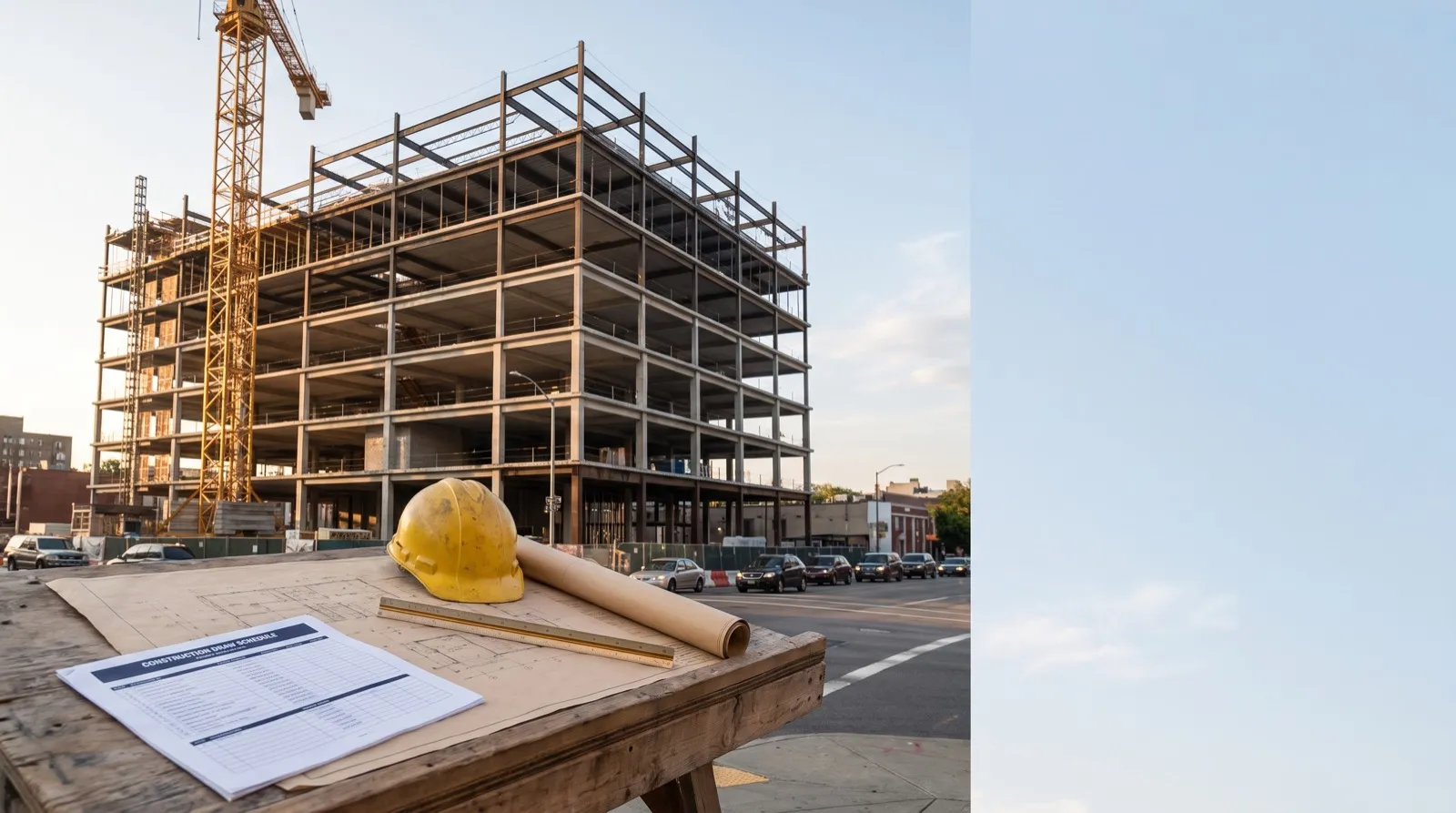


Commercial real estate lenders qualify two things at once: the property and you. The property has to throw off enough income to cover the payment with a cushion, and you have to be strong enough to stand behind the debt if it does not. Every ratio, document, and guarantee on a commercial loan traces back to one of those two questions, and this guide walks through exactly what a lender checks before it says yes.
Key takeaways
- Qualifying runs on three tests: property cash flow (DSCR), collateral (LTV and debt yield), and borrower strength (credit, net worth, liquidity, guarantee). A strong property with a weak guarantor stalls, and so does the reverse.
- DSCR is the covenant that most often resizes or kills a deal. Conventional lenders start at 1.25x; 1.15x business cash flow is the SBA floor on standard 7(a) and 504 loans (1.25x on most 7(a) business purchases); hotels and restaurants run 1.30x and up.
- Debt yield is the check you can’t game. Because it is NOI divided by loan amount, stretching the amortization does nothing to it, which is why it often sets the real loan ceiling on riskier assets.
- On a recourse loan (most bank and all SBA loans) the lender underwrites your personal balance sheet alongside the property’s, and post-close liquidity is what they weigh hardest.
- The 2026 backdrop matters: a wall of maturing loans is re-qualifying at tougher standards and higher rates, so the cushion you show today has to survive a stricter refinance later.
What “qualifying” actually means
Commercial real estate loan qualifications are the criteria a lender applies to decide whether to approve a loan and how large it can be. They fall into three groups. Cash-flow tests measure whether the property’s net operating income covers the debt (debt-service-coverage ratio). Collateral tests measure the loan against the asset’s value and income (loan-to-value and debt yield), and borrower tests measure your credit, net worth, liquidity, and willingness to guarantee the loan. The specific thresholds vary by lender type (bank, SBA, life company, CMBS, or DSCR investor lender) but the three questions behind them are constant.
The insurance-regulator view lines up with how a bank credit committee actually thinks. The NAIC’s Capital Markets Primer on Commercial Mortgage Loans calls the debt coverage ratio “the key metric” for gauging a property’s capacity to service its mortgage, and names loan-to-value the second. Cash flow first, collateral second, and, on any recourse deal, you third. Get all three lined up before you approach a lender and the file moves; miss one and the loan gets resized or declined no matter how good the other two look. This is the qualification side of the commercial real estate loan terms that end up on your term sheet.
The three ratios lenders run first
Debt-service-coverage ratio (DSCR)
DSCR is the first calculation an underwriter performs. The formula is simple:
DSCR = net operating income (NOI) ÷ annual debt service
NOI is the property’s gross income minus vacancy and operating expenses; it excludes your mortgage payment, income taxes, and capital expenditures. A property with $300,000 of NOI and $240,000 of annual payments runs a 1.25x DSCR: it produces $1.25 of income for every $1.00 of debt service, so income could fall 20% before the property stops covering its own payment.
The general starting point for a conventional commercial mortgage is 1.25x. SBA underwriting runs a little lower: SOP 50 10 8.1 sets a 1.15x business-cash-flow floor on standard 7(a) and 504 loans. Most 7(a) business purchases need 1.25x from October 1, 2026, and SBA 504 lenders often look for 1.20x on existing cash flow. Higher-risk property types run higher: hotels and full-service restaurants frequently require 1.30x to 1.40x, and complex resort assets can reach 1.50x. One detail that surprises first-time borrowers: most lenders test DSCR at a stressed rate, adding 100 to 150 basis points to your quoted rate, so the ratio they underwrite is tighter than the one your actual payment implies.
If you want the calculation worked across several property types, how to calculate DSCR runs the examples, and you can test your own deal in the free DSCR calculator before you ever talk to a lender.
Loan-to-value (LTV)
LTV is the loan amount divided by the property’s value, and it sets your down payment. The denominator is almost always the lower of the appraised value or the purchase price: if the appraisal comes in under your contract price, the loan shrinks even though the price did not. Typical caps by lender:
- Conventional bank: 65% to 75%, so you bring 25% to 35% equity.
- SBA 504: up to roughly 90% (10% down) on owner-occupied property; about 85% on special-purpose assets like hotels and motels.
- DSCR investor lender: 75% to 80% on rental and small commercial assets.
- Life company: the most conservative, often 55% to 70% for core assets.
Debt yield
Debt yield is the metric borrowers hear about last and lenders increasingly check first on larger deals. It is net operating income divided by the loan amount:
Debt yield = NOI ÷ loan amount
A property with $500,000 of NOI and a $5,000,000 loan has a 10% debt yield. Lenders use it because it is independent of loan structure: you cannot improve it by stretching the amortization, adding an interest-only period, or buying down the rate, the way you can flatter a DSCR. CMBS conduits historically required 9% to 10% (some dropped toward 7% when chasing volume), and hotel lenders commonly want 10% to 12%. On volatile assets the debt-yield floor often becomes the binding constraint: a hotel with $1,000,000 of NOI and a 12% minimum caps the loan near $8.3 million regardless of what the DSCR would allow. If you are financing anything CMBS or hospitality, ask the lender for the debt-yield minimum early: it may set your loan size before LTV does.
The borrower side: credit, net worth, liquidity, and the guarantee
On a recourse loan the property is only half the file. Because your guarantee stands behind the debt, the lender underwrites you.
Credit score. Community and regional banks generally want a personal FICO in the 660 to 680 range or higher on a recourse CRE loan. The SBA retired its minimum FICO Small Business Scoring Service (SBSS) score for 7(a) Small loans in 2026, so SBA credit standards now run through each lender’s own score overlays rather than a single national cutoff. DSCR investor lenders sometimes accept low-600s scores because they lean on property cash flow, though a weaker score usually raises your rate or lowers your leverage.
Net worth and liquidity. These are market rules of thumb rather than published regulations, so they flex by lender, but they are remarkably consistent. Banks commonly want a guarantor’s net worth roughly equal to the loan amount and post-close liquidity covering 9 to 12 months of debt service (some frame it as about 10% of the loan in liquid reserves after closing). Post-close liquidity is the number underwriters guard hardest, because it is what carries the property through a soft quarter. A clean, current net worth statement (you can build the figure in the free net worth calculator) is what lets a lender see that number without a week of email back-and-forth.
Global cash flow. SBA lenders, and many community banks, don’t stop at the property.
SOP 50 10 requires a global cash flow analysis. The lender combines the income and debt service of all your businesses, rental properties, and personal obligations, including the liquidity of every owner of 20% or more and their spouses and minor children. It then tests whether the aggregate cash flow still covers the aggregate debt with a margin. The SOP’s floor for that global ratio is 1:1, and many lenders look for something in the 1.15x to 1.20x range. It is tied to the SBA’s revitalized “credit elsewhere” test, which requires the lender to document why you cannot get conventional financing on reasonable terms. Borrowers moving from a bank loan to an SBA loan are often surprised by how much personal financial detail this pulls in.
The personal guarantee. Most bank loans and all SBA loans are recourse. The SBA requires an unconditional personal guarantee from every owner of 20% or more, and under SOP 50 10 8 all equity holders in a partial change of ownership must guarantee the loan for at least two years, regardless of stake size. CMBS and life-company loans are usually non-recourse, but every non-recourse loan carries bad-boy carve-outs that spring back to full personal liability for fraud, unauthorized transfers, or voluntary bankruptcy. There is no non-recourse version of an SBA small-business loan.
Build your personal financial statement in minutes
StatementsReady syncs bank balances read-only through Plaid, fills SBA Form 413, and exports a lender-ready PDF on demand.
- SBA Form 413 with every section filled
- Bank sync through Plaid, read-only
- 7 days free, no card
Down payment and equity injection by lender type
How much cash you bring is a qualification test in its own right: lenders want real capital at risk, from documented sources.
| Loan type | Borrower equity | Notes |
|---|---|---|
| Conventional bank | 25% to 35% | Matches a 65% to 75% LTV cap; more on construction or transitional assets |
| SBA 504 | 10% (owner-occupied) | Rises to 15% for a startup or special-purpose asset, 20% if both |
| SBA 7(a) | 10% minimum | Required on any startup and most business purchases under SOP 50 10 8 and, from October 1, 2026, SOP 50 10 8.1 |
| DSCR investor | 20% to 25% | Driven by the 75% to 80% LTV cap and the debt-yield floor |
| Life company | 30% to 45% | The conservative LTVs push equity higher |
Two SBA-specific rules trip people up. On a 7(a) change of ownership, a seller note can count toward the 10% injection only if it sits on full standby for the life of the SBA loan. It can also cover at most half the required injection, so a 10% requirement means at least 5% has to come from other verified sources. For loans submitted from October 1, 2026, SOP 50 10 8.1 counts other standby debt and minority-investor equity against that same half.
And the SBA now expects “reasonable and prudent efforts” to verify equity: bank statements showing the funds for at least 30 days, wire confirmations, settlement statements. A gift letter or a promissory note alone will not clear it. The SBA loan down payment requirements post breaks the sourcing rules down in detail.
10%
Borrower down payment on an owner-occupied SBA 504 project, versus 25% to 35% equity on a conventional commercial mortgage
Property-level requirements
The borrower and the ratios are not the whole test: the property itself has to qualify.
Owner-occupancy (SBA). SBA 504 and most SBA 7(a) real-estate loans finance property you use, not property you rent out. You must occupy at least 51% of an existing building, or 60% of new construction (working toward 80% within 10 years), and you have to be in the space within 12 months of funding. This is the single rule that disqualifies most real-estate investors from SBA financing. For a pure rental play, a DSCR loan or conventional mortgage is the path.
Appraisal. An independent commercial appraisal sets the value that drives LTV. Lenders order it themselves and size the loan against the lower of the appraised value or your contract price.
Environmental and condition. A Phase I Environmental Site Assessment is standard on commercial property, and it matters most on anything with an industrial past: a former gas station, dry cleaner, or manufacturing site. A Phase I that flags contamination can trigger a Phase II or condition the loan on remediation, and it is one of the few findings that can stop a deal outright rather than just resize it.
The documents that make or break the file
Underwriting is a reconciliation exercise. These are the documents every commercial lender expects, and they all have to agree with each other:
- Personal financial statement: the SBA uses Form 413; banks accept their own or a clean equivalent. Every 20%+ owner and guarantor files one.
- Business and personal tax returns: two to three years. Under SOP 50 10 8, SBA lenders pull IRS tax transcripts to verify the income you reported, so the returns and your statements have to reconcile.
- Rent roll and operating statements: trailing income, vacancy, and expenses by line item; this is where the underwriter rebuilds your NOI.
- Business debt schedule: every loan, lease, and line of credit with balance, rate, maturity, and payment, so the lender can compute global debt service.
The fastest way to slow a commercial loan is a personal financial statement that does not tie to the tax returns and the debt schedule. Starting from the SBA personal financial statement template rather than a blank page keeps the assets, liabilities, and net worth internally consistent, which is exactly what the underwriter is checking.
What underwriters look for that isn’t on the checklist
Two files can hit the same DSCR and LTV and still get different answers, because a few qualitative factors move a credit decision:
- Management experience. Lenders weight relevant operating experience heavily, especially in hands-on sectors like hospitality and food service. First-time operators in a complex industry draw more scrutiny and often need a stronger team or more equity. SOP 50 10 8 reinforces this by prohibiting SBA deals where a franchisor or management company holds complete operational control.
- Post-close liquidity, again. It shows up on the checklist as a number, but underwriters treat depth of reserves as a proxy for staying power. Two guarantors with equal net worth are not equal if one holds it in home equity and the other in cash.
- Story consistency. The narrative in your application, the numbers on your statements, and the returns the transcripts confirm all have to point the same direction. Gaps read as risk.
Disqualifiers and borderline cases
Some things stop an application cold. A prior loss or delinquency on federal debt makes a borrower ineligible for SBA financing (unless it is under an approved catch-up plan). As of March 1, 2026, SBA Procedural Notice 5000-876626 requires that applicant ownership be U.S. citizens or U.S. nationals, tightening prior residency rules. Unresolved environmental contamination or a critically low debt yield can each end a deal on their own.
Most files, though, are borderline rather than disqualified:
- “My DSCR is 1.15x.” Below a bank’s 1.25x, you have three levers: put more down (lower the loan, raise the coverage), find a lender with a lower floor, or pursue an SBA structure, where 1.15x business cash flow is the floor on standard 7(a) and 504 loans (most 7(a) business purchases need 1.25x).
- “My credit is 640.” Expect a higher rate or a lower LTV rather than a flat no, especially if the property’s cash flow is strong. A DSCR investor lender may weight the property over the score.
- “I don’t have 25% down.” For an owner-occupied property, SBA 504 at 10% down is the reason the program exists. For a pure rental, a DSCR loan at 20% to 25% is usually the lower-equity path.
If you don’t qualify today, the fix is almost always mechanical: raise the DSCR by adding equity or improving NOI, rebuild post-close liquidity over a couple of quarters, or move to the lender type whose thresholds fit your deal. The broader workflow of keeping your numbers lender-ready across a portfolio is in the commercial real estate investor use case, and for conventional owner-occupied deals, business loan applications covers the package.
What the 2026 market does to your qualifications
Qualification thresholds are not fixed: they tighten with the lending cycle, and 2026 is a tightening year. The Mortgage Bankers Association’s 2025 survey counted $875 billion of commercial and multifamily mortgage debt maturing in 2026 — about 17% of the $5.0 trillion outstanding — including roughly $396 billion serviced by depository lenders. Most of that debt was underwritten at far lower rates; S&P Global Market Intelligence pegs recently originated CRE loans near 6.2% against about 4.3% on the debt they are replacing. A lot of those loans only reached 2026 because they were extended once already.
The lack of transactions and other activity last year, coupled with built-in extension options and lender and servicer flexibility, has meant that many loans that were set to mature in 2023 have been extended or otherwise modified and will now mature in 2024, 2026, 2028 or in other coming years.
$875B
Commercial and multifamily mortgage debt scheduled to mature in 2026, roughly 17% of the $5.0 trillion outstanding, most of it re-qualifying at today's tougher standards
Source: Mortgage Bankers Association, 2025 CRE Survey of Loan Maturity Volumes
For a borrower, the practical read is straightforward: lenders working through a maturity wall grow more selective. They favor strong DSCR, lower leverage, healthy debt yield, and guarantors with real liquidity. The cushion you show today has to survive a stricter refinance a few years out, because that is the market the balloon comes due into. Building the qualification metrics with genuine room above the minimums is what keeps the next negotiation from being a scramble.
More on how lenders read your numbers is in the commercial real estate archive and the SBA lending archive.
Skip the spreadsheet
A lender-ready personal financial statement from synced balances, in about 8 minutes.
- 7 days free
- No credit card
- PDF, SBA Form 413, Word, or Excel
Build your personal financial statement in minutes
StatementsReady syncs bank balances read-only through Plaid, fills SBA Form 413, and exports a lender-ready PDF on demand.
- SBA Form 413 with every section filled
- Bank sync through Plaid, read-only
- 7 days free, no card