SBA Form 159: The Fee Disclosure Nobody Explains
SBA Form 159 discloses what your broker or packager is paid on a 7(a) or 504 loan. Who counts as an agent, who signs, and which fees the SBA prohibits.

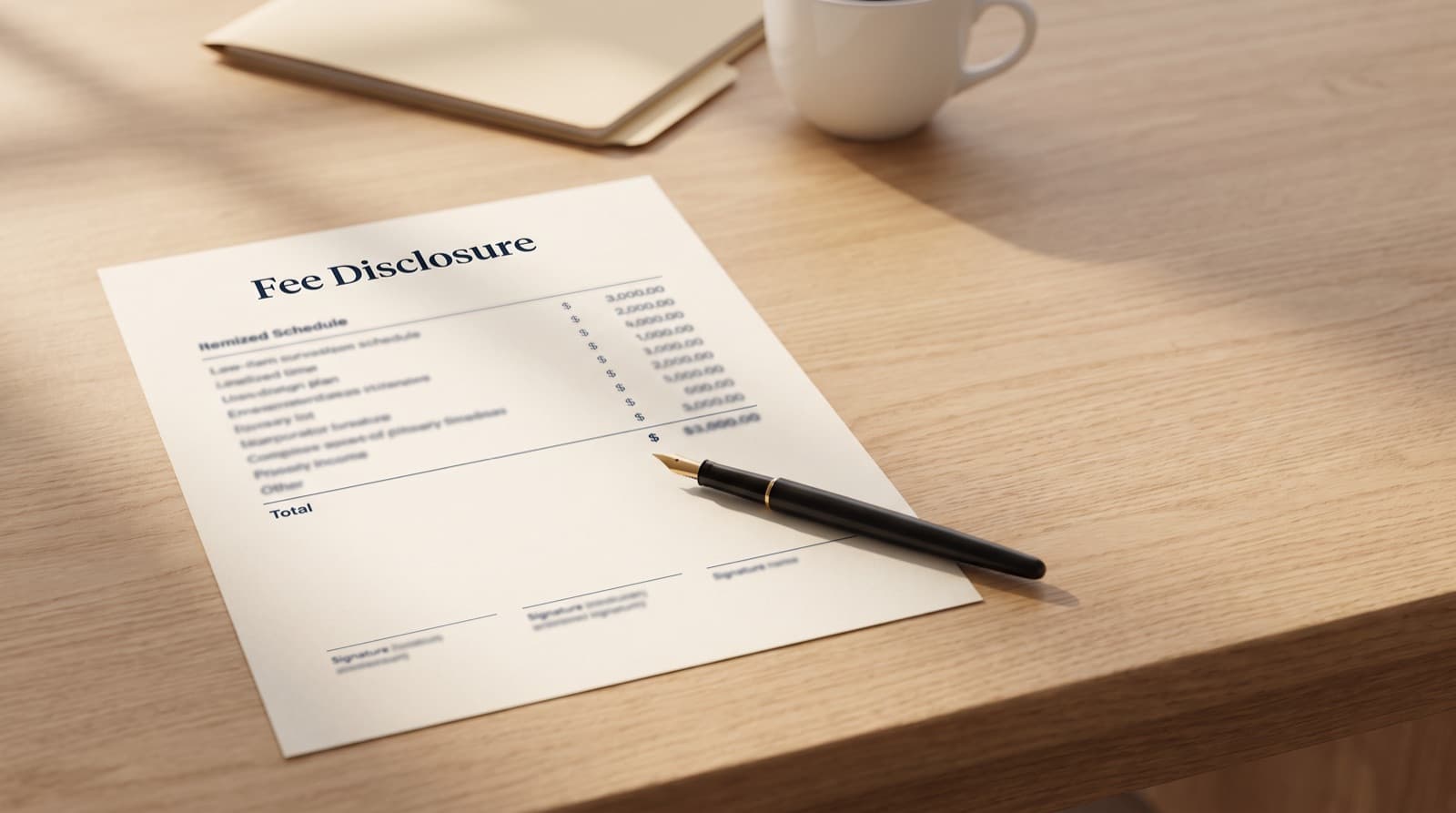
If someone helped you get an SBA loan and got paid for it, that arrangement is supposed to appear on a form you sign. SBA Form 159, the Fee Disclosure and Compensation Agreement, names the agent, lists the services, states the dollar amount, and records who paid it. Most borrowers sign it near closing without reading it, which is the wrong moment to discover what their broker charged.
Key takeaways
- Form 159 is required whenever a compensated agent is involved and no listed exclusion applies. There is no fee amount small enough to skip it — the exclusions are role-based, not dollar-based.
- The $2,500 figure everyone cites triggers itemization, not the form itself.
- The applicant, the agent, and the lender or CDC all sign, and a separate form is required for each agent.
- Contingency fees, flat fees charged to everyone, and charges for unnecessary services are all prohibited.
- The tiered percentage caps you'll find repeated across the web (3.5% / $10,000) were pulled out of the regulations in 2020. The operative ceilings live in SOP 50 10 8.
- If SBA deems a fee unreasonable, the agent has to refund the excess to you.
What is SBA Form 159?
Definition
SBA Form 159, the Fee Disclosure and Compensation Agreement, is the form that identifies every agent compensated in connection with an SBA 7(a) or 504 loan and discloses the services performed, the amount paid, and which party paid it. It exists because Section 13 of the Small Business Act (15 U.S.C. § 642) requires an SBA loan applicant to name anyone engaged to help expedite the application and to disclose the fees paid to them. The disclosure requirement is implemented through 13 CFR § 103.5.
The form used to come in two flavors. SBA maintained separate versions for the 7(a) and 504 programs until Information Notice 5000-18012, effective September 14, 2018, consolidated them into the single Form 159 that covers both programs. Disaster loans run on their own track and use a separate document, SBA Form 159D, with its own thresholds: $500 for a disaster home loan and $2,500 for a disaster business loan.
Download the current version from the SBA's Form 159 page rather than from a lender's or broker's website. Older editions circulate widely, and the instructions block is where the exclusions and signature rules live.
Who counts as an agent under SBA rules
The definition is broader than most borrowers expect. 13 CFR § 103.1(a) defines an Agent as:
"an authorized representative, including an attorney, accountant, consultant, packager, lender service provider, or any other person representing an Applicant or Participant by conducting business with SBA."
"Conducting business with SBA" is defined just as broadly: preparing or submitting an application on an applicant's behalf, preparing or processing an application for a lender, communicating in any way with SBA officers or employees on someone's behalf, or acting as a lender service provider.
The regulation and SOP break agents into working categories:
| Type of agent | What they do | Who pays them |
|---|---|---|
| Packager | Prepares the application: completing forms, building the business plan, assembling cash-flow projections | The applicant |
| Loan broker / referral agent | Finds the applicant a lender, or finds the lender an applicant | Either side, but never both |
| Lender service provider (LSP) | Performs lender functions: originating, disbursing, servicing, liquidating | The lender only; cost cannot be passed to the borrower |
| Attorney, accountant, consultant | Loan-specific work that involves representing you before SBA | Usually the applicant |
Who is not an agent
The Form 159 instructions carve out specific roles. These people do not require a Form 159 for the listed service:
- An attorney acting only in connection with the 7(a) or 504 loan closing
- Your accountant, for financial statements or tax returns prepared in the ordinary course of business and unrelated to the loan application
- An appraiser employed by the SBA lender to appraise collateral
- An individual employed by the SBA lender to perform the SBA-loan business valuation
- An environmental professional employed by the SBA lender for an environmental assessment of the collateral
- A real estate agent receiving an ordinary commission on the property sale
- An approved LSP operating under an SBA-reviewed LSP agreement, since that written agreement is the controlling compensation document instead
- A 504 professional-services contractor working under an SBA-approved contract
Read that list as covering the service, not the person. A closing attorney who also packages your application has crossed into agent territory for the packaging work, and that work needs a Form 159.
Is Form 159 required if the fee is under $2,500?
Yes, it is required. The $2,500 figure is not a filing threshold, and treating it as one is the single most repeated error about this form, including on pages that otherwise get the details right.
Where a compensated third-party agent is involved in a 7(a) or 504 loan and no listed exclusion applies, Form 159 is required regardless of the amount. A $400 referral fee needs a form. The exclusions below are role-based, not dollar-based. What $2,500 triggers is the documentation requirement. SOP 50 10 8 states that if the aggregate compensation for all fees from the same agent exceeds $2,500, an itemization of the compensation received and supporting documentation must be attached to the Form 159.
That itemization has to show real detail:
- What work was actually performed
- Whether the fee is hourly or a percentage of the loan
- The hourly rate, if hourly
- The number of hours spent on each service
- Documentation substantiating the charge
SBA can ask for that breakdown at any amount, not just above $2,500. And fees are aggregated per agent. An agent who bills you $1,500 for packaging and $1,400 for consulting on the same application has crossed the line and owes you an itemized schedule.
Whether a Referral Agent is paid by the Applicant or the Lender in connection with an SBA loan, a completed Form 159 (Fee Disclosure and Compensation Agreement) is required.
How much can an SBA agent or broker charge?
Under SOP 50 10 8, a percentage-based fee charged to the applicant is capped at 3% on loans of $50,000 or less, 2% through the first $1,000,000, and 0.25% on any portion above $1,000,000, with a $30,000 aggregate ceiling. Hourly billing has no fixed maximum but must be reasonable and customary for work actually performed.
The reason that answer needs stating carefully is what a search turns up. Look for SBA agent fee limits and you will very likely land on a different, tiered schedule: 3.5% or $10,000 for loans up to $500,000; 2% or $15,000 for loans from $500,001 to $1,000,000; and 1.5% or $30,000 for loans over $1,000,000.
Those numbers are not current law, and the history explains why they keep resurfacing. SBA added them to 13 CFR § 103.5(b) in an interim final rule published February 10, 2020 (85 FR 7647), titled Express Loan Programs; Affiliation Standards. Section 1102(e) of the CARES Act then permanently rescinded that entire interim final rule effective March 27, 2020. SBA published the cleanup rule on December 14, 2020 (85 FR 80587), removing the added regulations and reinstating the prior text. The current text of § 103.5 contains no numeric caps at all, only a reasonableness standard and a refund obligation.
The ceilings that actually govern today sit in SOP 50 10 8, effective June 1, 2025, not in the CFR:
| Loan amount | Maximum percentage fee |
|---|---|
| $50,000 or less | 3% of the loan amount |
| Over $50,000, through the first $1,000,000 | 2% of the loan amount |
| The portion above $1,000,000 | 0.25% of that portion |
| Aggregate ceiling, any loan size | $30,000 |
If an agent performs multiple services for you, the combined fee for all services has to fit under those maximums. On hourly work, the SOP requires the rate and the time spent on each service to be documented.
51,000+
7(a) loan agent compensation disclosures SBA recorded between December 2010 and the September 2015 OIG audit, which found the underlying data 'poor and materially incomplete'
That OIG audit is a decade old and SBA has since moved Form 159 collection into its Capital Access Financial System, but it remains the best published account of how agent fees flow through the program. The same report found that agents were involved in roughly 15% of the 7(a) loans it analyzed and that SBA had investigated at least 22 confirmed loan-agent fraud cases since 2005. Worth knowing: no SBA or OIG source publishes a reliable median or typical broker fee, so treat any "average SBA broker charges X%" claim as marketing rather than data.
Build your personal financial statement in minutes
StatementsReady syncs with your bank accounts, auto-populates SBA Form 413, and generates a lender-ready PDF on demand. No spreadsheets, no manual updates.
- SBA-compliant Form 413 generation
- Bank sync via Plaid (read-only)
- Always current — no stale snapshots
Which agent fees the SBA prohibits
Three prohibitions in SOP 50 10 8 matter most to borrowers, because they describe pitches you will actually hear.
Contingency fees are prohibited. An agent may not charge a fee payable only if the loan is approved or closed. If a broker tells you "you only pay when it funds," that is a success fee, and the SBA does not permit it for agent services on an SBA loan application. This is probably the most-violated rule in the space, precisely because it sounds like a borrower-friendly offer.
Flat fees charged to every applicant are prohibited. An agent cannot run a standard price list untethered from the work done on your specific file. Fees have to relate to the services actually performed for you.
Charges for unnecessary services are prohibited. SBA does not allow fees for services that are not reasonably necessary in connection with the application. Padding an invoice with reviews and consultations that did not move your file forward is not allowed.
On the lender side, 13 CFR § 120.221 works from a closed list: any fee not expressly permitted is prohibited. Lenders and their associates may not charge you commitment, bonus, origination, broker, commission, or referral fees, and may not charge points or add-on interest. Separately, 13 CFR § 120.222 bars a lender from sharing secondary-market premium with a service provider, packager, or other loan-referral source. If you are budgeting the true cost of a 7(a) or 504 loan, our SBA loan calculator handles the payment and guaranty-fee math, and the SBA loan down payment guide covers the equity injection.
What SBA Form 159 asks for
Form 159 is short. The content divides into four blocks:
1. Loan and party identification. Program (7(a) or 504), SBA loan name and number, lender name and SBA Location ID, and the name of the agent whose services are being disclosed.
2. The agent's agreement and certification. The type of agent, the type of services provided (loan packaging, financial statements or tax returns prepared specifically for the application, legal services performed specifically for closing, or other), and the total compensation charged. The agent certifies that it has charged nothing beyond the services actually performed and identified on the form, and that neither it nor any employees of its organization are currently debarred, suspended, proposed for debarment, declared ineligible, or voluntarily excluded. The certification carries a 18 U.S.C. § 1001 false-statement warning.
3. The applicant's certification. You certify that the amounts shown are the only amounts paid or to be paid for the covered services and that they are satisfactory to you. You also certify that a separate Form 159 has been executed for every agent involved.
4. The lender's or CDC's certification. An authorized representative signs, and where a referral fee was paid by the lender, identifies the recipient and the amount.
A separate form goes with each agent. Where the lender is also acting as the agent — performing the packaging itself — the lender signs in both capacities.
When SBA Form 159 is filed
This is the part with real practical consequence. Form 159 is not filed with your initial application: the executed form is submitted to SBA electronically after the loan's initial disbursement. The lender keeps the original in the loan file. For 7(a) loans, a copy is uploaded through SBA's Capital Access Financial System within two SBA Form 1502 reporting cycles; for 504 loans, within 30 calendar days after the debenture funds. Direct CAFS submission replaced the older Fiscal Transfer Agent email route.
Read that timeline against your own: by the time the disclosure reaches the SBA, your loan has already funded and your broker has already been paid.
That is why the useful moment for a borrower is the engagement conversation, not the signature. Before you hire anyone, ask what they charge, on what basis, and whether the fee is contingent on closing. Ask your lender, in writing, whether it is paying a referral fee to anyone on your deal. Your lender is separately required to tell you in writing that you are not obligated to hire an agent at all — including the lender itself — to get SBA financing. A 7(a) or 504 application is something a reasonably organized borrower can assemble unaided, and the Form 413 walkthrough, the Form 1919 guide, and the 7(a) requirements cover most of what a packager would charge you to explain.
What to do if an agent fee looks wrong
You have real recourse, and it does not depend on your broker's goodwill.
Ask the lender for your copy. The lender must retain the completed form and its supporting documentation. Request a copy before or at closing and keep it with your loan records.
Demand the itemization. If aggregate compensation from one agent exceeds $2,500, the itemized schedule is required to be attached. If it isn't there, it's missing.
Escalate to the lender. Lenders are directed to review services and fees when there is an indication that fees may be excessive or when an applicant complains, and to report unreasonable fees to the Director of SBA's Office of Credit Risk Management.
Understand the remedy. Where SBA determines compensation is unreasonable, 13 CFR § 103.5(b) requires the agent to reduce the charge to an amount SBA deems reasonable, refund the excess to you, and stop collecting above that amount directly or indirectly. Under 13 CFR § 103.4, a fee that does not bear a necessary and reasonable relationship to services actually rendered is good cause for SBA to suspend or revoke the agent's privilege to conduct business with the agency.
Report misconduct. The SBA Office of Inspector General Hotline takes complaints about agent fraud and abuse. Bring the Form 159, the engagement agreement, invoices, payment records, the closing statement, and any written promise of approval.
Do you need an agent at all?
The cleanest way to keep agent fees off your loan is to not need much agent help. The two documents that most often push borrowers toward a packager are the personal financial statement and the business financial package, and both are more tedious than they are difficult.
Every 20%+ owner files a personal financial statement on SBA Form 413, and our section-by-section SBA 413 guide walks the whole form. The business debt schedule is the other document that trips people up, and the PFS for a business loan post covers how lenders read the two together. If you are still deciding which program fits, the 7(a) vs. 504 comparison is the place to start, and our SBA lending archive has the rest of the cluster. Borrowers assembling a full application package usually start with the business loan application use case.
Hiring a packager is a legitimate choice, and plenty of good ones earn their fee on complex deals. The point of Form 159 is that you get to see the price before it becomes a line item you already paid.
Skip the spreadsheets
Generate a lender-ready personal financial statement in minutes with StatementsReady.
- Free to start
- No credit card required
- Used by SBA-preferred lenders
Frequently asked questions
Build your personal financial statement in minutes
StatementsReady syncs with your bank accounts, auto-populates SBA Form 413, and generates a lender-ready PDF on demand. No spreadsheets, no manual updates.
- SBA-compliant Form 413 generation
- Bank sync via Plaid (read-only)
- Always current — no stale snapshots
Keep reading

SBA Loan Prepayment Penalty: What It Costs in 2026
A 7(a) loan prepayment penalty applies only above a 15-year maturity, and a 504 carries a separate debenture premium. What each one actually costs.

IRS Form 4506-C: Why Your Lender Wants You to Sign It
IRS Form 4506-C lets your lender pull your tax transcripts through IVES. What it authorizes, what the lender sees, and the 120-day clock that kills deals.
How to Fill Out SBA Form 1919: A Field-by-Field Guide
SBA Form 1919 is the borrower information form every 7(a) applicant signs. What each field and question asks, and the 2026 eligibility changes to know.