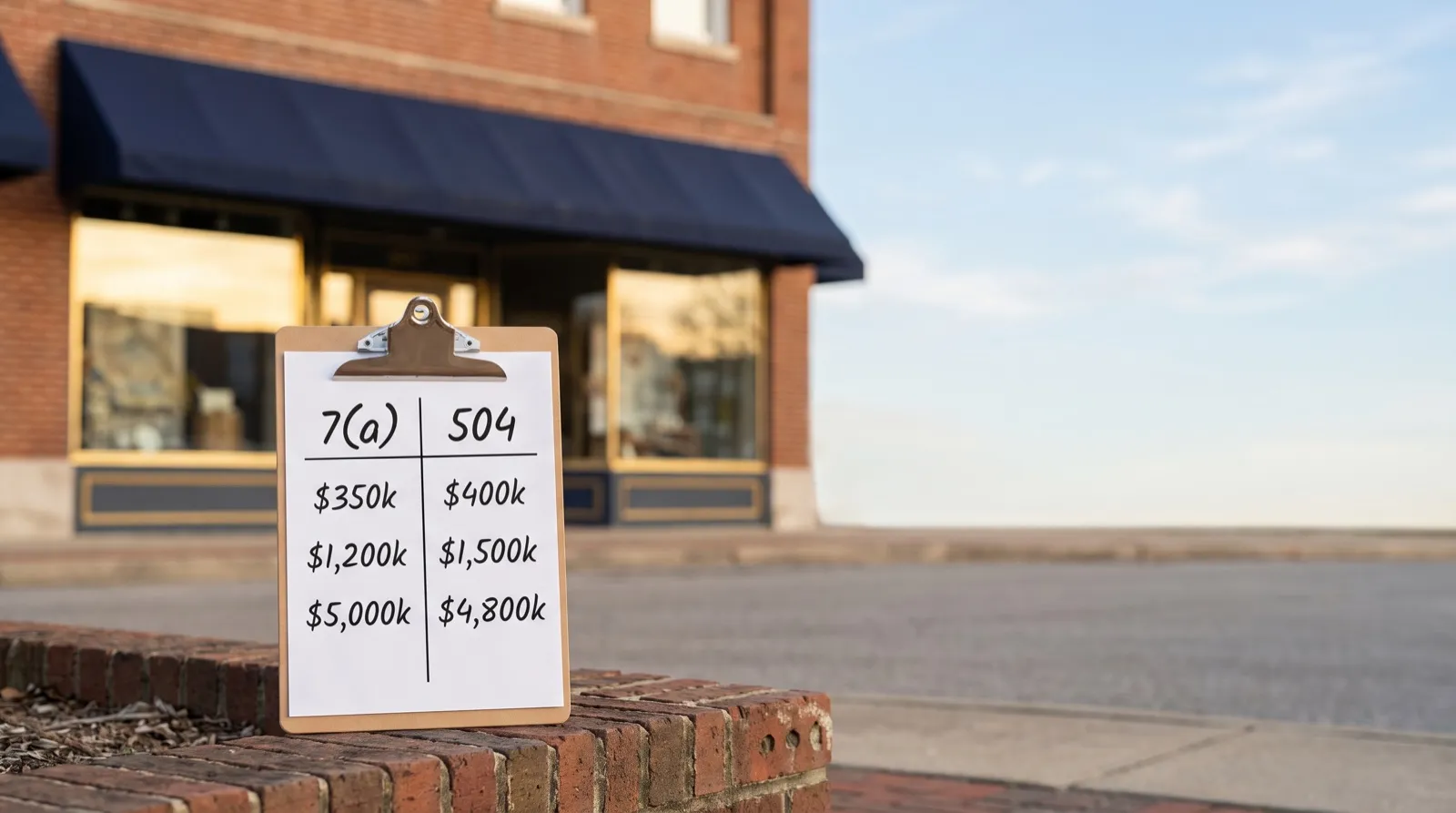


An SBA 504 loan is the most capital-efficient way for a small business to buy the building it operates from: about 50% comes from a bank, up to 40% from an SBA-guaranteed debenture, and roughly 10% from you. The program’s whole advantage is structural: a two-loan capital stack, a fixed debenture rate set on a monthly funding cycle, a prepayment penalty that touches only one lien, and terms that beat a 7(a) on owner-occupied real estate. If you’re still checking whether you qualify, the eligibility side (size tests, occupancy percentages, job creation, citizenship, and Form 413) is covered separately in SBA 504 loan requirements.
Key takeaways
- The 504 is a two-loan, three-party structure: a ~50% bank first lien, an up-to-40% CDC second lien funded by an SBA-guaranteed debenture, and ~10% borrower equity. The bank’s low loan-to-value is what lets you in at 10% down.
- The CDC debenture rate is fixed for the full term and pegged to an increment above the 10-year Treasury. The bank’s 50%, by contrast, often carries a shorter fixed period that resets, so “504 is fixed-rate” is only fully true for the SBA portion.
- Real estate typically uses the 25-year debenture, fully amortizing, no balloon on the CDC piece. The bank first lien must run at least 10 years alongside it.
- The prepayment penalty hits only the CDC/SBA second lien, declines to zero at the halfway point of the term, and is computed on the debenture rate, lower than your all-in rate. You can refinance the bank first lien without triggering it.
- Property type moves the stack. Standard owner-occupied real estate is 50-40-10; special-purpose assets shift to 50-35-15.
- Since July 4, 2026, a 7(a) balance no longer reduces your 504 debenture maximum, and the combined ceiling is $10 million, so 504 and 7(a) pair more cleanly on larger projects.
What a 504 looks like on a property purchase
An SBA 504 loan finances owner-occupied commercial real estate through a two-loan structure. A conventional first-lien mortgage from a bank covers about 50% of total project cost, and a subordinate second-lien loan for up to 40% is funded by a debenture that the SBA guarantees 100%, issued through a Certified Development Company (CDC). The borrower brings an equity injection of at least 10%. The CDC portion carries a long-term fixed rate and fully amortizes over a 10-, 20-, or 25-year term with no balloon payment.
The reason the program exists in this shape is risk-sharing. Because the CDC’s 40% sits in second position behind the bank’s 50%, the bank is only exposed to half the property’s value, so it will write terms it would never offer on a straight commercial mortgage. That is how a small business gets to 10% down on a building. For the program in its wider SBA context, what an SBA loan is covers how the guaranty works; for the head-to-head with the general-purpose program, see SBA 7(a) vs. 504.
It’s a low down payment compared to conventional commercial real estate lending or other loan types where the down payment might be 20, 25, 35%. This is 10% down. So it helps business owners to conserve cash upfront and kind of boost their post-closing cash reserves.
The capital stack: 50-40-10 on real estate
Every 504 real estate deal is built from the same three layers. The Office of the Comptroller of the Currency’s guide to the program describes the standard split, and the SBA’s 504 program page sets the debenture caps.
| Layer | Share of project | Who funds it | Lien | Rate & term |
|---|---|---|---|---|
| Bank first mortgage | ~50% | Conventional lender | 1st | Negotiated; fixed or variable; ≥10-year term |
| CDC / SBA debenture | up to 40% | CDC, via SBA-guaranteed debenture | 2nd | Long-term fixed; 10/20/25 years; no balloon |
| Borrower equity | ≥10% | You | n/a | Cash or project-related land |
Two structural details matter more than the percentages. First, the lien order is the whole engine: the bank is paid first in a liquidation, the CDC’s second lien absorbs loss behind it, and the SBA’s 100% guarantee on the debenture is what makes a lender comfortable sitting in second position at all. Second, the caps apply only to the SBA’s 40%. Per 13 CFR 120.931, the debenture tops out at $5 million for most projects and $5.5 million for small manufacturers and qualifying energy projects. Because that piece is only 40% of the stack, a $5 million debenture supports a project around $12.5 million. There is no SBA cap on the bank’s first mortgage or on total project size; the cap constrains the government’s exposure, not your building.
10%
Minimum borrower equity on a standard 504 real-estate project: a 50% bank first lien and a 40% SBA-guaranteed CDC debenture cover the rest, where a conventional commercial mortgage typically wants 20-30% down.
Source: OCC, Community Developments Insights: SBA 504 Loan Program
How the fixed debenture rate is set
The 504’s signature feature is the long-term fixed rate on the CDC portion, and it comes from the bond market rather than from a bank’s rate sheet. Per the SBA’s 504 program page, the rate is pegged to an increment above the current market rate for 10-year U.S. Treasury issues, and the all-in figure “totals approximately 3% of the debt” once fees are folded in.
CDCs pool their 504 loans into debentures and sell them to investors on a monthly funding cycle. The coupon investors demand — a spread over the comparable Treasury — sets the base. On top of that sit the fees the allowable-fee rule authorizes. Those include a CDC processing fee of up to 1.5% of net debenture proceeds, plus the SBA’s upfront guaranty fee and an ongoing annual servicing fee, most of which are financed into the loan rather than paid at closing. Stack the fees onto the coupon and you get the effective all-in rate the CDC quotes you. Once the debenture funds, that rate is locked for the entire 10-, 20-, or 25-year term.
One distinction is worth carrying with you, because it comes back in the prepayment math: your debenture rate and your effective rate are not the same number. The debenture rate is the underlying coupon; the effective rate is that coupon plus the fee load. The effective rate is what you pay monthly, but the debenture rate is what a few other calculations key off. Since the specific monthly figure reprices every funding cycle, ask your CDC for the current effective rate rather than trusting a number you found online: a rate quoted three months ago is already stale.
The bank’s 50% is a different animal. It can be fixed or variable, and its rate, term, and fees are negotiated directly with the lender. In practice, many banks write a 25-year amortization with a 5-year fixed period that then resets against an index. So when a lender tells you “504 loans are fixed-rate,” the precise version is: the SBA’s 40% is fixed for life, and the bank’s 50% may reprice on its own schedule. Model both.
Build your personal financial statement in minutes
StatementsReady syncs bank balances read-only through Plaid, fills SBA Form 413, and exports a lender-ready PDF on demand.
- SBA Form 413 with every section filled
- Bank sync through Plaid, read-only
- 7 days free, no card
Terms, amortization, and the prepayment penalty
Maturities. The CDC debenture comes in 10-, 20-, and 25-year terms. Equipment and short-life assets take the 10-year; commercial real estate takes the 20- or 25-year, and the 25-year fully-amortizing debenture is now the common choice because it spreads a large balance into a manageable monthly payment with no balloon at the end. Our SBA loan calculator estimates that 504 payment across the 20- and 25-year terms.
The bank’s minimum term. The first-lien loan can’t be structured as a short fuse that relies on the CDC piece to carry the deal. Under 13 CFR 120.921, a Third Party Loan must run at least 7 years when the 504 is a 10-year loan and at least 10 years when the 504 is 20 (or 25) years. The same regulation bars the bank from adding an early-call feature (§120.921(c)), and under §120.921(e) the bank’s lien is subordinate to the CDC/SBA lien with respect to any prepayment penalties, late fees, and other default charges owed under its own loan.
The prepayment penalty. This is where the debenture-versus-effective-rate distinction earns its keep. A 20- or 25-year debenture carries a declining prepayment penalty across its first 10 years (a 10-year debenture, across its first 5); after the halfway point, there is no penalty for the rest of the term. The penalty is the remaining balance times the debenture rate times a factor that steps down each year: 100% of one year’s debenture interest in year one, 90% in year two, and so on to zero, the schedule brokers call “10-9-8-7-6-5-4-3-2-1.” Growth Corp’s breakdown works a full example: on a 25-year loan with a 5.82% debenture rate, the year-one penalty is 5.82% of the balance, falling to about 3.49% by year five.
Which commercial properties a 504 finances
A 504 finances property your business occupies and operates from, which is the line that separates it from investment lending. For an existing building the operating business must occupy at least 51%; for new construction, 60%. Those occupancy tests are eligibility mechanics, and the full detail (including the Eligible Passive Company structure and the temporary-lease allowances) lives in the 504 requirements post. For structuring purposes, what matters is that owner-occupancy is assumed and the property type drives the down payment.
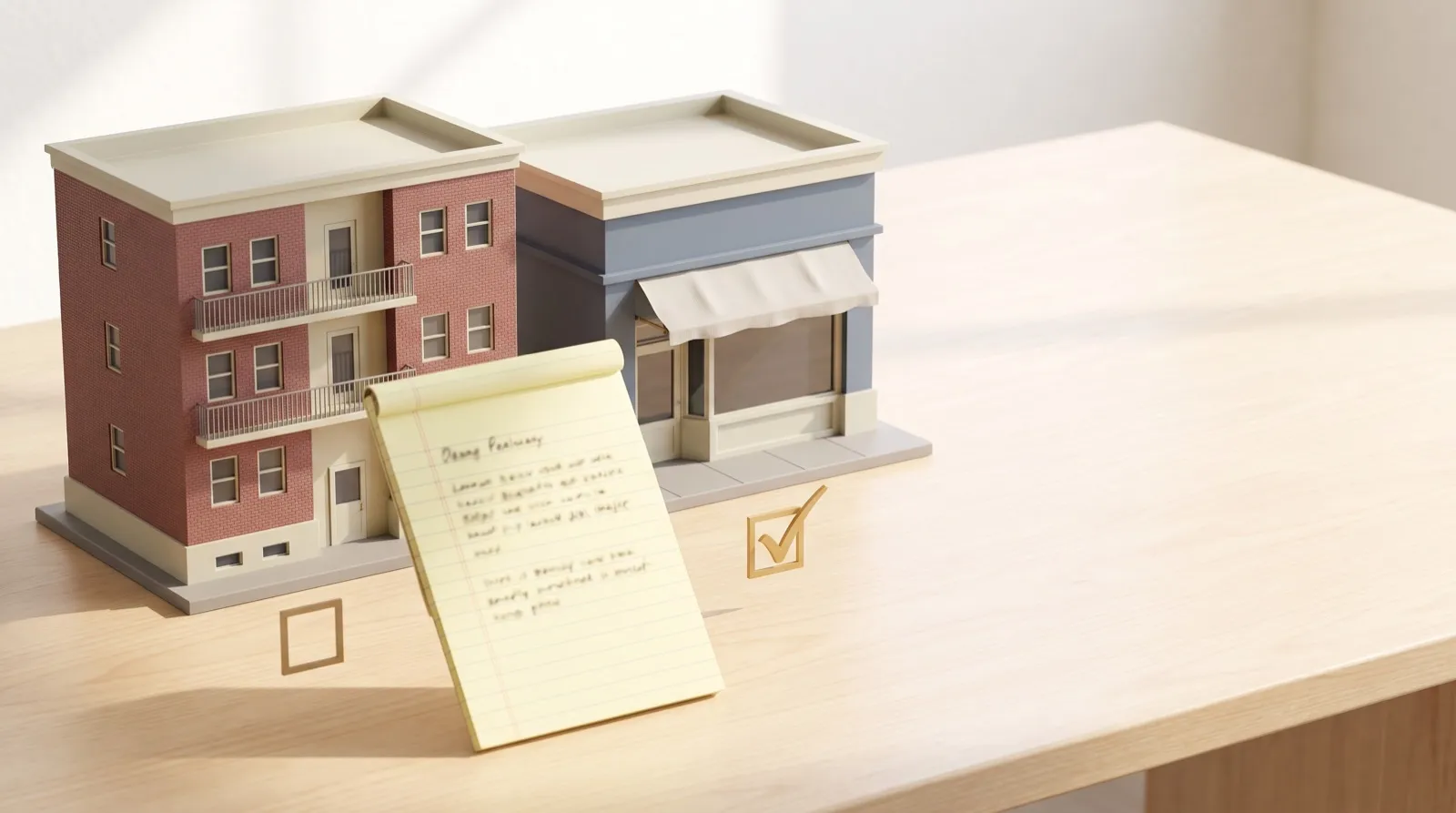
Standard properties (owner-occupied office, industrial, warehouse, flex, retail, and most medical buildings) use the ordinary 50-40-10 stack because they can be re-leased or resold if the business fails.
Special-purpose properties (hotels and motels, gas stations, car washes, bowling alleys, cold-storage facilities, funeral homes, wineries, and similar assets whose design ties them to one use) shift the stack to 50-35-15. The CDC piece drops to 35% and your equity rises to 15%, because the collateral is harder to repurpose. If the business is also a startup (two years or less), the requirement steps up again to 50-30-20. The requirements post has the full down-payment table by scenario.
What a 504 will not finance: rental or investment real estate you don’t occupy, raw land held for speculation, working capital, or inventory. If you’re buying to lease the whole building out, the 504 is the wrong instrument: a DSCR loan underwrites the property’s own cash flow and doesn’t care whether you occupy it. We cover why SBA financing doesn’t reach rental property, and you can pressure-test a rental deal in the free DSCR calculator. For the investor workflow generally, see the commercial real estate investor use case.
Why the 504 beats a 7(a) for real estate
Both programs can touch commercial real estate, but the 504 was engineered for it. Three structural differences decide most owner-occupied purchases: rate, down payment, and amortization.
| Dimension | SBA 504 | SBA 7(a) |
|---|---|---|
| Rate on the SBA portion | Long-term fixed, pegged to 10-year Treasury, locked at funding | Typically variable, prime-plus, floats for the life of the loan |
| Structure | Two loans (bank 50% + CDC 40%) + 10% equity | Single loan, one lender |
| Down payment | ~10% on standard property | Commonly 10-15% |
| Real-estate term | 20 or 25 years, fully amortizing, no balloon on CDC piece | Up to 25 years |
| Best fit | Owner-occupied real estate and long-life fixed assets | Working capital, business acquisition, mixed use, faster close |
The 504’s edge on a real-estate purchase is the fixed rate on 40% of the stack and the low equity requirement; a 7(a) that floats prime-plus exposes you to rate risk over a 25-year hold. The 7(a) still has its place: broader permitted uses, working capital, business acquisition, and it’s often the faster close.
It’s common to run a 7(a) alongside a 504: the 7(a) for working capital or equipment, the 504 for the building. And the sequencing changed recently in the borrower’s favor: per SBA Policy Notice 5000-879058, effective July 4, 2026, an outstanding 7(a) balance no longer reduces your 504 debenture maximum, and SBA doubled the combined ceiling to $10 million. The asymmetry to plan around: a 504 still counts against your 7(a) capacity, so if you need both, take the 7(a) first and both stay whole.
Underwriting is a separate question from structure. On the credit side, most CDC and bank partners want global debt-service coverage around 1.20x-1.25x and post-close liquidity in reserve; how to calculate DSCR walks through what they include, and the conventional CRE loan terms post covers the non-SBA alternative. Every 20%+ owner still files SBA Form 413 and generally signs an unlimited personal guarantee; the 504 personal guarantee walkthrough has the specifics.
Putting the structure to work
The 504’s structure is its selling point. A bank first lien, a fixed-rate SBA-guaranteed debenture in second, and a 10% check from you buy a building that would otherwise take 20-30% down and expose you to a floating rate for 25 years. Two pieces reward attention before you call a CDC, and a summary skips both. The bank’s 50% may reset even though the SBA’s 40% is fixed, and the prepayment penalty only shackles the CDC piece, decaying to nothing at the halfway mark. Get those two right and the rest of the deal is arithmetic.
When you’re ready to move, the document that underwriting reads first is your personal financial statement, and it’s the one most often sitting half-finished while the appraisal and title work wait. More on the program is in our SBA lending archive and the broader commercial real estate archive; business loan applications covers the full document set most lenders ask for.
Skip the spreadsheet
A lender-ready personal financial statement from synced balances, in about 8 minutes.
- 7 days free
- No credit card
- PDF, SBA Form 413, Word, or Excel
Build your personal financial statement in minutes
StatementsReady syncs bank balances read-only through Plaid, fills SBA Form 413, and exports a lender-ready PDF on demand.
- SBA Form 413 with every section filled
- Bank sync through Plaid, read-only
- 7 days free, no card