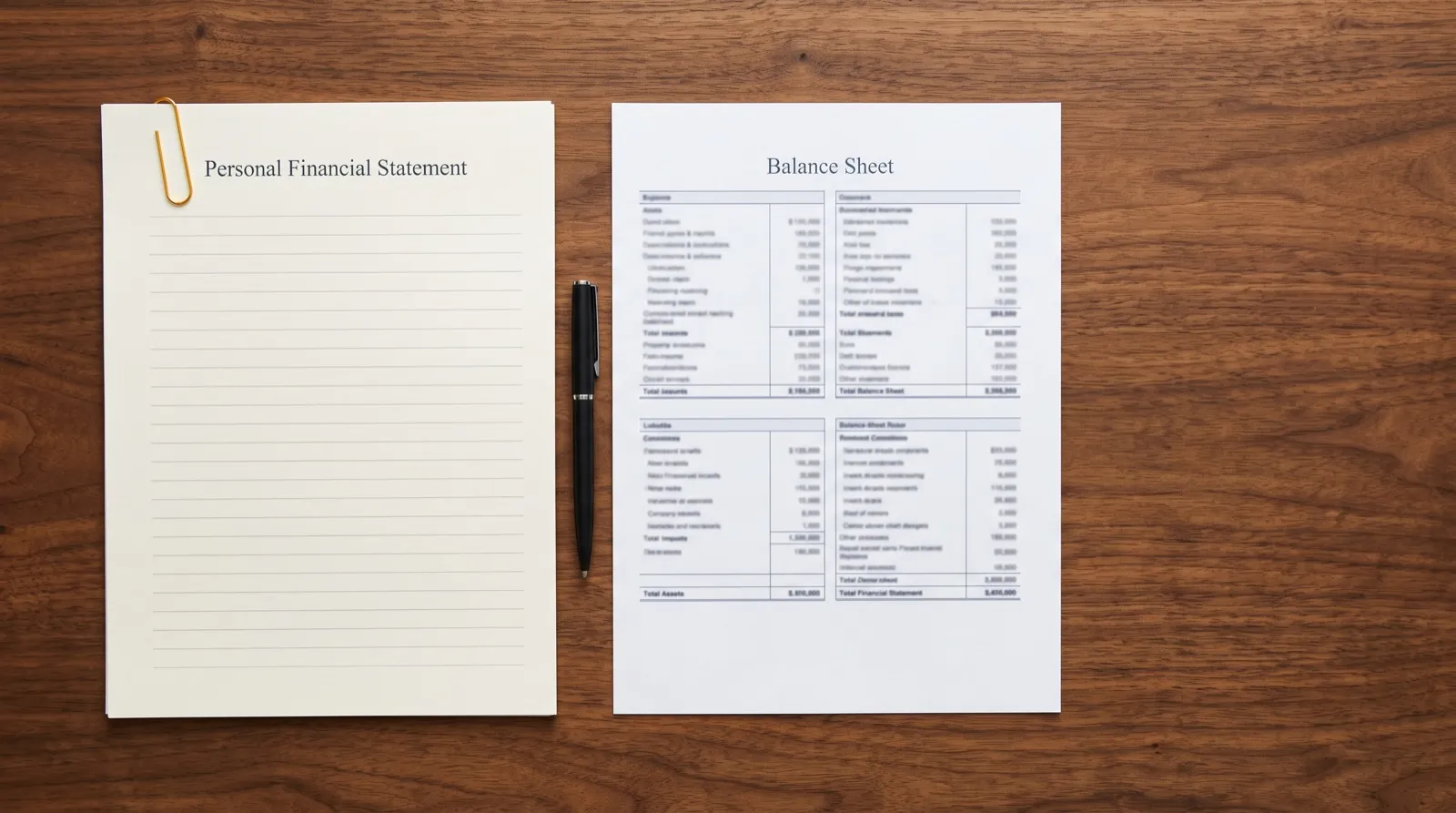


A net worth statement is a dated, one-page list of everything you own and everything you owe, with the difference at the bottom labeled as your net worth. The math never changes: total assets minus total liabilities. What changes is which version of the document a bank, a court, or the SBA will actually accept, and that is where people lose a week.
Key takeaways
- Net worth = total assets − total liabilities. One subtraction, one page, one date.
- The net worth statement is the core; the full PFS is the package. The full personal financial statement and SBA Form 413 add income and contingent liabilities around that core.
- Value assets at estimated current value. Today’s market price, not what you paid, and not the depreciated cost a business balance sheet would carry.
- Income is not net worth. Your salary is cash flow; it belongs on a different statement.
- The format depends on who is asking. A one-page statement, a full PFS, and a business balance sheet are three different instruments built on the same math.
What is a net worth statement?
is a summary of what a person or household owns and owes as of a specific date. You list assets at their current value in one column, liabilities at their current payoff in the other, and subtract liabilities from assets to arrive at net worth. Accountants call the same document a personal balance sheet or, under the AICPA standard, a statement of financial condition.
The defining feature is the date. A net worth statement is a photograph, not a video: it captures your financial position on one day, and every value on it has to reconcile to that day. Move the date and the numbers move with it, because a mortgage payoff, a brokerage balance, and a home’s market value are all different next quarter.
The second defining feature is what it leaves out. A net worth statement says nothing about your income, your spending, or your future earnings. It is a stock measure (what you have accumulated) rather than a flow measure (what moves through your accounts each month). That distinction is why lenders ask for a net worth statement and pay stubs or tax returns: the two answer different questions.
What goes on a net worth statement
Every version of the document, from a spreadsheet you keep for yourself to SBA Form 413, captures the same two inventories and one subtraction.
Assets (what you own), usually ordered from most liquid to least:
- Cash and equivalents. Checking, savings, money market, CDs, and the cash surrender value of any whole-life policy.
- Investments and retirement. Brokerage accounts at current value, plus 401(k), 403(b), and IRA balances.
- Real estate. Each property at what it would sell for today.
- Vehicles. Cars, boats, and RVs at trade-in value.
- Business interests. Your ownership stake in any company, valued as a single line.
- Personal property. Only items with real resale value: jewelry, art, collections.
Liabilities (what you owe), each at its current payoff balance:
- Mortgages on every property, at the current principal balance.
- Home equity lines and second liens.
- Auto, student, and personal loans.
- Credit card balances you carry.
- Business debt you have personally guaranteed.
- Unpaid taxes, including any IRS payment plan.
Add the first column, add the second, and subtract. Here is a worked example for a single filer with a house, a retirement account, and the usual loans:
| Assets | Amount | Liabilities | Amount |
|---|---|---|---|
| Checking + savings | $18,000 | Mortgage | $250,000 |
| 401(k) + IRA | $145,000 | Auto loan | $14,000 |
| Brokerage | $30,000 | Student loans | $28,000 |
| Home (market value) | $390,000 | Credit cards | $6,000 |
| Car (trade-in value) | $22,000 | ||
| Total assets | $605,000 | Total liabilities | $298,000 |
Net worth is $605,000 − $298,000 = $307,000. The one structural rule that catches people: list the home at its full $390,000 market value and the $250,000 mortgage as a separate liability. Do not collapse them into a single “$140,000 of equity” line. A lender wants to see the gross asset and the lien against it on their own lines so each can be verified against a statement and a credit report.
Net worth statement vs. personal financial statement vs. balance sheet
These three names get used as if they were interchangeable. They are not, and picking the wrong one is the most common way this document costs someone time. All three rest on the same assets-minus-liabilities math, but they differ in scope, in how they value what they list, and in who reads them.
| Feature | Net worth statement | Personal financial statement (PFS) | Business balance sheet |
|---|---|---|---|
| Reporting entity | An individual or household | An individual or household | A company (LLC, corporation, partnership) |
| Core output | Net worth | Net worth, plus income and contingencies | Owners’ / shareholders’ equity |
| Scope | Assets, liabilities, net worth | The above plus an income schedule, contingent liabilities, and detail schedules | Assets, liabilities, equity, with notes |
| Valuation basis | Estimated current value (today’s market) | Estimated current value (ASC 274) | Mostly historical cost, less depreciation |
| Your business appears as | One line: your ownership stake | Your stake, with a supporting schedule | The entity’s own assets and debts, line by line |
| Typical reader | You, a mortgage or personal lender, a court | An SBA or business lender, a court, a planner | Investors, creditors, the company’s own lender |
The practical translation: your business has a balance sheet, and you have a net worth statement, and on your statement the whole company collapses into one asset. The full personal financial statement sits between them, wrapping your net worth core in the income and contingent-liability detail a business lender wants. When you apply for an SBA loan, the lender reads your personal statement and the business’s balance sheet side by side, because they answer two different questions about two different entities.
As a commercial real estate agent, the version of this I see most often is a borrower who brings the wrong instrument to the wrong desk. Someone shows up to an SBA lender with a tidy personal net worth spreadsheet, or worse, their LLC’s balance sheet, when the file needs a signed Form 413 from every 20%+ owner. The numbers might be right; the format is not the one the program accepts, and the request comes back. The reverse also happens: an investor lists a duplex at its 2015 purchase price, the way a balance sheet carries it, and understates their own net worth by six figures to a lender who was trying to see reserves. The math is identical across all three documents. The instrument you hand over is what has to match the ask.
Build your personal financial statement in minutes
StatementsReady syncs bank balances read-only through Plaid, fills SBA Form 413, and exports a lender-ready PDF on demand.
- SBA Form 413 with every section filled
- Bank sync through Plaid, read-only
- 7 days free, no card
Who gets asked for a net worth statement
The document evaluates you as an individual, separate from any business you own. The people routinely asked for one:
- Small-business owners and guarantors. For SBA 7(a) and 504 loans, every owner of 20% or more files SBA Form 413, and the form has to be dated within 90 days of submission for loans submitted from October 1, 2026 (SBA SOP 50 10 8.1). The section-by-section mechanics are in our SBA Form 413 guide.
- Mortgage and jumbo borrowers. Large or complex loans, especially for self-employed applicants or investors with several properties, often come with a net worth or reserves disclosure on top of tax returns and pay stubs.
- Anyone in a divorce. Family courts require a full financial disclosure from both spouses. In New York, a sworn Statement of Net Worth is mandated by Domestic Relations Law §236(B)(4), and the court form defines net worth in its own words as “assets of whatsoever kind and nature and wherever situated minus liabilities” (NY Unified Court System). Our divorce financial disclosure use case covers the workflow.
- People building an estate plan. A current personal balance sheet is the starting point for wills, trusts, and beneficiary decisions. See the estate planning financial statement use case.
- Anyone tracking their own finances. Kept as a yearly series, a net worth statement is the single clearest measure of whether you are moving forward. Real estate investors tracking equity across a portfolio use the same document; the real estate net worth tracker use case maps to it directly.
How to value what’s on it
The valuation rule is where a net worth statement quietly diverges from a business balance sheet, and getting it wrong is what over- or understates the number. Personal financial statements use estimated current value, not the historical cost that a company carries its assets at.
The amount at which the item could be exchanged between a buyer and a seller, each of whom is well informed and willing, and neither of whom is compelled to buy or sell.
In practice, that means:
- Real estate at recent comparable sales or an appraisal, not the purchase price.
- Marketable securities at their value on the statement date.
- Vehicles at trade-in value, which is what you would actually get for them today.
- A closely held business at a supportable estimate: capitalized earnings, an appraisal, or a discounted-cash-flow figure. That is why lenders ask for the company’s own financials to back it up.
The mirror-image rule applies to debts: list each liability at the current amount needed to settle it, not the original loan balance. Your mortgage goes on at the payoff figure from your latest statement, not the amount you borrowed five years ago. Value both sides at what is true today and the net worth line reflects reality instead of history.
How your net worth compares
The number at the bottom means more once you see where it sits. The Federal Reserve’s Survey of Consumer Finances is the standard benchmark; it runs every three years, and the 2022 release is the most recent.
$192,900
Real median U.S. family net worth in 2022, up 37% from 2019, the largest three-year jump in the modern Survey of Consumer Finances.
Source: Federal Reserve, Changes in U.S. Family Finances from 2019 to 2022
Median is the more useful yardstick than the average. The 2022 mean was $1,063,700, roughly five times the median, because a small number of very wealthy households pull the average up (Federal Reserve). A net worth well above the typical family can still sit below the national mean. If you would rather not run the arithmetic by hand, the free net worth calculator returns the same total and a clean breakdown, with no signup.
How to prepare one that holds up
Start from the source documents, because every figure on a net worth statement should trace back to one: a bank statement, a brokerage statement, a mortgage payoff, a current value for each property. A lender who pulls your credit report will notice when the two disagree, so the statement is only as strong as the evidence behind it.
Keep the format matched to the request. For personal tracking, financial aid, or a basic line of credit, the one-page net worth statement template is usually what a lender means, and our 20-minute build guide walks it step by step. When you move into SBA or larger business financing, you need the fuller form; the personal financial statement template adds the income and contingent-liability schedules.
Then keep it current. A net worth statement is most useful as a series you can compare over time, and lenders enforce freshness rules on top of that: SBA Form 413 on a 7(a) or 504 loan has to be dated within 90 days of submission. Our post on how often to update a personal financial statement covers the trigger events and lender windows in more depth, and the personal net worth statement guide is the longer reference for building and reading one. More on tracking and documenting your finances is in the personal finance archive.
Related reading
- What is a personal financial statement? covers the full document that wraps your net worth core.
- Personal financial statement vs. balance sheet takes the accounting side of the distinction.
- Net worth statement template: build yours in 20 minutes is the step-by-step how-to.
- How often should you update a personal financial statement? covers freshness windows and trigger events.
If you would rather generate a clean, dated statement than assemble one in a spreadsheet, that is what StatementsReady does. It syncs read-only bank balances through Plaid, which holds your login so StatementsReady never stores your credentials, keeps the values current, and exports a PDF with the right “as of” date.
Skip the spreadsheet
A lender-ready personal financial statement from synced balances, in about 8 minutes.
- 7 days free
- No credit card
- PDF, SBA Form 413, Word, or Excel
Build your personal financial statement in minutes
StatementsReady syncs bank balances read-only through Plaid, fills SBA Form 413, and exports a lender-ready PDF on demand.
- SBA Form 413 with every section filled
- Bank sync through Plaid, read-only
- 7 days free, no card