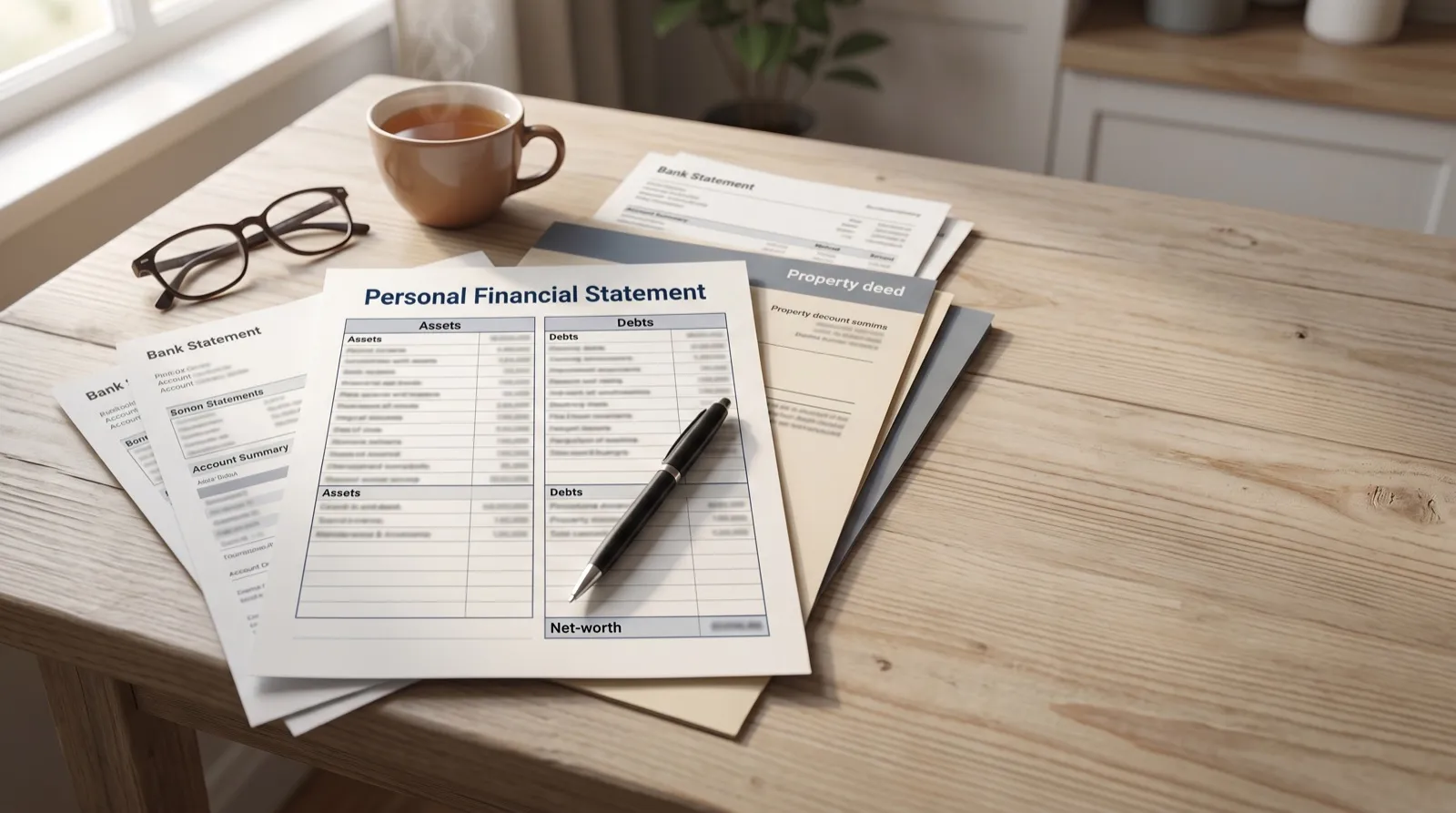


FL-142, the Schedule of Assets and Debts, is the California family law form you use to list everything you own and owe in a divorce or legal separation. It has 27 numbered items: 18 for assets, 8 for debts, and one line counting continuation pages. You sign it under penalty of perjury and serve it on your spouse with your preliminary declaration of disclosure, usually within 60 days after filing. You don’t file it with the court.
This walkthrough follows the current FL-142 PDF, revised July 1, 2025, and the disclosure rules in Family Code sections 2100 to 2113. It’s general information about the form, written from a lender-paperwork point of view, and a California family lawyer should answer questions about your own case.
What FL-142 is, and what the 2025 revision changed
A four-page Judicial Council of California form, approved for optional use. Each spouse or domestic partner lists every known community and separate asset and debt on it, with each asset’s value and the amount owed against it. It is served on the other party as an attachment to the Declaration of Disclosure (FL-140) and is marked “This form should not be filed with the court.”
“Optional use” means you can serve a Property Declaration (FL-160) instead. FL-142 is shorter and doesn’t ask how you want the property divided.
The July 1, 2025 revision changed only the footer. The Judicial Council approved it on April 25, 2025 as a technical change to the footer. The old Code of Civil Procedure citations became sections 2030.010 to 2030.310, which cover interrogatories, and Family Code sections 2100 to 2113, which cover disclosure, were added.
The 27 line items read the same as the January 1, 2005 version. If your county’s packet still prints “Rev. January 1, 2005,” the questions are identical. Side by side, the two PDFs also differ in one column label: the debts table’s last column reads “Date Acquired” on the 2025 form and “Date Incurred” on the 2005 form.
Where FL-142 fits in the declaration of disclosure
FL-142 is one piece of a packet. Under Family Code section 2104, your preliminary declaration of disclosure includes:
- Declaration of Disclosure (FL-140), the signed cover sheet listing what you’re serving.
- FL-142 or FL-160, with copies of the statements and documents each line calls for.
- Income and Expense Declaration (FL-150), with proof of income for the past two months. FL-150 covers what you earn and spend; FL-142 covers what you own and owe.
- All tax returns you filed in the two years before you serve the disclosure. Count returns by the date you filed them, so a late return for an older year still counts.
- A written disclosure of any income-producing opportunity offered since separation that grows out of an investment or business activity from the marriage, if one exists (section 2102).
| Step | Deadline | Filed with the court? |
|---|---|---|
| Petitioner’s preliminary disclosure | With the petition, or within 60 days after filing it | No. File only the proof of service on FL-141 |
| Respondent’s preliminary disclosure | With the response, or within 60 days after filing it | No. File FL-141 |
| Joint petition (available since January 1, 2026) | Both spouses within 60 days after filing the joint petition | No. Each files FL-141 |
| Final declaration of disclosure | At or before a property or support agreement, or at least 45 days before the first trial date | No. File FL-141, or waive it together on FL-144 |
The parties can extend the 60-day deadlines in writing, and the court can extend them by order. The final declaration can be waived only by a mutual stipulation under section 2105(d). The court’s self-help guide uses the Stipulation and Waiver of Final Declaration of Disclosure (FL-144) for that, signed by both spouses under penalty of perjury. In a default, the petitioner can skip the final declaration but still serves a preliminary one unless the case was served by publication or posting.
One change is coming. AB 2782, signed September 27, 2026, amends section 2110 so spouses who already have an enforceable legal separation judgment dividing their property don’t exchange disclosures again in a later dissolution. As a regular 2026 statute, it takes effect January 1, 2027.
FL-142 or FL-160?
| FL-142 Schedule of Assets and Debts | FL-160 Property Declaration | |
|---|---|---|
| Revision | July 1, 2025 | July 1, 2016 |
| Use | Disclosure only | Disclosure, or filed with a petition, response, default, or judgment |
| Columns | Separate property flag, date acquired, gross value, amount owed | Date acquired, gross value, debt, net value, proposed division |
| One form or two | One form for everything | Separate forms for community and separate property |
| Filed with the court | Never | Sometimes, without the private attachments |
Pick FL-142 if you only need to disclose. Pick FL-160 if your court packet or your lawyer wants your proposed division on paper, or if you’ll attach it to a default or judgment later. Both use the same 26 categories in the same order, so the work transfers.
Before you start
- Statements for every account you or your spouse hold, as close to your signing date as you can get: checking, savings, credit union, brokerage, 401(k), IRA, pension, HSA, crypto exchange.
- Your latest mortgage statement and the grant deed for each property. FL-142 asks for “copies of deeds with legal descriptions and latest lender’s statement.”
- Vehicle titles and the latest loan statement for anything financed.
- Life insurance declaration pages, showing cash surrender or loan value if the policy has any.
- Your two most recent tax returns, plus the latest K-1 and Schedule C for any business interest.
- Credit card, student loan, and personal loan statements, and any court order for support you’re behind on.
Plan on two to three hours if your finances are a house, two cars, a few accounts, and a 401(k). Plan on a weekend if you own a business, rental property, or accounts that were partly yours before the marriage, because those need dates and tracing notes.
The four columns on every asset line
Every asset item on pages 1 to 3 has the same columns. Get these right once and the rest of the form is data entry.
- Sep. Prop. Leave it blank if you treat the asset as community property. Write P if you contend it is the petitioner’s separate property, or R for the respondent’s. Under Family Code section 760, property acquired during the marriage while living in California is community property unless a statute says otherwise. Section 770 makes property you owned before the marriage, or received by gift or inheritance, separate. Marking P or R states your position, and the court decides if your spouse disagrees.
- Date acquired. A month and year is enough. This date is what lets the other side and the court check your separate-property claims, so don’t leave it blank on anything you’ve marked P or R.
- Current gross fair market value. What the asset would sell for today, before subtracting any loan.
- Amount of money owed or encumbrance. The payoff balance of any loan secured by that asset.
The two value columns are where lender paperwork habits help. Report the house at its full value and the mortgage in the next column. Don’t write the equity. The form totals both columns separately on item 18, and a netted figure throws off both totals.
All values are as of the date you sign, unless you note a different valuation date in the description. If you pull statements on different days, write the statement date next to each account so the numbers can be checked.
Assets: items 1 through 18
Most asset items say in parentheses what to attach. Attach it. A copy of the statement turns a number into something the other side can verify without sending you discovery.
Item 1: Real estate
Give the street address, attach the deed with its legal description, and attach the latest lender’s statement. Put the market value in the gross value column and the total of every loan against it (first mortgage, second, HELOC) in the encumbrance column. If you own a rental or a share of property with someone else, list it here too. Section 2104 requires your percentage of ownership when property isn’t owned solely by you and your spouse, so write “50% with brother” in the description.
If you have more than one property, a lender-style schedule of real estate owned attached as a continuation sheet keeps the address, value, and every loan on one page.
Items 2 to 4: Household goods, valuables, and vehicles
Item 2 covers furniture, furnishings, and appliances. Value them at what they’d bring used, not what you paid. A household of furniture bought new for $30,000 often sells for a fraction of that, and padding this line invites an argument over sofas.
Item 3 covers jewelry, antiques, art, and collections. List anything worth a few thousand dollars on its own line. Engagement rings and gifts between spouses carry their own characterization questions, so note the date and how you got it.
Item 4 covers vehicles, boats, and trailers. Attach the title. Use a published used-car value for the gross value and the loan payoff for the encumbrance.
Items 5 to 8: Bank accounts and cash
Savings (item 5), checking (item 6), and credit union and other deposit accounts (item 7) each get the account name, number, bank, and branch, plus a copy of the latest statement. Cash (item 8) asks only for the amount and where it is kept. The form asks for the account number. For privacy, many people list only the last four digits on the schedule and serve the full statement as the attachment, which still identifies the account.
List accounts in your spouse’s name that you know about. The instructions say to include assets “even if they are in the possession of another person, including your spouse.”
Items 9 and 10: Tax refund and life insurance
Item 9 is easy to forget: a refund you’ve filed for but not received, or one you expect for the current year, is an asset.
Item 10 is life insurance with cash surrender or loan value. Term life has none and doesn’t belong here. Whole life and universal life usually do. Attach the declaration page for each policy and use the cash surrender value, not the death benefit.
Items 11 to 13: Investments and retirement
Item 11 covers stocks, bonds, secured notes, and mutual funds. Taxable brokerage accounts go here.
Item 12 covers retirement and pensions. Attach the latest summary plan description and benefit statement. A defined-benefit pension often has no single balance; write the monthly benefit from the statement and note that a valuation is pending.
Item 13 covers profit-sharing, annuities, IRAs, and deferred compensation.
Report retirement accounts at the full statement balance, before tax. If part of a 401(k) or IRA was earned before the marriage, you have two options. List it once at the full balance and explain the split in the description, or put the premarital part on its own line marked P or R. A loan against a 401(k) goes in the encumbrance column.
Items 14 and 15: Receivables and business interests
Item 14 covers money owed to you: a loan to a relative, a promissory note from someone who bought a car from you, an unpaid invoice. Attach a copy of each note.
Item 15 covers partnerships and other business interests. Attach the most recent K-1 and Schedule C.
Give your ownership percentage and your best estimate of what your share is worth. If you don’t know, say a valuation is pending and give book value from the last tax return. A business interest is the line most likely to need an outside appraisal before the final declaration.
Items 16 to 18: Other assets and totals
Item 16 catches everything else: HSAs, crypto, frequent-flyer balances with cash value, a deposit you’re owed back, a claim in a lawsuit. Item 17 carries the asset totals from any continuation pages. Item 18 is total assets, in two figures: total gross value and total amount owed.
A worked example for a couple married in 2014, with one spouse (the respondent) holding an IRA from before the marriage:
| Item | Description | Sep. Prop. | Acquired | Gross value | Owed |
|---|---|---|---|---|---|
| 1 | Home, 418 Elm St., Sacramento | 06/2016 | $850,000 | $412,000 | |
| 4 | 2021 Toyota RAV4 | 03/2021 | $22,000 | $9,500 | |
| 5 | Savings, credit union, x4471 | 2015 | $18,000 | ||
| 6 | Joint checking, x0918 | 2014 | $6,200 | ||
| 12 | 401(k), petitioner’s employer | 2014 | $146,000 | ||
| 13 | IRA opened before marriage | R | 2011 | $38,000 | |
| 18 | Total assets | $1,080,200 | $421,500 |
Build your personal financial statement in minutes
StatementsReady syncs bank balances read-only through Plaid, fills SBA Form 413, and exports a lender-ready PDF on demand.
- SBA Form 413 with every section filled
- Bank sync through Plaid, read-only
- 7 days free, no card
Debts: items 19 through 26
The debts table on page 4 has four columns: separate property flag, the person or company owed, total owing, and the date acquired. It covers debt that isn’t secured by an asset already listed on pages 1 to 3.
That point catches people. The debts section has no mortgage line and no car loan line. The form puts those balances in the encumbrance column next to the house and the car. If you’ve entered the $412,000 mortgage there, don’t repeat it under item 24, or the totals count it twice.
- Item 19, student loans. Servicer, balance, and when you took them out. Loans from before the marriage get a P or R.
- Item 20, taxes. Unpaid income tax, an IRS installment agreement balance, or property tax in arrears.
- Item 21, support arrearages. Past-due child or spousal support from an earlier case. Attach the order and a statement of the arrears.
- Item 22, unsecured loans. Personal loans and lines of credit. Give the bank name and loan number and attach the latest statement.
- Item 23, credit cards. Creditor’s name and address, account number, and the latest statement for each card, including cards in your spouse’s name that you know about.
- Item 24, other debts. Medical bills, money owed to family, a buy-now-pay-later balance, a judgment against you.
- Item 25 carries debts from continuation pages, and item 26 is total debts.
FL-142 has no line for contingent liabilities, such as a personal guarantee you signed on your business’s bank loan or an office lease. Section 2104 reaches “all liabilities for which the declarant is or may be liable,” so a guarantee belongs on the disclosure.
A workable way to show it is a line under item 24 with a description like “personal guarantee of ABC LLC line of credit, $250,000 limit, contingent.” Ask your lawyer how they want it shown, but don’t leave it off. Our walkthrough of what a personal guarantee commits you to explains why a lender treats it as your debt.
Continuing the example: credit cards of $4,300 (item 23) and a $12,000 student loan from before the marriage marked R (item 19) make total debts $16,300. FL-142 never asks for net worth, but you can work it out: $1,080,200 in assets, minus $421,500 owed against them, minus $16,300 in other debts, is $642,400.
Continuation sheets and signing
Item 27 asks how many continuation pages are attached. Use plain numbered sheets, and label each entry to show which item it continues (“Item 5, continued”).
Sign and date page 4 under the printed declaration: “I declare under penalty of perjury under the laws of the State of California that the foregoing is true and correct.” No notary is needed. Type or print your name, sign, and date it. That signing date is the valuation date for every number on the form unless you noted otherwise.
After you serve FL-142
Someone over 18 who isn’t you serves the packet on your spouse or their lawyer, by mail or in person. Then you complete and file the Declaration Regarding Service of Declaration of Disclosure (FL-141), which tells the court the disclosure was served. You don’t file FL-142, FL-140, FL-150, or the statements. Keep a complete copy of exactly what you served, with the date.
In an uncontested divorce, the two FL-142s become the working list for a marital settlement agreement.
In a contested case, the other side’s lawyer compares your schedule against your tax returns and looks for interest or dividends from accounts that aren’t listed. They may use form interrogatories (FL-145) to ask about anything that doesn’t reconcile. The Judicial Council’s 2025 report notes that FL-142 can also be used to respond to those interrogatories.
Before the case ends you serve a final declaration of disclosure, or both sides waive it on FL-144. If values have moved, such as a house that’s been appraised or a 401(k) that’s grown, the final declaration is where the updated numbers go.
FL-142 vs. a lender’s personal financial statement
If you’ve applied for a mortgage, an SBA loan, or a business line of credit in the last year, most of FL-142 is already done. A personal financial statement covers the same balance sheet in a different order.
| FL-142 item | Where it sits on SBA Form 413 or a bank PFS |
|---|---|
| 1. Real estate | Real estate, with each property detailed in the real estate schedule; mortgages on the liabilities side |
| 4. Vehicles | Automobiles; auto loans as installment accounts |
| 5 to 8. Bank accounts and cash | Cash on hand and in banks; savings accounts |
| 10. Life insurance | Life insurance, cash surrender value only |
| 11. Stocks and bonds | Stocks and bonds |
| 12 and 13. Retirement | IRA or other retirement account |
| 14. Receivables | Accounts and notes receivable |
| 15. Business interests | Usually listed separately; your share is valued in the business’s own statements |
| 19 to 24. Debts | Notes payable, installment accounts, unpaid taxes, other liabilities |
Three differences matter. FL-142 has a date-acquired column and a separate-property column on every asset and debt item, which no lender asks for. FL-142 has no income section, because FL-150 carries income and expenses. And a lender PFS has a contingent liabilities block for guarantees and co-signed loans that FL-142 lacks, which is the gap the item 24 note above fills.
Timing differs too. Lenders generally want a PFS dated recently, and SBA requires Form 413 on a 7(a) or 504 loan to be signed within 90 days of submission. FL-142 values everything as of the day you sign it.
Pull fresh statements rather than copying numbers from a loan application that’s six months old. The divorce financial disclosure guide covers the reconciliation between the two in more detail.
What to do next
- Download the current FL-142 and FL-140 from the court’s self-help guide, and check your county’s packet for local cover sheets.
- Pull a statement for every account, loan, and policy dated within a few days of when you’ll sign.
- Build the asset list first, with gross values and amounts owed in separate columns, then the debts that aren’t already secured against an asset.
- Mark P or R only where you have a date and a reason, and note both in the description.
- Serve the packet, file FL-141, and calendar the final declaration.
Other states give the form a different name. See the Florida financial affidavit, the Illinois financial affidavit, or the New York Statement of Net Worth. Our comparison of financial affidavits and personal financial statements explains where court forms and lender forms overlap, and the divorce financial disclosure use case shows how one organized statement feeds both. More guides are under personal finance.
Skip the spreadsheet
A lender-ready personal financial statement from synced balances, in about 8 minutes.
- 7 days free
- No credit card
- PDF, SBA Form 413, Word, or Excel
Build your personal financial statement in minutes
StatementsReady syncs bank balances read-only through Plaid, fills SBA Form 413, and exports a lender-ready PDF on demand.
- SBA Form 413 with every section filled
- Bank sync through Plaid, read-only
- 7 days free, no card