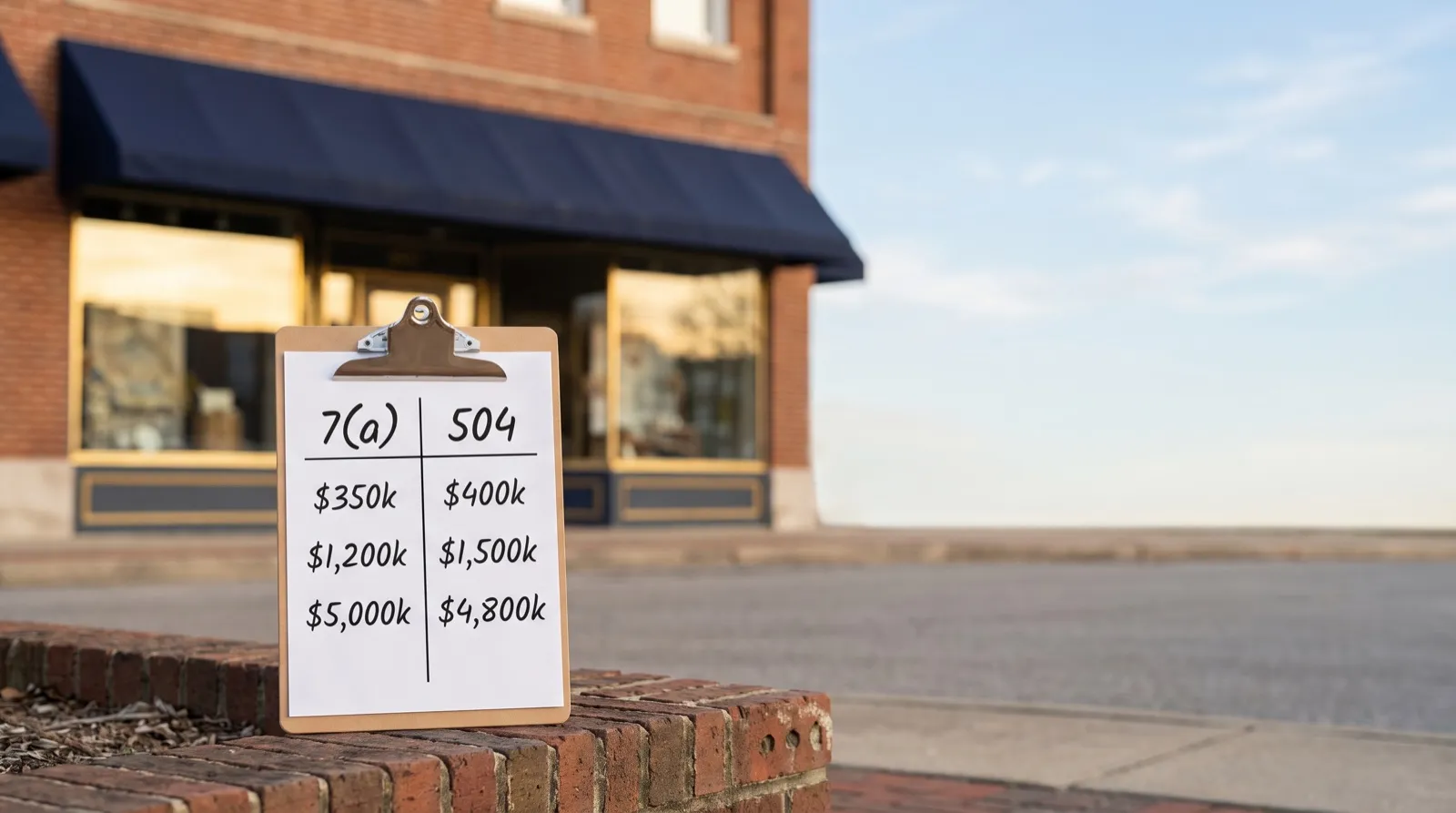

You cannot use an SBA 7(a) or 504 loan to buy a rental property you intend to lease out for income. The owner-occupancy rule requires your own operating business to occupy the majority of the building, and SOP 50 10 8.1 flatly excludes businesses “primarily engaged in owning or purchasing real estate and leasing it for any purpose.” A pure rental gets financed with a DSCR loan or a conventional investment-property loan instead.
Key takeaways
- SBA loans finance owner-occupied business premises. The property has to be space your operating business uses, financed as a business purchase rather than an income investment.
- The bright line is 51% / 60%. Occupy 51% of an existing building (or 60% of new construction) and you clear the occupancy test; fall below it and the deal is dead.
- Apartment buildings, mobile home parks, shopping centers, salon suites, and ghost kitchens are generally ineligible: they’re landlord business models the SBA classifies as passive.
- Mixed-use works if your business occupies the majority; you can lease up to 49% of an existing building to tenants, but SBA proceeds can’t improve the leased part.
- Pure rentals go to DSCR or conventional loans. Run the numbers in the free DSCR calculator before you talk to a lender.
Why SBA loans exclude rental property
The SBA guarantees loans to operating small businesses so they can buy the premises they work from. A landlord collecting rent from unrelated tenants isn’t running that kind of business in the eyes of the program, and the rules say so in two places at once.
The owner-occupancy requirement is the SBA rule that your business must physically occupy and use a minimum share of any real estate financed with 7(a) or 504 loan proceeds: 51% of an existing building or 60% of new construction. It’s what separates an eligible owner-occupied purchase (a business buying its own building) from an ineligible investment purchase (a landlord buying a building to rent out).
First, the eligibility rule. Federal regulation 13 CFR § 120.110(c) makes ineligible any “passive businesses owned by developers and landlords that do not actively use or occupy the assets acquired or improved with the loan proceeds,” with a narrow exception for Eligible Passive Companies. SOP 50 10 8.1 — the Standard Operating Procedure that governs how lenders originate SBA loans, effective October 1, 2026 — spells it out even more directly. “Businesses that are primarily engaged in owning or purchasing real estate and leasing it for any purpose are not eligible.”
Second, the occupancy rule. Even for an eligible operating business, SOP 50 10 8.1 caps how much of a financed building can be leased out. That’s the 51% / 60% test below.
First and foremost, developers and landlords who do not actively use or occupy the real property to be purchased, improved or refinanced with loan proceeds, or meet the definition of an Eligible Passive Company, as discussed in 13 CFR §120.111, are not eligible borrowers.
I’ve had investor clients arrive convinced that a “commercial real estate loan” and an “SBA loan” are the same product. The SBA guaranty backs operating businesses buying their own premises: the manufacturer buying its plant, the dentist buying the building for the practice. Someone assembling a rental portfolio needs a different lender. Sort out which one you are before you spend a week gathering documents for a program you can’t use.
The owner-occupancy rule: 51% and 60%
When SBA loan proceeds are used to purchase, improve, or refinance real estate, SOP 50 10 8.1 sets a hard occupancy floor. It’s the same for 7(a) and 504.
| Property | Your business must occupy | You may lease to third parties |
|---|---|---|
| Existing building | at least 51% of rentable space | up to 49% |
| New construction | at least 60% initially | up to 20% permanent + 20% temporary* |
“Rentable Property” is the total square footage of all buildings used for business operations, excluding stairways, elevators, and mechanical areas, and including common areas. It can also include exterior space actively used in your business, such as an outdoor storage yard for a contractor or boat slips for a marina.
51%
Minimum share of an existing building your operating business must occupy to finance it with an SBA 7(a) or 504 loan. Fall below it, for example by renting most of the building to tenants, and the property is an ineligible investment purchase.
The practical translation for an investor is simple. Buy a building and lease most of it to unrelated tenants, and your business occupies less than 51%, and the deal fails. Buy a building with no operating business in it at all, just rental income, and you’re a passive landlord that 13 CFR § 120.110(c) excludes on its face.
What the SBA will finance
Inside the occupancy rule, SBA 7(a) and 504 loans are strong tools for owner-occupied commercial real estate. Typical qualifying deals:
- A manufacturer buying or building the plant it produces in.
- A medical or dental practice acquiring the office building it operates from.
- A restaurant buying the building it serves customers in.
- A law or accounting firm purchasing office space for its own staff.
In each case the operating business occupies the majority of the building, and the loan is repaid from that business’s cash flow. The 7(a) program backs lender-made loans of up to $5 million for real estate plus other business needs; the 504 program is built specifically for long-term, fixed-rate financing of owner-occupied real estate and heavy equipment. If you’re weighing the two, our SBA 7(a) vs. 504 comparison walks the decision.
$7.8 billion
Total SBA 504 lending in fiscal year 2025, across 6,750 loans, financing owner-occupied commercial real estate and equipment for operating businesses, never passive rental property.
Source: U.S. Small Business Administration, FY2025 lending results
Mixed-use: renting out part of your building
The rule leaves genuine room for a landlord component. Occupy 51% of an existing building and you can lease the other 49% to unrelated tenants, and the property still clears the occupancy test. A design firm buying a two-story building, occupying the upper floor and one ground-floor suite (60% of the space) while leasing the remaining storefronts, meets the occupancy requirement. The rest of the SBA’s eligibility and underwriting rules still apply.
There’s also a carve-out for residential space that’s genuinely part of the business: a manager’s apartment in a small hotel, for instance. The square footage has to fit the needs of the business and may not exceed 49% of the total property.
What doesn’t qualify
SOP 50 10 8.1 and its interpreters name the ineligible models directly. If your plan is any of these, an SBA loan is off the table regardless of how the property cash-flows:
- Apartment buildings and mobile home parks: named as ineligible in SOP 50 10 8.1.
- A commercial building leased entirely to unrelated retail or office tenants: a landlord purchase with no owner-occupant.
- Shopping centers and office/salon suites: income comes from renting space to independent businesses.
- Ghost kitchens: same landlord model, renting stations to independent food operators.
- Land leased for cell towers, solar panels, billboards, or wind turbines: the passive landowner is ineligible (the company operating the tower or panel can be eligible).
- Buying and holding real estate purely for appreciation: SOP 50 10 8.1 treats purchasing and holding an item until its market price rises as a speculative purpose, which is ineligible.
A narrow exception exists for shared-space models, but the bar is high: revenue has to come from membership dues rather than rent, customers can’t have an assigned space they return to, and you have to be responsible for upkeep and supply the equipment. Miss any of those and you’re an ineligible landlord.
The one exception: the EPC/OC structure
The most common source of confusion is the Eligible Passive Company. It sounds like a way for a passive real-estate entity to borrow from the SBA, and it is, but only in service of an operating business you control.
Under 13 CFR § 120.111, an EPC can own the real estate and lease it out, provided it leases 100% of the rentable property to one or more eligible operating companies. Those operating companies must themselves meet the same 51% / 60% occupancy test that SOP 50 10 8.1 sets for a direct purchase. The lease has to be in writing, subordinated to the SBA’s lien, and run at least as long as the loan. Every 20%-or-more owner guarantees the debt.
Investors set up an EPC/OC structure to hold the building in one entity and run the business in another, for liability and tax reasons. It does not open SBA financing to a building you’ll rent to third parties. If the EPC leases to tenants who aren’t your operating company, you’re back to being an ineligible landlord.
Build your personal financial statement in minutes
StatementsReady syncs bank balances read-only through Plaid, fills SBA Form 413, and exports a lender-ready PDF on demand.
- SBA Form 413 with every section filled
- Bank sync through Plaid, read-only
- 7 days free, no card
Borderline cases
A few situations sit close to the line. Where each one lands:
- “I’ll live in one unit of a 4-plex and rent the other three.” Not eligible. Residential rental units are passive investment real estate; owner-occupancy for the SBA means your operating business occupies the space, so living in a unit yourself doesn’t count. This is a conventional or DSCR-financed deal.
- “My business will occupy 40% and I’ll rent out 60%.” Not eligible: you’re below the 51% floor for an existing building. Either take more space or use investor financing.
- “I run a business and want to buy a building with extra space to lease.” This can qualify, if your business occupies at least 51%. The leased 49% is fine; just don’t spend loan proceeds improving it.
- “I want to buy the building my business currently rents.” This is the textbook owner-occupied deal. Assuming your business and the use of proceeds otherwise qualify, it’s exactly what the programs are built for. You’ll provide a personal financial statement (SBA Form 413 or the lender’s equivalent) and, if it’s a startup or a change of ownership, meet the equity injection requirement.
The right loan for a pure rental: DSCR
When the property is a genuine rental — an apartment building, a portfolio of single-family homes, a small multifamily you’ll never occupy — the standard financing is a DSCR loan.
A DSCR (debt service coverage ratio) loan is an investment-property loan underwritten on the property’s own cash flow rather than the borrower’s personal income. For a 1-4 unit rental, the lender typically divides the property’s monthly rent by its monthly mortgage payment (taxes and insurance included); commercial DSCR programs use net operating income over annual debt service. A ratio of 1.0 means the rent exactly covers the payment; a ratio above 1.0 leaves a cushion and can earn better terms, while some programs accept a lower ratio with compensating factors. There’s no owner-occupancy requirement, which is exactly why it works where an SBA loan can’t.
DSCR loans for a 1-4 unit rental typically require 20% to 25% down, according to lender guidance from JVM Lending. Lenders generally want a ratio of at least 1.0 (rent covering the payment) though some programs accept a lower ratio in exchange for a larger down payment. Larger multifamily (five or more units) is financed through commercial mortgages underwritten on the property’s net operating income. Because qualification hinges on the property rather than your W-2, these loans suit full-time investors and self-employed buyers whose tax returns understate their real income.
20–25%
Typical down payment on a DSCR loan for a 1-4 unit rental, well above what an established owner-occupant brings to a standard SBA 504 loan, the trade-off for financing a property the SBA programs won't touch.
Before you talk to a lender, run the deal through our free DSCR calculator to see whether the rent covers the debt at the leverage you’re planning. The what is a DSCR loan explainer, the DSCR loan down payment breakdown, and the DSCR loan for investment property guide cover how these loans qualify and price. For the full investor workflow, the commercial real estate investors use case maps the documents you’ll assemble.
What to do next
Figure out which borrower you are, because it decides the whole financing path:
- If your business will occupy the building, an SBA 7(a) or 504 loan often asks a lower borrower contribution than conventional commercial financing, which is why owner-users reach for it. Get your SBA Form 413 current and reconciled; the guide to filling out Form 413 walks it section by section, and the business loan applications use case covers the rest of the package.
- If you’re buying to rent, skip the SBA entirely and go straight to a DSCR or conventional investor loan. More posts on both live in the SBA lending and commercial real estate archives.
Whichever path you take, the lender will look closely at your personal finances. An SBA lender collects a personal financial statement (Form 413 or its equivalent), generally from each 20%-or-more owner, and many DSCR and conventional lenders ask for one to verify your reserves and net worth. That’s the one piece you can finish today. StatementsReady builds your PFS or SBA Form 413 from read-only bank-sync through Plaid, so the cash and securities behind your file populate the statement directly. StatementsReady never sees your bank login and doesn’t pull your credit.
Related reading
- SBA 7(a) vs. 504 loan: how to choose in 2026
- SBA loan down payment requirements: 7(a) and 504 in 2026
- What is a DSCR loan?
- DSCR loan for investment property
- More posts in the SBA lending and commercial real estate archives.
Match the loan to the property and the rest of the file gets easier. If your business will work from the building, the SBA path usually asks less cash down than conventional commercial financing. Get the Form 413 done and reconciled. If you’re buying to rent, price it as an investor deal from day one.
Skip the spreadsheet
A lender-ready personal financial statement from synced balances, in about 8 minutes.
- 7 days free
- No credit card
- PDF, SBA Form 413, Word, or Excel
Build your personal financial statement in minutes
StatementsReady syncs bank balances read-only through Plaid, fills SBA Form 413, and exports a lender-ready PDF on demand.
- SBA Form 413 with every section filled
- Bank sync through Plaid, read-only
- 7 days free, no card