

The fastest way to understand what SBA Form 413 expects is to look at a completed one. This post walks through a worked example for a hypothetical $350,000 SBA 7(a) applicant, line by line, with the actual numbers an underwriter would see and the reconciliation notes that decide whether the file moves forward.
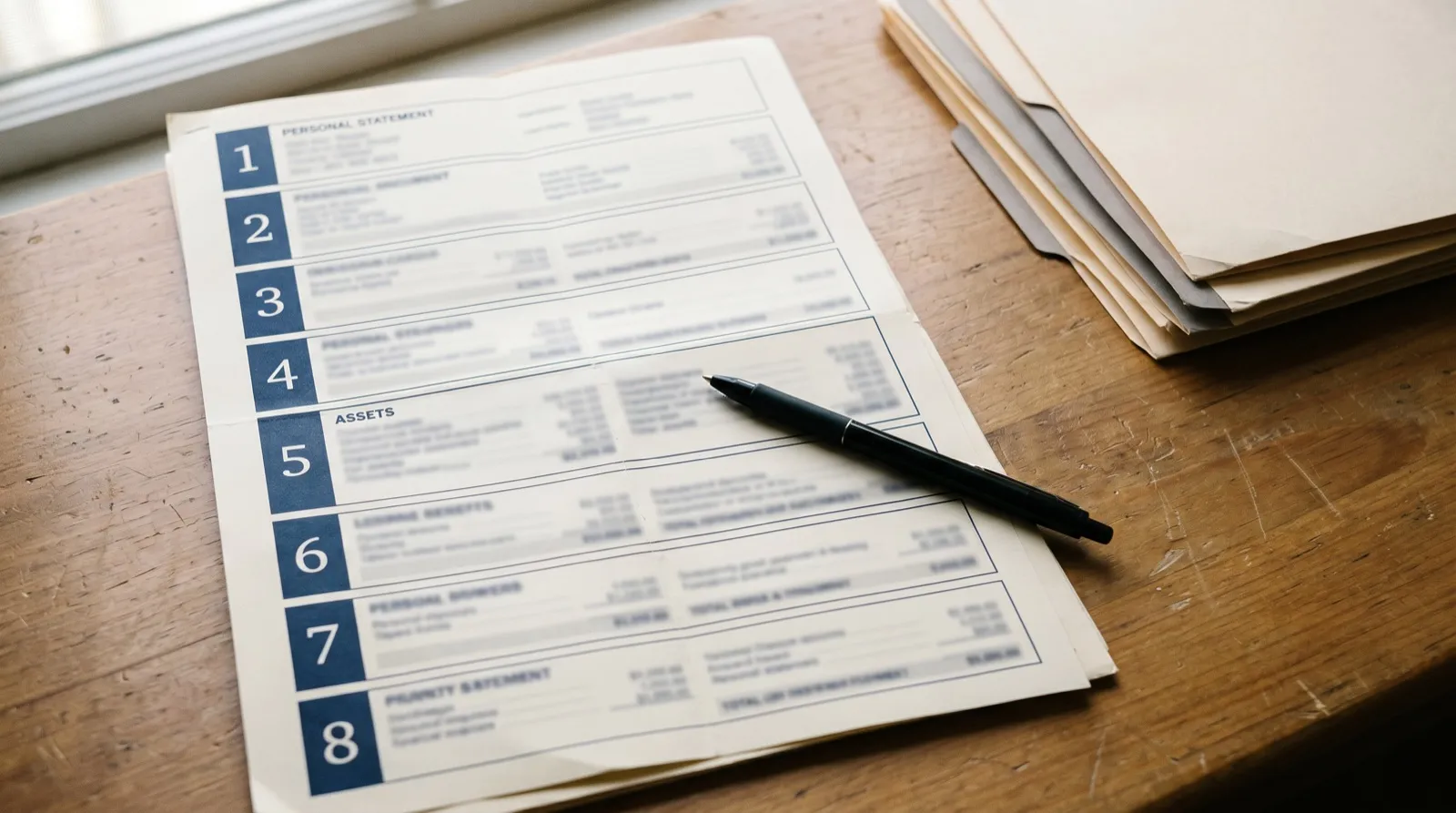
A completed SBA Form 413 for a 7(a) applicant lists assets and liabilities on the first page, with a net-worth line at the bottom. Alongside sits a Source of Income panel with a Contingent Liabilities sub-block, labeled Section 1 on the form, plus seven additional numbered schedules (Sections 2 through 8) detailing specific accounts. A typical applicant shows total assets of $700,000 to $1.2 million, total liabilities of $200,000 to $500,000, and net worth in the $450,000 to $700,000 range. The worked example below shows what each line looks like when the form is filled out cleanly for the first underwriter read.
Meet the applicant
Daniela owns Cruz Coffee Co. LLC, an established single-location coffee shop in Phoenix. She is the sole member of the LLC at 100% ownership. Her husband Marcus Cruz holds zero ownership in the borrower entity, so he does not file a separate Form 413. Marcus signs the second spousal-signature line on Daniela’s form because spousal assets are included in her statement, which the certification block requires for any 20%-or-more owner whose spouse’s assets appear.
Daniela dates the form 2026-05-12, which falls inside the 120-day window the form’s instructions specify for 7(a) submissions. A file SBA receives on or after October 1, 2026 is held to 90 days instead, under SOP 50 10 8.1.
The $350,000 loan funds tenant improvements and working capital for a second location across town. Daniela’s lender is an SBA-preferred bank that processes 7(a) packages in 35 to 45 business days when the borrower’s paperwork is clean.
Here are the totals on Daniela’s Form 413 before we walk the sections. Jointly owned assets and liabilities follow the form’s own instruction to “divide all jointly owned assets and liabilities, as appropriate with spouse or others,” so the joint primary residence and joint mortgage appear at 50% of their full value on Daniela’s statement.
| Line | Amount |
|---|---|
| Total Assets | $745,000 |
| Total Liabilities | $236,250 |
| Net Worth | $508,750 |
| Section 1 Total Annual Income | $124,400 |
These ratios sit inside the range an SBA 7(a) underwriter expects for a $250K to $500K loan request. They are not the most important ratios in the file. Debt service coverage on the business and personal credit score both matter more. They do put the file in the “worth reading” pile, which is Form 413’s job.
The header
The top of the form asks for name, business phone, residence address, residence phone, business name, and business address.
Daniela fills it out exactly as it appears on her driver’s license and federal tax return: same legal name, same middle initial, same residence address. The business name is “Cruz Coffee Co. LLC,” matching the operating agreement and the EIN registration.
Common mistake. Applicants enter a doing-business-as (DBA) on the business-name line when the loan is being made to the legal entity. The lender’s documents reference the legal entity. The signatures have to match the legal name, not the DBA.
The Assets column
This is the left side of the form. Ten named line items, with totals at the bottom. Daniela’s column reads as follows.
| Line | Amount |
|---|---|
| Cash on hand & in Banks | $42,000 |
| Savings Accounts | (included above) |
| IRA or Other Retirement Account | $185,000 |
| Accounts & Notes Receivable | $0 |
| Life Insurance Cash Surrender Value Only | $14,000 |
| Stocks and Bonds | $58,000 |
| Real Estate | $310,000 |
| Automobile Present Value | $32,000 |
| Other Personal Property | $9,000 |
| Other Assets | $95,000 |
| Total Assets | $745,000 |
A few notes on what the underwriter reads here.
Cash on hand & in Banks ($42,000). This is Daniela’s personal checking and savings at her credit union: $12,000 checking and $30,000 savings. Her business operating account at the same credit union holds $84,000; that does not go on Form 413. The business operating account appears on the business balance sheet the lender requests separately.
IRA or Other Retirement Account ($185,000). This is Daniela’s traditional IRA at a major brokerage, with her 401(k) balance from a prior W-2 job rolled into the same line. The form’s instructions for 7(a) and 504 applicants direct the 20%+ owner to “include the assets of the owner’s spouse and any minor children” on their statement. In this hypothetical Marcus has no separately owned retirement accounts, so the line reports Daniela’s own retirement balances only.
Stocks and Bonds ($58,000). A taxable brokerage account at Vanguard. Detailed in Section 3 with the position list and current market value.
Real Estate ($310,000). Present market value of Daniela’s 50% interest in the jointly owned primary residence (full property value: $620,000). The form’s instructions direct joint owners to “divide all jointly owned assets and liabilities, as appropriate,” so Daniela carries her 50% share. Section 4 reports the full property value with a note that the share on the asset column is 50%.
Automobile ($32,000). Present value of her 2022 Toyota 4Runner, titled solely in her name. She used Kelley Blue Book trade-in value, not retail. Detailed in Section 5.
Other Assets ($95,000). This is the big one for a business borrower. Daniela’s 100% membership interest in Cruz Coffee Co. LLC is valued at $95,000, supported by a 2025 seller’s discretionary earnings multiple. Section 5 carries the description: “100% membership interest in Cruz Coffee Co. LLC, fair-market value based on 2025 SDE × 2.5×, supporting workpaper attached.”
The free net-worth calculator is useful for sanity-checking these numbers before they go on the form. It adds and subtracts in real time so you can catch a column that does not foot.
The Liabilities column and Net Worth
The right side of the form. Eight named line items plus a net-worth line at the bottom.
| Line | Amount |
|---|---|
| Accounts Payable | $0 |
| Notes Payable to Banks and Others | $7,250 |
| Installment Account (Auto) | $22,000 |
| Installment Account (Other) | $3,500 |
| Loan on Life Insurance | $0 |
| Mortgages on Real Estate | $192,500 |
| Unpaid Taxes | $0 |
| Other Liabilities | $11,000 |
| Total Liabilities | $236,250 |
| Net Worth | $508,750 |
Accounts Payable ($0). This line captures personal accounts payable (unpaid bills to vendors). Cruz Coffee Co.’s vendor payables sit on the business balance sheet. Almost all individual applicants will show $0 here.
Notes Payable to Banks ($7,250). Daniela carries her 50% share of a $14,500 joint HELOC drawn against the primary residence. The full HELOC and the divided share both show in Section 2.
Installment Account (Auto) ($22,000). Outstanding balance on the 4Runner loan, payable to Toyota Financial Services at $612 per month.
Mortgages on Real Estate ($192,500). Daniela’s 50% share of the joint mortgage on the primary residence, payable to a regional credit union (full balance: $385,000). Detailed in Section 4 with both the full balance and the divided share.
Unpaid Taxes ($0). Daniela files quarterly estimated taxes and is current on federal and state. SBA requires all applicants to be current on federal, state, and local taxes before approval, so a non-zero number here triggers a callback for documentation.
Other Liabilities ($11,000). Personal credit card balances across two cards. Detailed in Section 7.
Net Worth ($508,750). Total Assets ($745,000) minus Total Liabilities ($236,250). The form has the math right at the bottom, but an underwriter still recalculates it.
Section 1: Source of Income and Contingent Liabilities
Section 1 sits side-by-side on the form with the Contingent Liabilities panel. The left side captures four sources of income; the right side captures four categories of contingent liability. They share a row because both feed into the same underwriting question: what cash is moving through this borrower’s life that we did not see on the asset side.
Source of Income (annual, left side)
| Source | Amount |
|---|---|
| Salary | $48,000 |
| Net Investment Income | $2,400 |
| Real Estate Income | $0 |
| Other Income | $74,000 |
| Total | $124,400 |
Daniela pays herself a $48,000 W-2 salary from Cruz Coffee Co. The $2,400 is dividends and interest from the brokerage account. The $74,000 in “Other Income” is owner distributions from Cruz Coffee Co., which flow through the LLC as Schedule K-1 income. She does not include alimony or child-support amounts (none received) and the form’s instructions allow her to exclude those even if received, unless she wants them counted.
Common mistake. Applicants double-count W-2 salary and K-1 distributions when both came from the same entity. The two are different income streams from the same business, so listing them separately is correct. The borrower’s personal tax return shows both, and the underwriter cross-references. The number on Form 413 has to match the tax return.
Contingent Liabilities (right side)
| Category | Amount |
|---|---|
| As Endorser or Co-Maker | $14,500 |
| Legal Claims and Judgments | $0 |
| Provision for Federal Income Tax | $0 |
| Other Special Debt | $0 |
The As Endorser or Co-Maker entry is Daniela’s personal guarantee on the existing Cruz Coffee Co. equipment lease, a $14,500 unamortized obligation if the LLC defaulted. Personal guarantees on someone else’s debt belong on this line; the Other Special Debt line is reserved for non-categorized obligations that do not fit the first three buckets. Disclosing the guarantee matters either way because the underwriter pulls a UCC search on the LLC and will see the equipment lease anyway. Disclosure first converts a discovery problem into a math problem; non-disclosure converts it into a misrepresentation problem.
The contingent-liability disclosure pattern extends to co-signed loans, sworn obligations under a separation or divorce decree, and quantifiable exposure on a pending lawsuit. Lenders see most of these in the credit report or court-record search regardless.
Build your personal financial statement in minutes
StatementsReady syncs bank balances read-only through Plaid, fills SBA Form 413, and exports a lender-ready PDF on demand.
- SBA Form 413 with every section filled
- Bank sync through Plaid, read-only
- 7 days free, no card
Section 2: Notes Payable to Banks and Others
This section is a schedule that backs the “Notes Payable to Banks” line on the main liability column. Daniela has one note to disclose, jointly held with Marcus.
| Field | Value |
|---|---|
| Name and Address of Noteholder | Phoenix Community Credit Union, 1200 N Central Ave, Phoenix, AZ |
| Original Balance (full) | $25,000 |
| Current Balance (full joint) | $14,500 |
| Daniela’s Share Reported on Main Column | $7,250 (50%) |
| Payment Amount | $389 monthly |
| How Secured | Second-position lien on primary residence (HELOC) |
| Type of Collateral | Real estate |
The HELOC is recorded as a second-position lien behind the primary mortgage. The underwriter will see the same lien in the title search the credit union runs as part of the loan close, so the numbers have to match. Current balance, payment amount, lien position, and the divided share all reconcile to the credit union’s payoff statement and the joint-asset convention used elsewhere on the form.
Section 3: Stocks and Bonds
This section backs the “Stocks and Bonds” line on the main asset column. Daniela holds one taxable brokerage account at Vanguard.
| Number of Shares | Name of Securities | Cost | Market Value | Date of Quotation | Total Value |
|---|---|---|---|---|---|
| Multiple positions | Vanguard Total Stock Market ETF (VTI), Vanguard Total Bond Market ETF (BND), and 4 individual equities | $42,000 | $58,000 | 2026-05-08 | $58,000 |
A few lenders ask for position-level detail. Daniela attaches her most recent Vanguard statement as a supporting workpaper rather than retyping thirty positions onto the form. The total on Section 3 matches the Stocks and Bonds line on the asset column.
Section 4: Real Estate Owned
This section backs the “Real Estate” line on the asset column and the “Mortgages on Real Estate” line on the liability column. Daniela owns one property, jointly with Marcus.
| Field | Value |
|---|---|
| Type of Property | Primary residence, single-family detached |
| Address | 4408 E Roma Ave, Phoenix, AZ |
| Date Purchased | 2019-08 |
| Original Cost | $445,000 |
| Present Market Value (full) | $620,000 |
| Daniela’s 50% Share Reported on Main Column | $310,000 |
| Name & Address of Mortgage Holder | Phoenix Community Credit Union, 1200 N Central Ave, Phoenix, AZ |
| Mortgage Account Number | XXXX-7821 (last 4) |
| Mortgage Balance (full joint) | $385,000 |
| Daniela’s 50% Share Reported on Main Column | $192,500 |
| Amount of Payment per Month | $2,810 (PITI) |
| Status of Mortgage | Current |
“Present Market Value” is a fair-market estimate, not the purchase price and not the property tax assessment. Daniela used a recent comparable-sales report her mortgage broker pulled six months ago. The lender’s appraiser may come in lower. The borrower is not expected to predict the appraisal.
Common mistake. Applicants list the property tax assessor value, which usually trails real market value by 18 to 36 months in Phoenix. The form asks for present market value. If the comparable-sales basis is several years stale, request a refreshed broker price opinion or pay for a desk appraisal before submitting.
Section 5: Other Personal Property and Other Assets
This section is the catch-all for everything described on the asset side that does not have its own numbered schedule. The form directs five asset lines here: IRA or Other Retirement Account, Accounts & Notes Receivable, Automobile, Other Personal Property, and Other Assets. Daniela has four entries (her Accounts & Notes Receivable is $0, so it gets no entry).
| Description |
|---|
| Traditional IRA at a major brokerage, $148,000 current balance; rollover 401(k) from a prior W-2 employer at the same brokerage, $37,000 current balance ($185,000 total reported on the IRA line) |
| 2022 Toyota 4Runner, titled in Daniela’s name, present value $32,000, financed through the captive auto lender (see Liabilities) |
| Daniela’s 50% share of household goods, furniture, and personal effects (estimated insurance replacement value $18,000 joint; $9,000 share) |
| 100% membership interest in Cruz Coffee Co. LLC, fair-market value $95,000 based on 2025 SDE × 2.5×; valuation workpaper attached |
The business-equity entry is the line an SBA underwriter reads first in this section. The valuation method matters. SDE multiples are common for small operating businesses; the lender will not accept “I spent $200K building it, so it’s worth $200K” without independent support. Daniela’s workpaper shows trailing-twelve-month SDE of $38,000 and a 2.5× multiple, a conservative coffee-shop comp range, yielding the $95,000 figure.
Section 6: Unpaid Taxes
Daniela has none, so she enters “None” or leaves the section blank with a notation. If she had a federal or state tax bill outstanding, the section would capture: tax description, to whom payable, when due, amount, and whether a tax lien attaches to property.
SBA’s 7(a) program eligibility and the lender-program guidance in SOP 50 10 require applicants to be current on all federal, state, and local taxes before the loan can close. A non-zero entry in Section 6 is not automatically disqualifying; applicants on a documented IRS payment plan can still close. It does add underwriter time and supporting documentation to the file.
Section 7: Other Liabilities
This section backs the “Other Liabilities” line on the liability column. Daniela has two personal credit cards with carried balances, both in her name only.
| Creditor | Type | Current Balance | Monthly Payment |
|---|---|---|---|
| Bank-issued rewards Visa (XXXX-3401) | Personal credit card | $7,200 | $180 minimum |
| Co-branded business Mastercard (XXXX-9028) | Personal credit card (used for business expenses, paid personally) | $3,800 | $95 minimum |
Both balances are also visible in the tri-merge credit report the lender pulls. The numbers on Form 413 should match the credit-report balances as of the report date within a small variance, or the underwriter asks why.
Section 8: Life Insurance Held
This section backs the “Life Insurance Cash Surrender Value Only” line on the asset column.
| Field | Value |
|---|---|
| Face Amount | $500,000 |
| Cash Surrender Value | $14,000 |
| Insurance Company | Northwestern Mutual |
| Beneficiaries | Marcus Cruz (primary, 100%) |
Form 413 only counts cash surrender value on the asset side, not face value. A $500,000 face-value term-life policy with no cash value yields a $0 entry on the asset column. The existence of the policy still gets disclosed in Section 8 because the lender may ask the borrower to assign the policy as additional loan collateral. Whole-life and universal-life policies with a cash component show both numbers.
Signing, dating, and the 90-day rule
Daniela signs the form on 2026-05-12. Marcus signs the second spousal-signature line on the same form because spousal assets are included in Daniela’s statement, which the certification block requires for any 20%-or-more owner whose spouse’s assets appear. The date sits inside the form’s own 120-day window for 7(a) submissions; the form’s instructions specify the date “must be within 90 days of submission for Disaster or within 120 days of submission for 7(a)/504/SBG/8(a) BD/WOSB.” For 7(a) and 504 loans submitted from October 1, 2026, SOP 50 10 8.1 shortens that to “within 90 days of submission to SBA,” so the same statement filed today would need to reach the lender’s submission inside 90 days.
By signing this form, I certify under penalty of criminal prosecution that all information on this form and any additional supporting information submitted with this form is true and complete to the best of my knowledge.
If the file sits in underwriting past Daniela’s signature date plus the window (90 days on a file submitted from October 1, 2026), the lender will ask for a refreshed copy with current balances. Re-running the bank-balance and credit-card-balance fields takes about thirty minutes when the underlying accounts have not changed materially.
This timing matters more in 2026 than it did a year ago. SBA announced on May 18, 2026 that it would double the cumulative 7(a) and 504 loan limit to $10 million, effective July 4, 2026. As the cap rises, borrowers with prior SBA debt will run fresh Form 413 packages more often, especially when stacking a 7(a) on top of an existing 504.
What the underwriter actually does next
Once Form 413 is submitted, the credit analyst runs five reconciliations before sending the file to the underwriter:
- Net worth foot. Total Assets minus Total Liabilities should equal the Net Worth line on the form, and the math is checked by hand. Off-by-a-thousand errors are surprisingly common and are the fastest way to delay the file.
- Tax-return cross-check. Income amounts in Section 1 are compared against the most recent two years of personal returns. Big variances trigger questions. Increasing salary is fine; declining K-1 distributions raise eyebrows.
- Credit-report cross-check. Every credit card, installment loan, and HELOC on the form is matched against the tri-merge credit report. Undisclosed accounts in the credit report invite a callback even when the balance is zero.
- Title-search cross-check. Mortgage balances and lien positions in Section 4 are matched against the title report the lender pulls. The HELOC second-position lien should appear on both. Material differences in the recorded payoff statement trigger a callback.
- Contingent-liability search. UCC filings and county judgment searches surface personal guarantees and litigation. Anything that turns up but is not disclosed in Section 1 contingent liabilities is treated as a material omission.
If all five reconciliations clear, the analyst writes a brief credit memo summarizing the borrower’s financial profile and forwards it to underwriting. The full SBA 7(a) credit analysis usually takes another two to three weeks; the personal-financial-statement portion is the smallest part of that work, assuming Form 413 was filled out cleanly the first time.
For the broader process around the form (what to gather before you start, what the lender’s intake checklist usually requests, and how to handle multi-entity holdings), see the companion SBA Form 413 section-by-section walkthrough and the SBA 413 guide.
Where to start
If you are preparing your own Form 413, start with the bank-balance section and the credit-report cross-check. Open your most recent bank statements and run a tri-merge personal credit report; reconcile every account before any numbers go on the form. Once those reconcile, the rest is mostly typing.
For a structured starting point that mirrors the official form layout, the SBA Form 413 template and the broader personal financial statement template guide work as the foundation. The full SBA lending archive and the business lending archive carry the rest of the operator material on eligibility, common mistakes, and broker-side workflow.
For applicants who need to generate multiple Form 413s through underwriting (joint spouse filings, multi-entity ownership, annual refreshes), the StatementsReady use case for business loan applications covers the full workflow including bank-sync through Plaid and one-click rollovers.
Skip the spreadsheet
A lender-ready personal financial statement from synced balances, in about 8 minutes.
- 7 days free
- No credit card
- PDF, SBA Form 413, Word, or Excel
Build your personal financial statement in minutes
StatementsReady syncs bank balances read-only through Plaid, fills SBA Form 413, and exports a lender-ready PDF on demand.
- SBA Form 413 with every section filled
- Bank sync through Plaid, read-only
- 7 days free, no card