10 Types of Commercial Real Estate Loans (2026)
The 10 types of commercial real estate loans compared: bank, SBA 504/7(a), agency, CMBS, life company, DSCR, bridge, construction, and mezzanine.


Here are the 10 types of commercial real estate loans: the conventional bank mortgage, the SBA 504 loan, the SBA 7(a) loan, agency multifamily debt, CMBS conduit loans, life insurance company loans, DSCR investor loans, bridge loans, construction loans, and mezzanine debt or preferred equity. Each one is defined by three things: who funds it, what the property has to look like to qualify, and whether your personal assets stand behind it. Below, each type gets its structure, its typical terms, the borrower it suits, and the watch-out that costs people deals.
The 10 types at a glance
| # | Loan type | Typical structure | Best for |
|---|---|---|---|
| 1 | Conventional bank mortgage | 5–10 yr term, 20–25 yr am, balloon, recourse | Any property type, established borrower, bank relationship |
| 2 | SBA 504 | 50% bank / 40% CDC debenture / 10% equity; CDC piece fixed 10/20/25 yr, bank note priced separately | Owner-occupied purchase or build, lowest down payment |
| 3 | SBA 7(a) | Up to $5M, up to 25 yr fully amortizing, variable | Owner-occupied real estate bundled with other business needs |
| 4 | Agency multifamily | 5–10 yr, up to 30 yr am, non-recourse | Stabilized apartment properties |
| 5 | CMBS / conduit | 10 yr fixed, 30 yr am, non-recourse, securitized | Max leverage on stabilized income property |
| 6 | Life company | 10–25 yr fixed, low LTV, non-recourse | Institutional-quality stabilized assets, long hold |
| 7 | DSCR investor loan | 30 yr am, qualified on rent coverage | Small rental and investment property, no income docs |
| 8 | Bridge loan | 12–36 mo, interest-only, floating | Value-add, lease-up, fast closings |
| 9 | Construction loan | Draw schedule, interest-only, converts or refinances | Ground-up development and major renovation |
| 10 | Mezzanine / preferred equity | Subordinate to the senior loan, higher cost | Filling the gap between senior debt and your equity |
Definition
A commercial real estate loan is debt secured by a mortgage or deed of trust on income-producing or business-occupied property, underwritten against the cash flow the property or its occupant produces rather than the borrower's wages. On an investment property that means the rent: the lender sizes the loan with a loan-to-value cap and a debt-service-coverage floor. On an owner-occupied building financed through SBA 7(a) or 504, there may be no rent at all, so the lender underwrites the operating business and the owner's global cash flow instead. Either way it then decides whether the borrower guarantees repayment personally, and most of these loans carry a term shorter than their amortization schedule, which is what creates a balloon payment at maturity.
The market these loans come from is large and getting busier. The Mortgage Bankers Association counts roughly $5.0 trillion of commercial and multifamily mortgage debt outstanding, and forecasts 2026 origination volume at $805.5 billion, a 27% jump over 2025 (MBA CREF Forecast, February 2026).
$805.5 billion
Forecast 2026 U.S. commercial mortgage origination volume, up 27% from the $633.7 billion expected in 2025, with multifamily alone at $399.2 billion
1. Conventional bank mortgage: the default starting point
A conventional commercial mortgage is a balance-sheet loan from a bank or credit union, secured by the property and usually guaranteed by the owners. Banks and thrifts hold the largest share of commercial and multifamily mortgage debt in the country, at roughly 37% (MBA, Commercial/Multifamily Mortgage Debt Outstanding, Q4 2025).
The structure is usually a 5- or 10-year term against a 20- to 25-year amortization, which leaves a balloon balance due at maturity. Expect a loan-to-value cap in the 65–75% range and a debt-service-coverage floor near 1.20x–1.25x. The trade you are making is flexibility for recourse: a bank will look at an unusual property or an unusual borrower story that a securitized lender won't, and in exchange it wants your personal guarantee.
Who it's for: borrowers with an existing banking relationship, properties that don't fit a program box, and anyone who values a lender they can call.
Watch out for: the covenant package. Bank loans commonly carry an ongoing DSCR test and a deposit-relationship requirement, and breaching either can trigger a default even when payments are current. The full vocabulary is in our commercial real estate loan terms guide.
2. SBA 504 loan: the lowest down payment on owner-occupied property
The 504 is a three-party structure for owner-users: a bank funds a 50% first mortgage, a Certified Development Company funds a 40% second mortgage backed by an SBA-guaranteed debenture, and you bring 10% equity. The CDC portion is capped at $5 million for most projects and $5.5 million for small manufacturers and eligible energy public-policy projects, with 10-, 20-, and 25-year fixed-rate maturities (SBA, 504 loans).
You must occupy at least 51% of an existing building, or 60% of new construction at closing. The equity requirement rises to 15% for a startup business or a special-purpose property, and 20% when both conditions apply. Run it on a $4 million building: 10% equity on a 504 is $400,000, while a conventional bank asking 25% down wants $1 million, roughly $600,000 of cash you keep in the business.
Who it's for: profitable operating businesses buying, building, or renovating the space they occupy.
Watch out for: the timeline and the paperwork. Two lenders means two credit processes, and every owner of 20% or more files an SBA Form 413. Full eligibility detail is in our SBA 504 loan requirements post, and the property-level mechanics in SBA 504 for commercial real estate.
3. SBA 7(a) loan: owner-occupied real estate inside a bigger package
The 7(a) is SBA's general-purpose program, capped at $5 million, and it can be used for "acquiring, refinancing, or improving real estate and buildings" (SBA, 7(a) loans). Real estate maturities run up to 25 years, fully amortizing with no balloon, and rates are typically variable at Prime plus a spread the SBA caps by loan size (SOP 50 10, Lender and Development Company Loan Programs).
The owner-occupancy test mirrors the 504: at least 51% of an existing building, or 60% of new construction. The reason to choose 7(a) over 504 is scope: one 7(a) can cover the building plus working capital, equipment, and a business acquisition in a single closing, where the 504 is restricted to fixed assets. If the property is only one part of what you are financing, compare it against the non-property options in our guide to the 10 types of business loans.
A meaningful rule change landed this year. Effective July 4, 2026, SBA doubled the cumulative 7(a)-plus-504 borrowing limit from $5 million to $10 million, so a borrower who takes $5 million on the 7(a) side can now access another $5 million through the 504 program (SBA, May 18, 2026).
Who it's for: owner-occupants whose deal includes more than the building.
Watch out for: the guaranty fee. For FY 2026 it runs 3.5% of the guaranteed portion up to $1 million plus 3.75% above that on loans over $700,000, which is real money financed into your balance. One exception is worth checking before you assume it applies to you: loans of $950,000 or less to manufacturers in NAICS sectors 31–33 carry a 0% upfront fee for FY 2026 (SBA Information Notice 5000-872051). Run the payment and fee side by side in our free SBA loan calculator, and see SBA 7(a) vs. 504 for the head-to-head.
Build your personal financial statement in minutes
StatementsReady syncs with your bank accounts, auto-populates SBA Form 413, and generates a lender-ready PDF on demand. No spreadsheets, no manual updates.
- SBA-compliant Form 413 generation
- Bank sync via Plaid (read-only)
- Always current — no stale snapshots
4. Agency multifamily loans: the cheapest debt on stabilized apartments
Fannie Mae and Freddie Mac buy multifamily loans originated by approved lenders under the DUS and Optigo programs. The Federal Housing Finance Agency set each Enterprise's 2026 purchase cap at $88 billion, for a combined $176 billion, with at least 50% required to be mission-driven affordable housing (FHFA, November 24, 2025). Agency and GSE portfolios hold about half of all multifamily mortgage debt outstanding, at roughly $1.1 trillion (MBA, Commercial/Multifamily Mortgage Debt Outstanding, Q4 2025).
Terms are program-specific. Freddie Mac's conventional fixed-rate multifamily product offers 5- to 10-year terms with amortization up to 30 years, and is non-recourse subject to standard carve-outs (Freddie Mac Multifamily, Fixed-Rate Loan term sheet). Agency programs generally serve apartment properties rather than other commercial asset classes. The catch that surprises first-time agency borrowers is that non-recourse does not mean unexamined. Fannie Mae's guide requires the combined net worth of the borrower and all key principals to equal or exceed the original loan amount, and combined post-closing liquid assets to equal at least nine monthly payments of principal and interest, with retirement accounts generally excluded from the liquidity test (Fannie Mae Multifamily Guide, Net Worth and Liquid Assets).
The CRE lending market showed strength throughout 2025. Commercial originations increased year-over-year during the first six months, and this growth continued in the second half of the year. The multifamily market experienced similar strength throughout the year, and that is expected to continue in 2026.
Who it's for: investors holding stabilized apartment properties who want long fixed terms and no personal repayment liability.
Watch out for: that net-worth-to-loan-amount test. It is the single most common reason a qualified property gets a smaller loan than the sponsor expected, and it is measured off your personal balance sheet, not the property's.
5. CMBS conduit loans: maximum leverage, minimum flexibility
A CMBS loan is originated to be pooled with other loans and sold to bond investors. Private-label CMBS issuance reached $125.6 billion in 2025, the most active year since the financial crisis, and 42 deals totaling $32.74 billion priced in the first quarter of 2026 (Trepp, CMBS issuance). CMBS, CDO, and other ABS issues hold about 13% of commercial and multifamily mortgage debt outstanding, or roughly $647 billion (MBA, Commercial/Multifamily Mortgage Debt Outstanding, Q4 2025).
The classic conduit structure is a 10-year fixed term on a 30-year amortization, non-recourse with bad-boy carve-outs, sized to the highest leverage the market will support. Because the loan gets securitized, the servicing is rigid: prepayment usually requires defeasance or yield maintenance, and a lease amendment or a change in ownership needs approval from a servicer who has no relationship with you.
Who it's for: investors who want proceeds and rate certainty on a stabilized asset they intend to hold to maturity.
Watch out for: the exit. Defeasance on a loan with years left to run can cost more than the equity you were trying to free up. Model the balloon before you sign, using our commercial real estate loan calculator.
6. Life insurance company loans: the lowest rate for the strongest deals
Life insurers lend against long-dated liabilities, which lets them write long fixed terms at tight spreads. They hold roughly 16% of commercial and multifamily mortgage debt outstanding, or about $774 billion (MBA, Commercial/Multifamily Mortgage Debt Outstanding, Q4 2025). Their underwriting is the most conservative in the market: industry data compiled from ACLI reporting puts average credit metrics on newly originated loans at about 63% loan-to-value and 1.82x debt-service coverage across 2007–2023 (NFG, Commercial Mortgage Debt white paper).
Terms commonly run 10 to 25 years fixed, non-recourse, on stabilized institutional-quality property in primary or strong secondary markets. Minimum loan sizes are usually well into the millions.
Who it's for: experienced sponsors with a Class A or B stabilized asset, low leverage, and a long hold horizon.
Watch out for: proceeds. A life company will quote the best rate on your deal and the smallest loan, and lower leverage means more equity out of pocket at closing.
7. DSCR investor loans: qualifying the property instead of yourself
A DSCR loan is underwritten on the property's ability to cover its own debt service, without asking for tax returns or a W-2. The formula and the floor both depend on the property. On a 1–4 unit rental, lenders use the monthly shortcut: gross rent divided by PITIA (principal, interest, taxes, insurance, and HOA dues). Most residential programs set the floor at 1.0x, with 1.25x or better earning the sharpest pricing. On five-plus-unit and mixed-use property, they switch to the commercial version, net operating income divided by annual debt service, against a floor nearer 1.20x to 1.25x. Terms usually mirror residential loans: 30-year amortization, fixed or ARM.
The reason this product exists is that a self-employed investor's tax return understates their real income, and a conventional debt-to-income calculation reads a growing portfolio as a growing liability. Run your own number in our free DSCR calculator, or read how to calculate DSCR for the formula and the adjustments lenders make.
Who it's for: buy-and-hold rental investors, especially those past the conventional financed-property limit.
Watch out for: prepayment penalties. Most DSCR programs carry a declining prepay over the first three to five years, and it is priced into the rate you were quoted. Full detail in what is a DSCR loan and DSCR loan requirements.
8. Bridge loans: short-term capital for a property that isn't ready
A bridge loan carries a property from where it is to where it needs to be before permanent debt will touch it. Terms typically run 12 to 36 months, interest-only, floating over SOFR, sized against loan-to-cost and an as-is or stabilized loan-to-value cap together (the lender advances to whichever produces the smaller loan) with extension options for a fee. Hard money is the small-balance private end of the same market: faster, more expensive, and more willing to lend on a story than an institutional bridge fund.
A bridge loan is only as good as its exit, and the exit is a decision you make before you close, not after. The underwriting question is whether the business plan produces enough net operating income to support a takeout at the rates you'll face in 18 months.
Who it's for: value-add acquisitions, lease-up, 1031 deadlines, and recapitalizations.
Watch out for: interest reserves running dry. If the lease-up slips two quarters, the reserve that was sized for the original schedule stops covering the payment, and you fund the gap from your own pocket.
9. Construction loans: funded in draws, not at closing
A construction loan advances money against completed work rather than at closing. You draw on a schedule tied to inspections, pay interest only on the outstanding balance during the build, and either convert to a permanent loan or refinance into one at certificate of occupancy. Leverage is measured against loan-to-cost, generally 65–75%, and the lender holds back retainage until completion.
The SBA 504 program supports ground-up construction for owner-occupants, with the interim bank loan carrying the project through the build and the debenture funding after completion, which is how a 10%-down new building becomes possible. The full mechanics are in our commercial real estate construction loan guide.
Who it's for: developers, and owner-occupants building or substantially renovating their own facility.
Watch out for: the gap between construction and permanent, and the fact that construction credit is the least uniform part of the market. In the April 2026 Senior Loan Officer Opinion Survey, banks reported standards basically unchanged on net across all three CRE categories, but the aggregate hides a split: large banks eased standards on construction and land development, while moderate net shares of other banks tightened them, and a moderate net share of banks reported weaker demand for construction lending (Federal Reserve, April 2026 SLOOS). Where your lender sits in that split matters more than the headline.
10. Mezzanine debt and preferred equity: the gap above the senior loan
When the senior loan stops at 65% and your equity check covers 20%, mezzanine debt or preferred equity fills the remaining slice. Mezzanine is secured by a pledge of the ownership interests in the property-owning entity rather than by the property itself, which lets the holder take over the entity on default without foreclosing. Preferred equity sits in the equity stack with a priority return instead.
Both are priced well above senior debt, and both come with intercreditor terms that limit what you can do without the senior lender's consent. Treat gap capital as the tool that makes a deal possible, not the tool that makes it profitable.
Who it's for: sponsors on larger transactions where the senior loan leaves a fundable gap.
Watch out for: control rights. Read the change-of-control provisions before the rate.
How to choose
Four questions settle it in about five minutes.
1. Do you occupy the building? If your operating business occupies 51% or more of an existing property, the SBA programs open up and with them a 10%-down structure nothing else on this list matches. If you don't, items 1 and 4 through 10 are your list.
2. Is the property stabilized? Stabilized income supports permanent debt: bank, agency, CMBS, life company, DSCR. Vacant, under-renovation, or under-construction property routes to bridge or construction financing until it stabilizes.
3. How long are you holding? A hold shorter than the loan term makes prepayment structure the dominant cost. CMBS defeasance and life company yield maintenance are punishing on an early exit; bank and SBA prepayment terms are generally lighter.
4. Whose balance sheet backs it? Recourse loans put your personal assets behind the debt, which is why every one of these lenders reads your personal financial statement. Non-recourse doesn't remove that step: agency underwriting tests your net worth against the loan amount and your liquidity against nine months of payments before it funds.
That last point is where most deals slow down. On nearly every loan type here, the lender is going to want a current, reconciled statement of your assets, liabilities, and net worth, and for SBA deals that statement is Form 413 from every 20% owner. Small-balance residential DSCR programs are the common exception, since many verify credit and reserves without asking for a formal statement. Details on what underwriters check are in commercial real estate loan qualifications, and on the guarantee itself in what is a personal guarantee.
Next step
Pick your loan type from the four questions above, then build the document the lender asks for regardless of which one you chose. StatementsReady generates a lender-ready personal financial statement (including the current SBA Form 413 layout) from your accounts and holdings, so the net worth and liquidity figures reconcile before an underwriter reads them. Start from the SBA Form 413 template, or see how investors keep theirs current in our commercial real estate investor workflow. More on financing property is in the commercial real estate archive.
Skip the spreadsheets
Generate a lender-ready personal financial statement in minutes with StatementsReady.
- Free to start
- No credit card required
- Used by SBA-preferred lenders
Frequently asked questions
Build your personal financial statement in minutes
StatementsReady syncs with your bank accounts, auto-populates SBA Form 413, and generates a lender-ready PDF on demand. No spreadsheets, no manual updates.
- SBA-compliant Form 413 generation
- Bank sync via Plaid (read-only)
- Always current — no stale snapshots
Keep reading
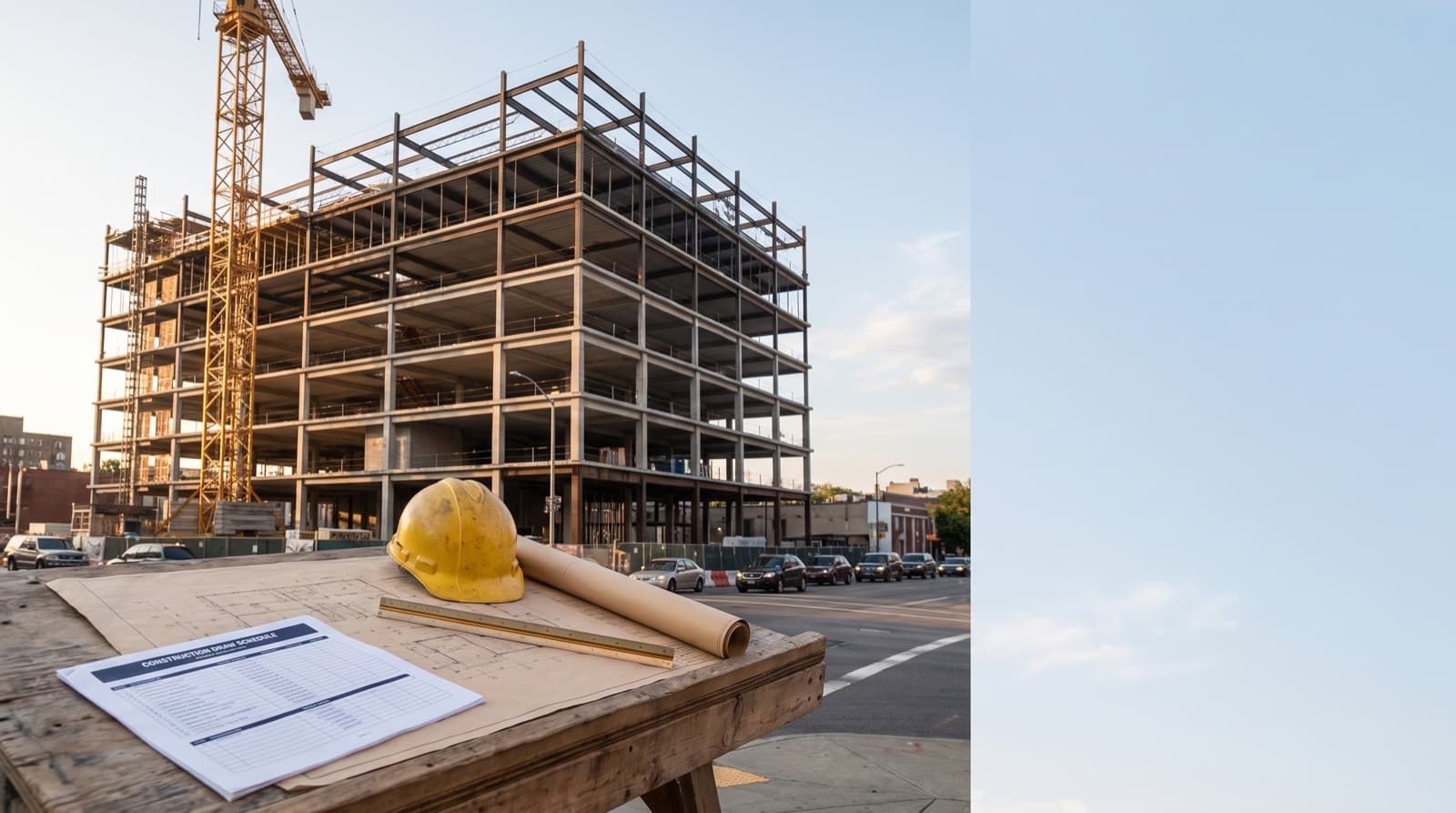
Commercial Real Estate Construction Loan: How It Works
How a commercial real estate construction loan works: draw schedules, the interest reserve, LTC vs LTV, the perm take-out, and the SBA 504 construction path.

Commercial Real Estate Loan Terms Explained (2026)
Commercial real estate loan terms cover term length, amortization, LTV, DSCR, recourse, and rate. What each one means before you sign.

What Is Debt Yield? The Ratio That Caps Your Loan
Debt yield is net operating income divided by the loan amount. On many commercial deals it caps the loan below what LTV and DSCR would allow.