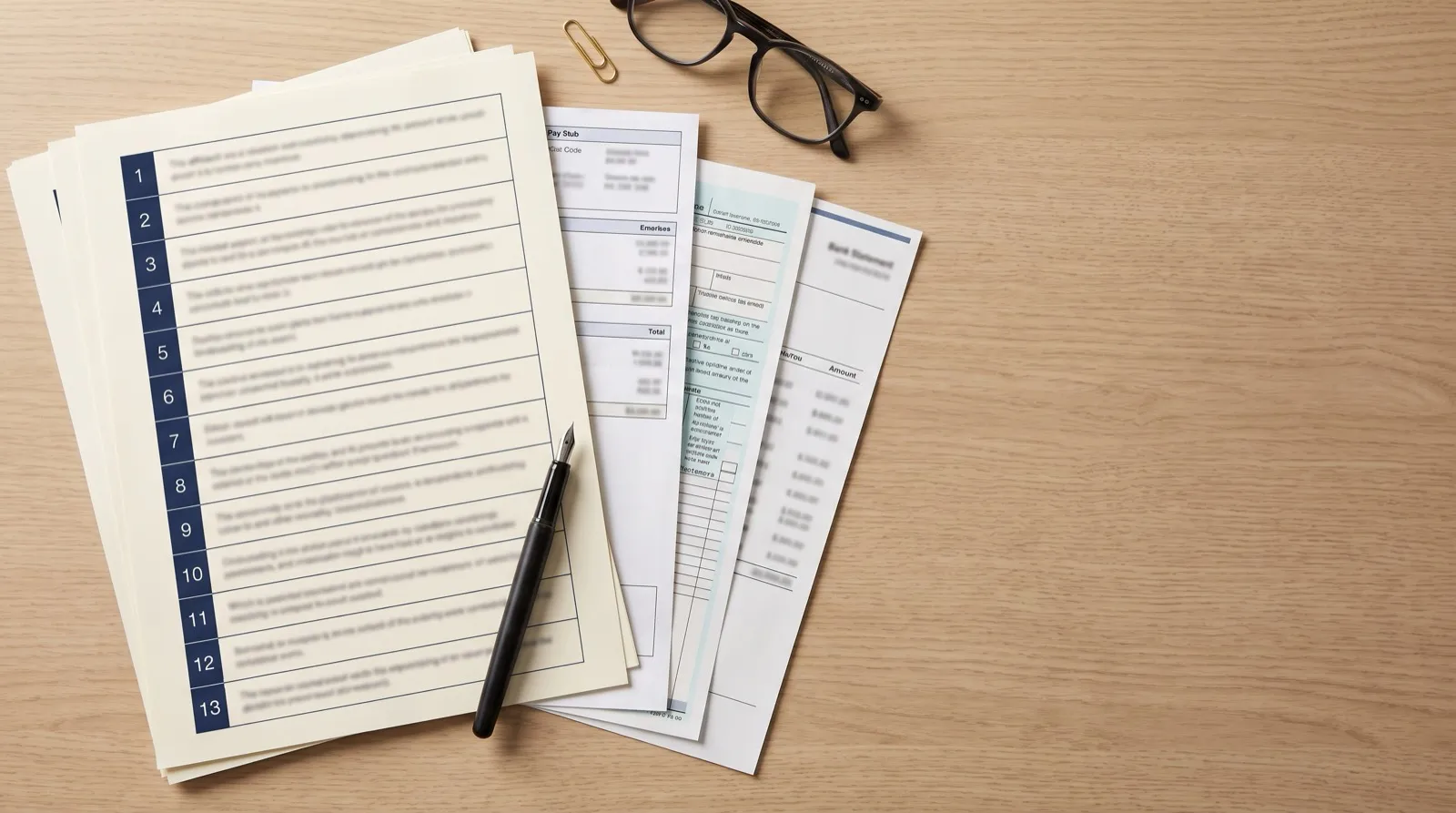


A New York Statement of Net Worth is the sworn financial affidavit both spouses file in a contested divorce, and a judge relies on it to split property and set support. New York rewrote the form effective December 1, 2025, so the version circulating in most online guides is already out of date. Build a clean, dated inventory of what you own and owe first, and the court form turns into a transcription job your attorney can finish in one sitting instead of three.
Key takeaways
- The Statement of Net Worth is a court form sworn under oath; a personal financial statement is the asset-and-liability backbone you build first, then transcribe onto it.
- New York issued a revised, gender-neutral form effective December 1, 2025, and now requires an updated sworn statement later in the case unless the court excuses it.
- The deadline is short: 20 days after a written demand under DRL section 236(B)(4), and the statement must be filed at least 10 days before the preliminary conference.
- It still has to be signed before a notary, even though CPLR 2106 now lets civil litigants use affirmations, because the statute requires a sworn statement.
- Filing late, incomplete, or inaccurate exposes you to sanctions under CPLR 3126, including preclusion of your evidence and an adverse inference on the numbers you left out.
What a New York Statement of Net Worth is
A New York Statement of Net Worth is the sworn, notarized affidavit of a spouse’s assets, liabilities, income, and monthly expenses, required in matrimonial actions under Domestic Relations Law section 236(B)(4) and 22 NYCRR 202.16. It is filed with the court and served on the other spouse so a judge can divide marital property and calculate child support and maintenance.
The statute defines net worth plainly: “the amount by which total assets including income exceed total liabilities including fixed financial obligations” (DRL section 236). That is the same arithmetic behind any net worth statement: assets minus liabilities. The court form wraps three more things around that core, though: a line-by-line monthly budget, every source of income, and a list of assets you moved in the last three years.
The form runs past a dozen pages. New York’s Office of Court Administration revised it effective December 1, 2025 under Administrative Order AO/283/25, replacing the prior version and making the language gender-neutral. If you downloaded a “Rev. 1/1/24” copy or pulled one from a law-firm blog, check the date before you start, because the court expects the current form that substantially complies with 22 NYCRR 202.16.
When the Statement of Net Worth is due
The deadlines are short and the court enforces them. Under DRL section 236(B)(4), once your spouse serves a written demand you have 20 days to provide a sworn statement of net worth. If no one serves a demand, each party files within 10 days after joinder of issue.
There is a second, firmer deadline. 22 NYCRR 202.16(f) requires both parties to exchange and file their statements no later than 10 days before the preliminary conference, and that conference is ordered within 45 days after the case is assigned. In practice the preliminary-conference deadline is the one that governs, because you cannot make or oppose a motion for support without a statement of net worth in the official form (202.16(k)).
Before you start: what to gather
Do the document pull before you type a single number. New York asks you to attach and exchange a specific package, and your statement has to reconcile to it:
- three years of filed federal and state income tax returns, including any partnership or S-corp returns where you are an owner;
- W-2s, 1099s, and K-1s for those years;
- all pay stubs for the current year plus the last stub from the prior year;
- three years of statements for every bank and brokerage account;
- your signed retainer agreement, which the rule requires you to file with the statement if you have a lawyer.
That list comes straight from 22 NYCRR 202.16(f). Pull every account statement as of the same date so your totals reconcile. A net-worth figure built from a January bank balance and a March brokerage balance ties to nothing, and that mismatch is the first thing opposing counsel circles.
How to complete the form, step by step
Step 1. Fill in the family data
The first part is biographical: names, dates of birth, date and place of marriage, date of separation if there is one, your children, your employers, and health information. It establishes jurisdiction and identifies who support is calculated for. It is the easiest part to complete and the easiest to leave a blank on, so finish it fully.
Step 2. Build the asset and liability inventory
This is the core the whole form is named for. List every asset at estimated current value: cash and bank accounts, brokerage and retirement accounts, the marital home and other real estate, vehicles, business interests, life insurance with cash value, and personal property of real worth. Then list every debt and tie it to the asset it sits against: the mortgage under the house, the auto loan under the car, the line of credit behind the business, and the unsecured card balances.
A net-worth statement template or the free net-worth calculator gives you the structure so nothing gets skipped. The form asks you to show values both as of the date the action started and as of today, and to flag anything you believe is separate rather than marital property. Flag your position and note why; the characterization itself is a legal call your attorney makes.
Step 3. Itemize your monthly expenses
The New York form goes well past a lender’s statement here. It asks for a categorized monthly budget: housing, utilities, food, clothing, insurance, medical, transportation, education, and a long miscellaneous list down to haircuts and pet care. Do not guess. Pull two to four months of bills and average them, because an expense number you cannot support is easy to impeach. This section, together with income, is what a judge leans on to set a support award.
Step 4. Report all income
List income from every source, not just wages: salary, self-employment income, bonuses, commissions, investment and rental income, distributions, pensions, and benefits. W-2 earners can lean on their tax forms. If you own a closely held business or a professional practice, this line gets complicated fast, and it is worth running your figures through an income calculator and past your attorney before you commit to a number. Income drives both child support and maintenance, and New York caps how much of it the guideline formulas reach automatically.
$193,000
Combined parental income the New York child support formula reaches automatically as of March 1, 2026, up from $183,000; the maintenance payor cap rose to $241,000
Source: New York Child Support Standards Chart (LDSS-4515, Rev. 3/26)
Step 5. List assets transferred in the last three years
The statute requires a list of every asset you transferred “in any manner during the preceding three years, or the length of the marriage, whichever is shorter” (DRL section 236). Routine business exchanges of equivalent value are exempt, but a car you sold, property you gifted, or money you moved to a relative belongs here. Leaving a transfer off reads the same as hiding it.
Step 6. Swear it before a notary and attach the exhibits
The Statement of Net Worth is signed under oath. New York amended CPLR 2106 to let civil litigants use affirmations instead of notarized affidavits, but the current form still directs you to sign before a notary, because DRL section 236(B)(4) requires a sworn statement.
Build your personal financial statement in minutes
StatementsReady syncs bank balances read-only through Plaid, fills SBA Form 413, and exports a lender-ready PDF on demand.
- SBA Form 413 with every section filled
- Bank sync through Plaid, read-only
- 7 days free, no card
New York Statement of Net Worth vs. a lender’s personal financial statement
If you have ever filled out SBA Form 413 or any bank’s personal financial statement, you have already built the asset-and-liability half of this form. The two documents share that core and diverge everywhere else.
| Dimension | NY Statement of Net Worth | Lender PFS (SBA Form 413) |
|---|---|---|
| Audience | A matrimonial court and your spouse | One private lender |
| Oath | Sworn before a notary under DRL section 236(B)(4) | Certified true; rarely litigated |
| What it covers | Assets, liabilities, income, monthly expenses, 3-year transfers | Assets and liabilities, some income |
| Incentive risk | Understating looks like shrinking the marital estate | Overstating looks like padding |
| After you file | Continuing duty to update; compared across the case | Static snapshot for one decision |
The incentives run opposite. On a loan application most people present themselves as creditworthy as they honestly can. On a divorce disclosure, understating a value looks like an attempt to shrink the marital estate, and the person reading it has interests opposed to yours. I have watched underwriters reconcile the same building across a tax return, an SBA Form 413, and a closing statement before funding a loan; a forensic accountant in a divorce runs the identical exercise, except they are hunting for the gap on purpose. That is why matrimonial attorneys routinely ask for any lender statement you have signed and set it next to the court filing.
Although the form is required to be submitted at the Preliminary Conference, the Statement of Net Worth continues to be one of the most frequently referenced forms through all stages in a matrimonial litigation.
What happens if it is late, incomplete, or false
Non-compliance carries real teeth. DRL section 236(B)(4) ties failure to disclose to the sanctions in CPLR 3126, which let a judge preclude you from offering financial evidence, strike your pleadings, or draw an adverse inference on the exact numbers you left out. New York courts reserve outright preclusion for failures they find willful and deliberate (Anthony v. Anthony, 24 A.D.3d 694), but an adverse inference is easier to draw and can cost you real money: a judge who infers you hid an account can award more of a contested asset to your spouse.
The statement is also sworn, so signing a false one carries the same perjury exposure as any affidavit, on top of the civil sanctions. The safe move is the boring one. Complete every section, reconcile it to your tax returns and to any statement you have handed a lender, and correct it promptly if you find an error after filing.
What “done” looks like
You have a single, dated statement that nets your assets against your liabilities, a monthly income-and-expense summary you can support with bills, a three-year transfer list, and a separate-versus-marital flag with a one-line reason on each asset. It is signed before a notary, your tax returns and retainer are attached, and it reconciles to every other financial document with your name on it. Your attorney can read it in minutes and file it without chasing you for a missing account.
What to do next
Start with the asset-and-liability inventory, because the rest of the form hangs off it. Build it in a personal financial statement template or generate it from your synced accounts, keep a dated copy of every version, and hand your attorney a clean package instead of a shoebox. If your divorce is outside New York, the multi-state divorce disclosure guide covers the equivalents, and the full workflow lives in our divorce financial disclosure use case. More on the underlying document is in the personal finance archive and the net worth statement guide.
Related reading
- What is a net worth statement?
- Personal financial statement for divorce disclosure
- More in the personal finance archive and the net worth statement guide.
Skip the spreadsheet
A lender-ready personal financial statement from synced balances, in about 8 minutes.
- 7 days free
- No credit card
- PDF, SBA Form 413, Word, or Excel
Build your personal financial statement in minutes
StatementsReady syncs bank balances read-only through Plaid, fills SBA Form 413, and exports a lender-ready PDF on demand.
- SBA Form 413 with every section filled
- Bank sync through Plaid, read-only
- 7 days free, no card