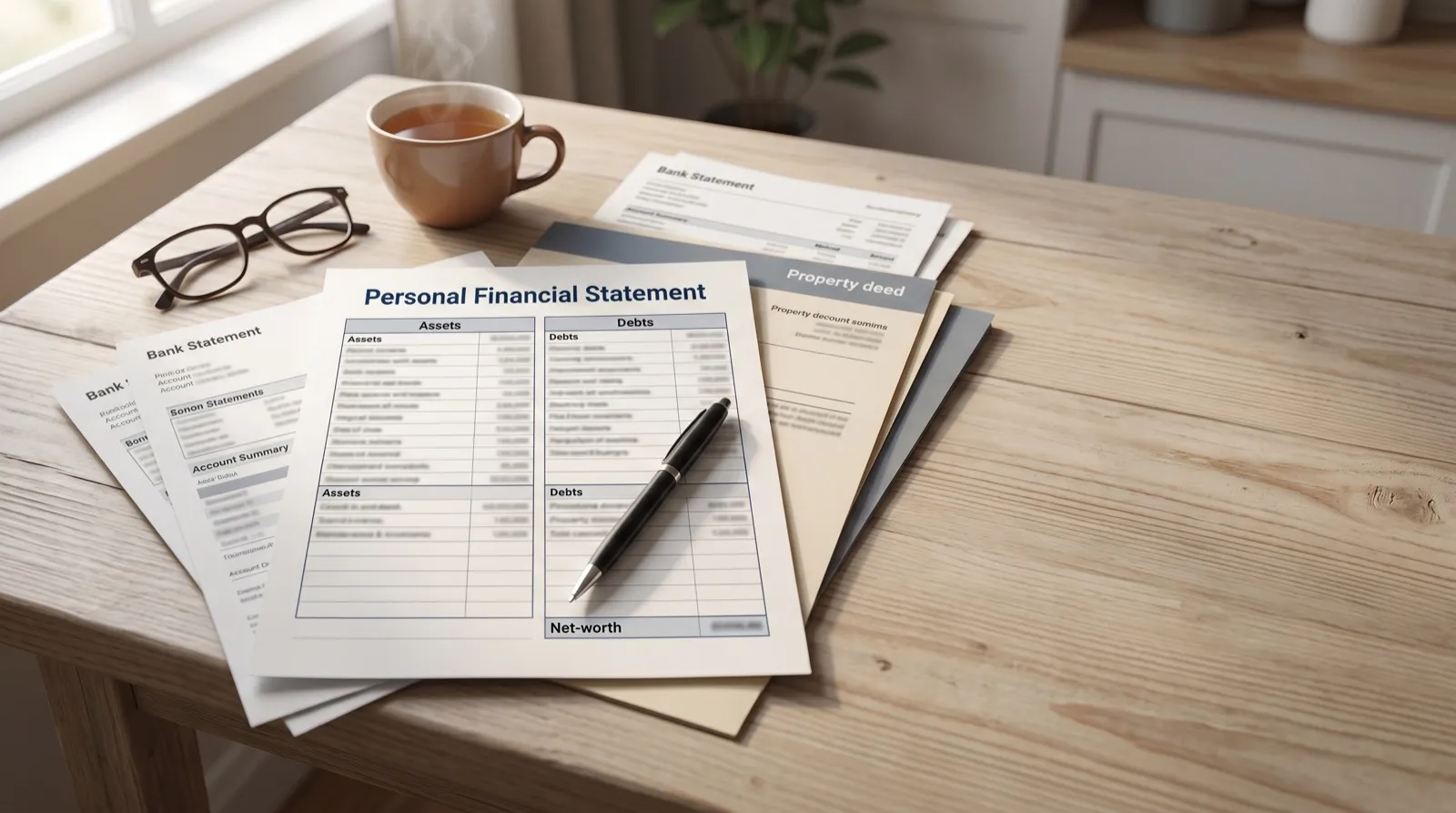

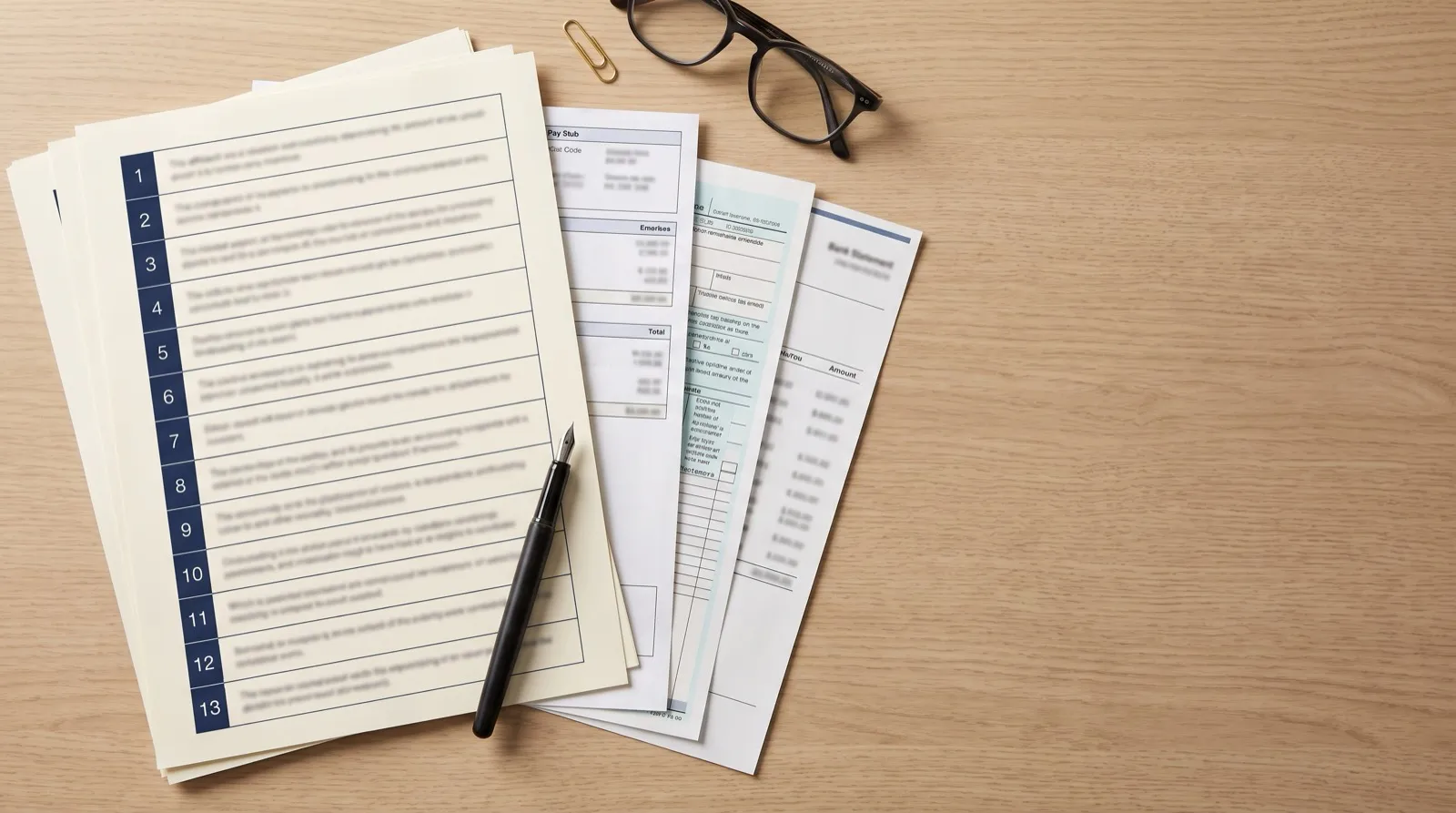
The Illinois financial affidavit is the sworn statement of income, expenses, assets, and debts that a judge uses to set temporary support and, later, to divide the marital estate. You complete one when you ask for temporary support, temporary maintenance, or interim attorney fees, and whenever a local rule or the judge requires it. Illinois uses one statewide form: the Financial Affidavit (Family & Divorce), form code ATJ 251.5, carrying the revision notation (06/25) and listed by the Illinois Courts as approved 06/2025. It runs 11 pages and 13 numbered sections, and this walkthrough covers each one in the order the form asks.
Key takeaways
- One form is used statewide. 750 ILCS 5/501(a)(1) says “one form of financial affidavit, as determined by the Supreme Court, shall be used statewide,” which ended the county-by-county patchwork.
- The affidavit functions as evidence. Temporary support is decided on a summary basis from the affidavits and the attached documents, usually without live testimony.
- Attachments are part of the requirement. The statute names tax returns, pay stubs, and banking statements by category.
- Section 9 has no equivalent on a lender’s form. Five subtotal categories of monthly household spending are what turn a balance sheet into a support calculation.
- Sanctions are mandatory, not discretionary. A court shall impose penalties for an intentionally or recklessly inaccurate affidavit.
- It is not a public record by default. The statute keeps the affidavit and its exhibits out of the public file unless the judge directs otherwise.
What the Illinois financial affidavit is
The Illinois Financial Affidavit (Family & Divorce) is the standardized Illinois Supreme Court form on which a party to a family or divorce case discloses income, monthly living expenses, assets, and debts under certification. In proceedings under the Illinois Marriage and Dissolution of Marriage Act, 750 ILCS 5/501(a)(1) makes it the single statewide form and requires it to be supported by tax returns, pay stubs, and bank statements. It is signed under 735 ILCS 5/1-109, which makes a material false statement a Class 3 felony.
Before the 2016 rewrite of the Illinois Marriage and Dissolution of Marriage Act, counties used their own affidavits or none at all. The statewide form fixed that, and it also fixed a disclosure problem that practitioners had complained about for years.
There’s no way the system could work if everything went to an evidentiary hearing.
That is the whole design. Section 501 says temporary maintenance and temporary child support “shall be dealt with on a summary basis based on allocated parenting time, financial affidavits, tax returns, pay stubs, banking statements, and other relevant documentation,” with a live hearing only on a showing of good cause. Your affidavit stands in for your testimony.
58,679
New family cases filed in Illinois circuit courts in 2024
Before you start
Plan on two to three hours if you are a single-employer W-2 earner with one bank and one mortgage. Plan on a weekend, spread over a couple of sittings, if you own a business or hold rental property.
The statute names tax returns, pay stubs, and banking statements as the required categories. The list below is the practical version of that, plus what you will need to answer Sections 9 through 11:
- Your filed federal and state tax returns, with all schedules, W-2s, 1099s, and K-1s. Cook County Rule 13.3.2 sets the local number at the last two calendar years; other circuits set their own, so check yours.
- Your most recent pay stub showing year-to-date gross and deductions. Cook County’s rule accepts the five most recent stubs instead when your employer does not print year-to-date figures.
- Statements for every checking, savings, money-market, brokerage, and retirement account. No rule cited here sets a number of months. Twelve is what Section 9 takes to categorize from records instead of memory.
- Mortgage and HELOC statements, vehicle loan payoffs, and current credit-card balances.
- Any existing support order and proof you are paying it.
- Business tax returns and a current profit-and-loss statement if you are self-employed.
One rule the form states up front and people miss: do not put Social Security numbers, taxpayer-identification numbers, driver’s license numbers, or financial account numbers on the affidavit. Black them out on anything you attach. The account-number columns in Section 11 are absent for this reason.
Section 1 — Basic Information
Section 1 asks whether you are the Petitioner or the Respondent. It then asks you to swear the information is true as of a stated date. Check boxes follow for the documents you are attaching: pay stubs, income tax returns, bank statements, and anything else supporting Sections 10 and 11.
The date in Section 1b governs every balance you report later. Pick a date you can document across all accounts, usually a month-end statement date, and use that same date everywhere.
Section 2 — Information About Myself
Name, phone, date of birth, and address. If disclosing your address would put you or your household at risk, the form permits an alternative address at which you can receive case mail.
Section 3 — My Employment/Business
Three paths: unemployed, employed by someone else, or self-employed with other business income.
The employed path asks for employer name and address and the number of paychecks per year: 12, 24, 26, 52, or paid in cash. It also asks for gross income from that employer since January 1, as of a stated date.
The self-employed path asks you to identify the entity type. Report gross business receipts for last year and this year, then ordinary and necessary business expenses for both. Last come check boxes for perquisites the business provides: reimbursed meals, a company car, free housing or a housing allowance, or other.
Those perquisite boxes are the ones business owners underestimate. They exist because a lender and a judge both look past reported salary to what the business funds. If the company pays your phone, your vehicle, and your health premium, say so.
More than one job or business means attaching an Additional My Employment/Business form. The suite publishes a separate overflow schedule for most sections, so extra jobs, debts, and accounts each get their own page rather than a cramped margin.
Section 4 — My Gross Income and Taxes From Last Year
A short section that transcribes last year’s federal return: filing status, gross income, and taxes. Copy the figures from the return itself rather than from memory, because the return is already an attachment and the other side will compare the two.
Section 5 — My Monthly Gross Income From All Sources
The longest income section on the form. Roughly thirty lines total into Total Gross Monthly Income:
- Earned — regular employment and self-employment earnings, overtime, commission, tips, bonus.
- Retirement and investment — pension, annuity, interest, dividends, trust income, investment income, royalties.
- Government — Social Security retirement, Social Security disability, SSI, unemployment, workers’ compensation, TANF and SNAP, military allowances.
- Business and property — rental income, partnership income, distributions and draws.
- Household — maintenance received, child support received, non-Social-Security disability payments, gifts of money.
Two parentheticals are printed next to specific lines and both matter:
- SSI is marked “not included as income for child support purposes.”
- TANF and SNAP carry the same exclusion.
You still report them. The exclusion is applied downstream in the support calculation, not by leaving the line blank.
Maintenance received is split into two lines: amounts you must report as income on your tax return, and amounts you do not. Orders entered after January 1, 2019 generally fall into the second category.
Section 6 — My Monthly Payroll Deductions
Five lines only: federal tax, state tax, FICA or a self-employment-tax equivalent, Medicare tax, and mandatory retirement contributions required by law or as a condition of employment. They total into Total Monthly Deductions.
The mandatory-retirement line carries its own parenthetical, printed on the form, reading “not allowed as a deduction if you also have a deduction for FICA or Social Security equivalent”. Voluntary 401(k) contributions do not belong here at all. Neither does health insurance, which the form routes to Section 9e.
Section 7 — Monthly Maintenance Payments
Section 7 captures maintenance you pay under an order in this case and under an order in any other case, with a tax-deductibility check box for each. Attach the order and proof of payment.
Section 8 — Monthly Child Support
Section 8 is more granular. It separates:
- 8a — child support you pay under an order in this case.
- 8b — child support you pay under orders in other cases, listed by county, state, number of children, case number, and amount.
- 8c — support you pay to the other parent with no court order behind it.
- 8d — other biological or adopted children living in your home whom you support, with how parentage was established for each: born during the marriage or union, a voluntary acknowledgment of paternity, or a court order.
Sections 8c and 8d exist because the Illinois support calculation accounts for children you support outside the case. Leaving them blank understates your obligations and works against you.
Build your personal financial statement in minutes
StatementsReady syncs bank balances read-only through Plaid, fills SBA Form 413, and exports a lender-ready PDF on demand.
- SBA Form 413 with every section filled
- Bank sync through Plaid, read-only
- 7 days free, no card
Section 9 — My Monthly Living Expenses
Five subtotal blocks, each adding into Total Monthly Living Expenses:
| Block | Covers |
|---|---|
| 9a Household Expenses | Mortgage or rent, HELOC and second mortgage, real estate taxes, association dues, homeowners or renters insurance, gas, electric, telephone, cable or satellite |
| 9b Transportation Expenses | Vehicle payments, fuel, insurance, maintenance, and related costs |
| 9c Personal Expenses | Out-of-pocket medical, life insurance premiums, clothing, grooming, gym dues, entertainment and dining, subscriptions, gifts, donations, vacations, union and professional dues, professional fees |
| 9d Minor and Dependent Children Expenses | Child-specific costs kept separate from the household total |
| 9e Health Insurance Expenses | Health premiums, including amounts deducted from your paycheck |
The instruction line says to enter what your household spends on each item each month, which is a different question from what you personally spend. Read it that way, then be consistent about it across every line.
Section 9 is where affidavits fall apart. Household expenses are the one part of the form no bank statement summarizes for you, and estimating them from memory produces a number that will not survive comparison against twelve months of transactions. Pull the actual statements and categorize.
Health insurance has a routing rule worth repeating: premiums deducted from your paycheck belong in 9e, not in Section 6.
Section 10 — My Debts
A six-row table for creditor name, what the debt was for, amount owed, and the monthly payment you are making, totaling into Total Monthly Debt Payments. Overflow goes on an Additional My Debts form.
The heading carries its own instruction: do not list expenses included in Section 9. Your mortgage payment and your car payment are already counted there. Listing them again in Section 10 double-counts your monthly outflow, and it is an easy error for the other side to spot.
Section 10 is for the debts that are not already monthly line items: credit-card balances, past-due bills, attorney’s fees, parking tickets, financed household goods. If you want the classification framework behind current, long-term, and contingent obligations, our breakdown of types of liabilities covers how each is reported.
Section 11 — My Assets
Five lettered subsections, each with its own overflow schedule. Balances and values are stated as of the date of this affidavit, the date you entered in Section 1b.
- 11a Cash and Cash Equivalents — checking, savings, money-market and other bank or credit-union accounts by institution, name on account, and type; certificates of deposit; and cash, prepaid debit cards, and money-transfer apps such as Venmo, PayPal, and Apple Pay.
- 11b Investment Accounts and Securities — stocks, bonds, options, and employee stock ownership plans by company, share count, type and owner; plus brokerage accounts, mutual funds, secured and unsecured notes, and cryptocurrency.
- 11c Property & Business Interests — business interests by name, entity type, and ownership percentage; real estate by address, name on title, fair market value, and mortgage balance; and any transfer or sale of assets or property within the last two years with a fair market value of at least $1,000.
- 11d Insurance and Retirement — life insurance policies with death benefit and cash value, and retirement accounts.
- 11e Personal Property — vehicles, furnishings, and other tangible property.
The form defines fair market value on the page: “a selling price for an item to which an unrelated buyer and seller can agree.” That is a market standard, not a purchase price and not a tax-assessed value. Using the assessor’s number for a house is a routine source of disagreement.
The two-year transfer disclosure in 11c is the line most people read past. It asks about dispositions, not holdings, so a car sold to a relative, a crypto position liquidated, or a “loan” to a sibling all belong there. Assume the other side will reconstruct the same list from your bank statements, because those statements are already attached.
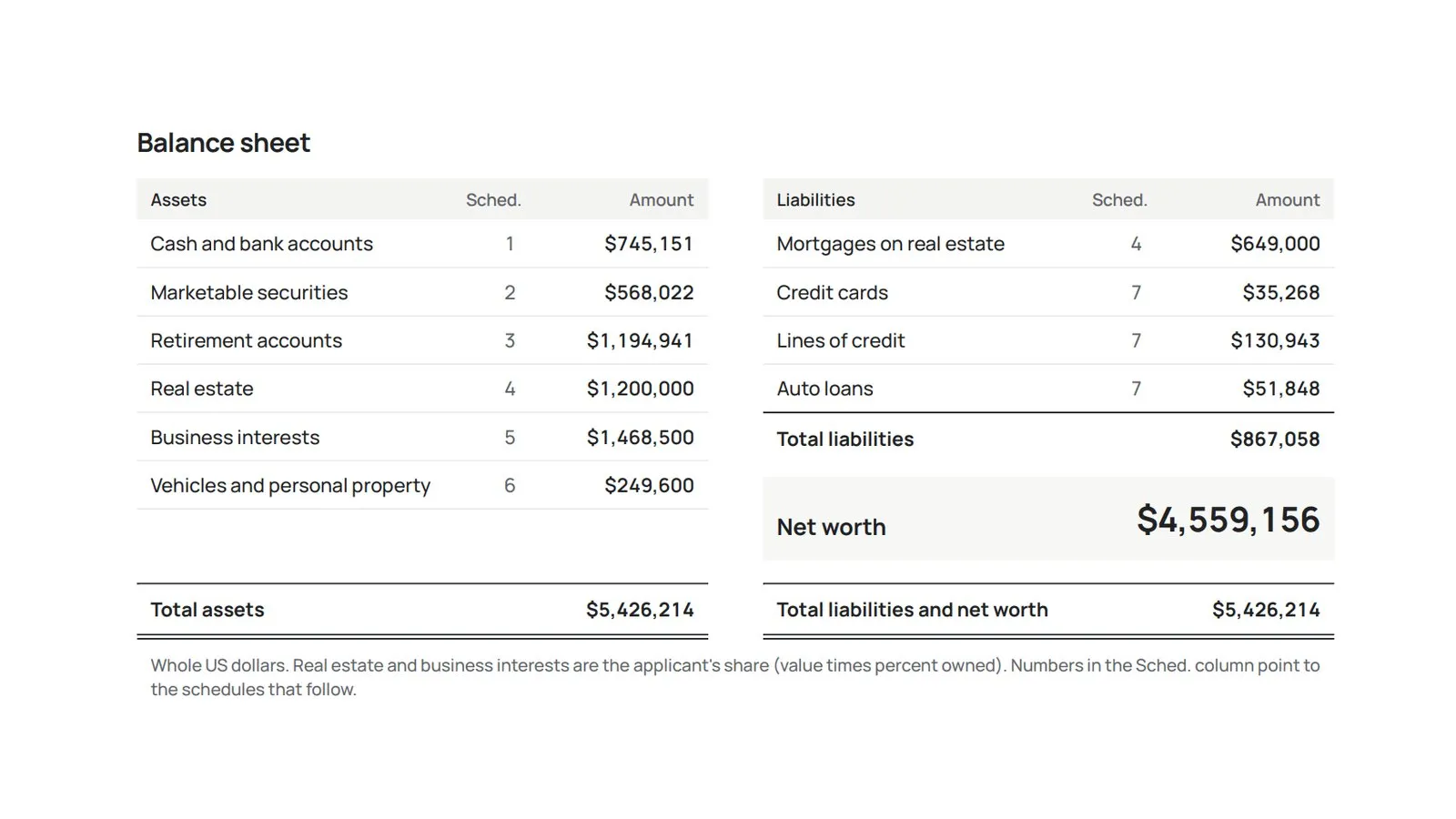
Building the underlying inventory is the same work whether it feeds a court form or a lender package. Our list of assets and liabilities walks through the account-by-account sweep, and the free net worth calculator totals it without a signup.
Section 12 — Lawsuits and Claims
Section 12 covers lawsuits and claims, naming workers’ compensation and disability as examples. A pending claim is a contingent asset even when no money has arrived, and it belongs on the form.
Section 13 — Income Tax Refunds or Amounts Owed for the Last 2 Years
Federal and state, for both years. A refund you have not yet received is an asset, and an amount owed is a liability that Section 10 will not have captured.
Signing, serving, and what not to file
The signature block states the rule plainly.
The form states that under 735 ILCS 5/1-109, signing means the document is true and correct, or true to your information and belief. It adds that a false statement is perjury with penalties provided by law. The statute itself sets the penalty: a material false statement in a certified document is a Class 3 felony. Typing your name counts as signing if you complete the form online.
The form’s own NEXT STEP block then sets out three steps, in this order:
- Serve a copy of the completed affidavit and the supporting documents on the other person in the case, or on their lawyer if they have one.
- File a Proof of Delivery with the Circuit Clerk showing you sent it.
- Do not file the affidavit itself with the Circuit Clerk unless a local rule or court order requires it.
Cook County works the same way. Rule 13.3.1(d) says the completed affidavit should not be filed with the Clerk unless the court orders it, and asks each party to file a Certificate of Service instead.
When the Illinois financial affidavit is due
The statewide instructions set no single date. The Illinois Courts instruction sheet ties the deadline to your local court rules and to any deadline the judge sets. It adds one date of its own: if you file a request for temporary child support, temporary maintenance, or interim attorney fees, the affidavit is due at the same time.
Cook County supplies the dates that the statewide instructions leave to local rules. Under Rule 13.3.1(a), the petitioner serves within 30 days after service of the initial pleading. The respondent serves within 30 days after filing an appearance. Either deadline gives way to a hearing set sooner, since service is due not less than seven business days before one.
Post-judgment proceedings follow the same schedule. Rule 13.3.1(a) adds that when further relief is sought and a material change of circumstances has occurred, an updated affidavit must be served at least seven days before any hearing. Those dates are local to Cook County. Check your own circuit’s domestic-relations rules for the equivalent deadlines.
What happens after you serve it
The other side reads your affidavit against your attachments before they read anything else. Three things typically come back.
A disparity motion. Either party may move for a hearing on “whether and why there is a disparity between a party’s sworn affidavit and the supporting documentation,” under Section 501(a)(1). Bonus income that appears on the W-2 but not in Section 5 is the classic trigger.
A sanctions request. The statute is written in the mandatory: a court shall impose significant penalties and sanctions, including costs and attorney’s fees, when a party intentionally or recklessly files an inaccurate or misleading affidavit. Note that the standard reaches reckless filing, not just intentional filing, which is a lower bar than most people assume. In Cook County, failure to serve on time separately exposes a party to sanctions under Illinois Supreme Court Rule 219, and non-compliance is not grounds to continue the hearing.
A supplement request. Missing statements, an unattached K-1, a business return that was never filed. These are ordinary and are cured by producing the document, not by re-arguing the number.
An honest error is fixed with an amended affidavit, served the same way the original was. Send the correction as soon as you find it, because a correction you volunteer reads very differently from one the other side extracts.
Illinois financial affidavit vs. a lender’s personal financial statement
They are different documents with different audiences, and one cannot be substituted for the other. Divorce and refinancing arrive together often enough that the overlap is worth planning for. Both draw on the same account inventory, and they diverge on six dimensions.
| Dimension | Illinois Financial Affidavit | Lender’s personal financial statement |
|---|---|---|
| Audience | The judge and the other party | An underwriter |
| Signature | Certified under 735 ILCS 5/1-109, Class 3 felony exposure | Signed representation on the lender’s form |
| Monthly budget | Section 9, five subtotal categories | Not requested |
| Asset transfers | Two-year lookback at $1,000 and above in Section 11c | Rarely requested; SBA Form 413 has no equivalent field |
| Valuation date | The date you enter in Section 1b | The lender’s own recency window |
| Filing | Served on the other party, not filed with the clerk by default | Submitted directly to the lender |
The failure mode is a sequencing problem. The two get built separately, weeks apart, from different starting points, and then someone lines them up. Build the account inventory once, timestamp it, and report from it into each document on that document’s own date. When a value differs between the two, you want a reason on hand: a market move, a paid-down balance, a different valuation standard.
StatementsReady builds the lender-side document, not the court form. The Illinois affidavit is completed on the court’s own PDF, and Illinois Legal Aid Online publishes a free guided interview for it. Where our product helps is the inventory underneath: read-only Plaid bank sync pulls current balances, so the asset list you hand your attorney reflects real account data.
We are not attorneys and this is not legal advice. Your own counsel decides what goes on a court filing.
For the surrounding workflow, see our divorce financial disclosure use case and the step-by-step personal financial statement for divorce disclosure guide.
What to do next
- Download the current Financial Affidavit (Family & Divorce) from ilcourts.info/forms and save it to your computer before typing into it. The Illinois Courts warn that filling a form out on a webpage loses your progress.
- Pick your Section 1b date and pull statements as of that date for every account.
- Categorize twelve months of spending before you touch Section 9.
- Reconstruct the two-year transfer list for Section 11c from your own bank statements.
- Confirm the deadlines in your own circuit’s domestic-relations rules, then serve and file the Proof of Delivery.
Those five steps get your file ready. What you serve and file is governed by your own attorney and your circuit’s rules.
If you also owe a lender a personal financial statement during the case, the comparison of the two documents is covered in financial affidavit vs. personal financial statement. New York’s equivalent filing is walked through in how to complete a New York Statement of Net Worth, and more on this topic is in our personal finance archive.
Skip the spreadsheet
A lender-ready personal financial statement from synced balances, in about 8 minutes.
- 7 days free
- No credit card
- PDF, SBA Form 413, Word, or Excel
Build your personal financial statement in minutes
StatementsReady syncs bank balances read-only through Plaid, fills SBA Form 413, and exports a lender-ready PDF on demand.
- SBA Form 413 with every section filled
- Bank sync through Plaid, read-only
- 7 days free, no card