Business Debt Schedule: How to Build One Lenders Accept
How to build a business debt schedule lenders accept: which columns to fill, what to leave off, and how to reconcile the total to your balance sheet and DSCR.

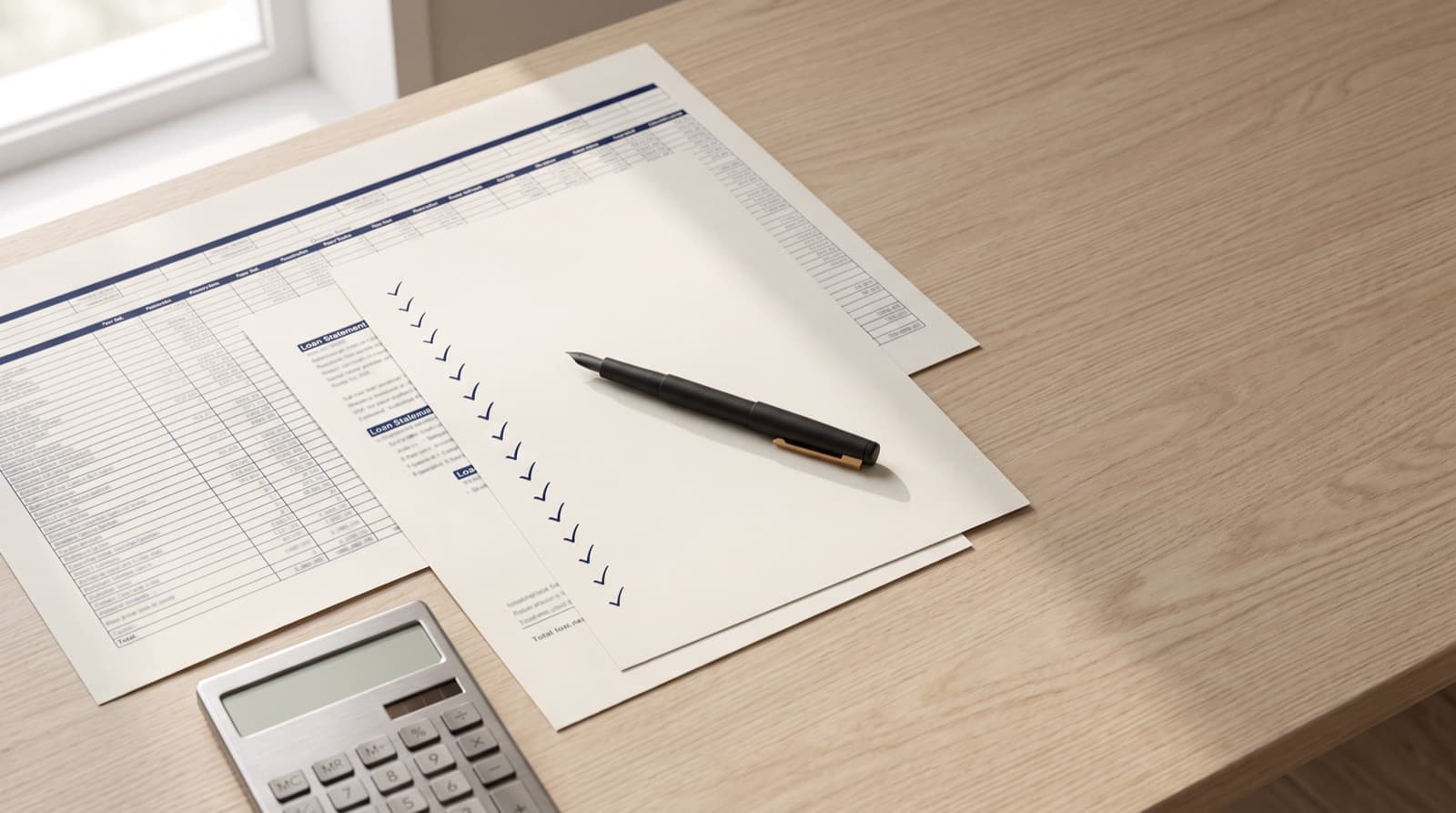
A business debt schedule is a one-row-per-loan table of every financed obligation your company owes, and lenders use it to total your existing debt service before deciding whether cash flow supports a new loan. Building one takes about an hour if your loan statements are handy, and the entire exercise comes down to three things: list the right debts, fill the columns exactly, and make the total agree with your balance sheet.
Definition
A business debt schedule is a supporting schedule to the balance sheet that itemizes every interest-bearing or financed obligation of the business, one row per debt, showing the creditor, original loan date and amount, current principal balance, interest rate, periodic payment, maturity date, collateral, and original purpose. Its function in underwriting is to let a lender compute total annual debt service, which becomes the denominator of the debt service coverage ratio.
The columns lenders ask for
Published lender schedules vary in layout, and they converge on the same fields. This is the set that satisfies almost every template you will be handed:
| Column | What goes in it | Where to get it |
|---|---|---|
| Creditor name | Legal name of the bank, lender, or lessor | Your loan agreement |
| Original date | Date the loan funded | Loan agreement or note |
| Original amount | Starting principal | Loan agreement or note |
| Current balance | Remaining principal as of your schedule date | Most recent loan statement |
| Interest rate | Current rate, noting fixed or variable | Loan statement |
| Monthly payment | Total recurring principal and interest | Loan statement |
| Maturity date | Date of the final payment | Loan agreement |
| Collateral | Assets securing the loan | Loan agreement or UCC filing |
| Original purpose | What the money bought | Your records |
| Status | Open or closed, current or past due | Loan statement |
Two more columns show up specifically on SBA lender templates. A published SBA lender debt schedule from Business Development Corporation adds a government-loan flag asking whether the debt is an EIDL, PPP, 7(a), 504, or other government loan along with the account number, and instructs applicants to list all government loans the business has received "whether still open or now closed." The other is a refinance marker, where an asterisk indicates any debt the new loan will pay off.
Before you start
What you need: the most recent statement for every business loan, line of credit, equipment lease, and business credit card carrying a balance; your interim balance sheet; and the same information for any affiliate business you control.
Time: roughly one hour for a business with five to ten obligations. The reconciliation in Step 6 is what takes the time, not the typing.
Cost: none. Your lender supplies the template.
Step 1 — Set one "as of" date and pull statements to match
Pick the date of your interim balance sheet and use it for everything. Then pull the loan statement closest to that date for each debt.
Mismatched dates across the file are a routine cause of underwriting delays. Pursuit Lending, an SBA lender, lists mismatched dates on interim financial statements among its top delay triggers, noting that your profit-and-loss statement, balance sheet, AR and AP agings, and debt schedules "need to have the same date or date range" so the lender can evaluate a single period.
Done looks like: every statement in front of you shows a balance as of the same month-end.
Common mistake: pulling the current balance from an online amortization calculator. Use the lender's actual statement, which reflects fee roll-ins, deferred interest, and any payment timing your calculator does not model.
Step 2 — List only financed debt
Include term loans, commercial mortgages, equipment loans, vehicle loans, lines of credit, capital leases, business credit cards carrying a revolving balance, merchant cash advances, and shareholder notes.
Exclude the operating liabilities. The Business Development Corporation schedule states the instruction plainly: the form covers "installment debts, notes, lines of credit and mortgages," and applicants are told to "not include accounts payable or accrued liabilities." Payroll liabilities and sales tax payable come off for the same reason. They are operating obligations that your AP aging and balance sheet already report, and folding them in inflates your apparent debt service.
Two edge cases decide themselves once you know the rule. A line of credit with a zero balance still gets a row showing zero, because the lender wants to see the available facility. A capital lease belongs on the schedule because it is a financing arrangement, while a true operating lease for office space generally does not.
Step 3 — Fill every cell, including the ones that do not apply
Blank cells read as unanswered questions and generate follow-up requests. If a revolving card has no maturity date, write N/A. If a payment is deferred to zero, write 0. Both are answers. An empty box is not.
Note whether each rate is fixed or variable. On a schedule with several variable-rate loans, an underwriter modeling a rate move needs to know which rows are exposed, and supplying that upfront saves a round trip.
Step 4 — Add shareholder debt
If you have loaned money to your own company under a formal note with an expectation of repayment, it goes on the schedule. This is written into SBA policy rather than left to lender preference.
To perform a complete analysis of debt service, it is important for a Lender to obtain a current debt schedule prepared by the Applicant, including any shareholder debt.
Owners leave these off constantly, usually reasoning that money they lent themselves is not real debt. From the underwriter's side it is a claim on the same cash flow as every other row. If the note will not be repaid until after the SBA loan matures, put it on the schedule and ask your lender about standby treatment.
Done looks like: the schedule includes obligations owed to you and to any related party, each with a real balance and payment.
Build your personal financial statement in minutes
StatementsReady syncs with your bank accounts, auto-populates SBA Form 413, and generates a lender-ready PDF on demand. No spreadsheets, no manual updates.
- SBA-compliant Form 413 generation
- Bank sync via Plaid (read-only)
- Always current — no stale snapshots
Step 5 — Build separate schedules for affiliates
If you control other entities, each one generally needs its own schedule. SBA cash flow analysis reaches beyond the applicant to affiliates because their obligations touch the same owners and the same cash. One SBA 7(a) loan application instructs applicants to include the debt schedule for affiliate businesses alongside the operating company's, and to make the balance-due column agree with the note balances on the most recent financial statement provided.
If you own the operating company and a separate entity that holds the real estate, expect to produce two schedules.
Step 6 — Reconcile the total to your balance sheet
This is the step that decides whether your schedule gets accepted, and it is where most first drafts fail.
The SBA's own description of Form 2202, the disaster-program equivalent, captures the standard cleanly: the schedule "is a supplement to your balance sheet and should balance to the liabilities presented on that form."
Your schedule total will usually not match the long-term debt line on your balance sheet, and that is correct accounting. Standard balance sheet presentation splits every term loan across two lines. The principal coming due in the next twelve months sits up in current liabilities as the current portion of long-term debt. The rest sits below in long-term debt. Your debt schedule, by contrast, carries the full remaining principal on a single row per loan.
Term loans are not the only complication. A drawn line of credit and a revolving card balance are usually reported as current liabilities in their own right, separate from the current portion of long-term debt, and both belong on your schedule.
The reliable way to reconcile is to work backward from total liabilities:
Debt schedule total = total liabilities − accounts payable − accrued liabilities − taxes payable − deferred revenue and customer deposits
Whatever remains is financed debt, and that is your target number. If your schedule does not hit it, find the missing row or the stale balance before your lender does.
Common mistake: reconciling to the long-term debt line alone, concluding the numbers are off by roughly one year's principal, and "fixing" the schedule by understating balances.
Step 7 — Run your own coverage ratio before you submit
Total the monthly payment column and multiply by twelve. Subtract the annual payments on any debt the new loan will pay off, which is what the refinance asterisk in Step 2 marks. Then add the annual payment on the loan you are requesting. That figure is your pro-forma debt service, and it is the number the lender divides into your cash flow.
Skipping the subtraction is the common error, and it double-counts refinanced debt. SOP 50 10 8 defines debt service as the future required payments after the transaction closes, so a loan being retired at closing does not belong in the total.
1.15
Minimum SBA 7(a) debt service coverage ratio (operating cash flow ÷ debt service) under SOP 50 10 8
Source: SBA SOP 50 10 8, Lender and Development Company Loan Programs
SOP 50 10 8 defines operating cash flow as EBITDA and debt service as future required principal and interest on all business debt including the new SBA loan proceeds. The applicant's ratio must reach 1.15 on a historical or projected basis and 1:1 globally. Effective March 1, 2026, 7(a) Small Loans of $350,000 or less carry a lower floor of 1.10:1, per Starfield & Smith's summary of the procedural notice that also sunset the mandatory SBSS minimum for those loans. Many lenders underwrite to 1.25 regardless, because a deal at the floor has no margin.
Running this yourself changes what you do next. A ratio under the floor is a structural problem that no formatting fixes, and the levers are a smaller request, a longer amortization, or paying off a short-maturity obligation first. Our DSCR calculator will do the arithmetic, and how to calculate DSCR walks through the add-backs. To model the new payment before you add it, the SBA loan calculator covers both 7(a) and 504 structures.
What "done" looks like
Your finished schedule has one row per financed obligation, no blank cells, an "as of" date matching your interim balance sheet, a total that equals your balance sheet liabilities less the operating items, separate schedules for any affiliates, and shareholder notes included. You know your pro-forma DSCR before the lender calculates it.
What to do next
The debt schedule is one document in a larger package, and it has a personal-side counterpart. Your business debts go on the debt schedule; your personal debts go on SBA Form 413, the personal financial statement every owner of 20% or more files. Underwriters read them together, and the contingent liabilities section of the 413 is where a personal guarantee on business debt gets disclosed, which is exactly the kind of cross-document consistency that gets checked.
StatementsReady handles that personal side. It generates the Form 413 and personal financial statement from your synced balances so the personal half of the file is consistent and current, while the debt schedule stays with your bookkeeping.
Next steps worth taking in order:
- Finish the schedule using the columns above, then reconcile it.
- Work through the rest of the package with 10 documents needed for a business loan, where the debt schedule is item five.
- Build the personal financial statement that travels with it. See personal financial statement for a business loan for what lenders check, and the SBA Form 413 template to start from a structured layout.
- If your obligations need sorting before they go on the schedule, types of liabilities covers the current, long-term, and contingent distinction, and Form 413 Section 5 covers contingent liabilities specifically.
For the full application workflow, see our business loan applications use case. More on this topic is in the business lending archive, and SBA 7(a) loan requirements covers the current rule set.
Skip the spreadsheets
Generate a lender-ready personal financial statement in minutes with StatementsReady.
- Free to start
- No credit card required
- Used by SBA-preferred lenders
Frequently asked questions
Build your personal financial statement in minutes
StatementsReady syncs with your bank accounts, auto-populates SBA Form 413, and generates a lender-ready PDF on demand. No spreadsheets, no manual updates.
- SBA-compliant Form 413 generation
- Bank sync via Plaid (read-only)
- Always current — no stale snapshots
Keep reading
What Is on a Profit and Loss Statement? Line by Line
Every line on a profit and loss statement, top to bottom, and how an underwriter turns your net income into the cash flow figure behind the loan decision.

Business Loan Without Personal Guarantee: The Honest Answer
Which business loans you can get without a personal guarantee, which always require one (every SBA loan does), and how to qualify to skip it.

10 Documents Needed for a Business Loan (2026 Guide)
The 10 documents lenders require for a business loan: personal financial statement, tax returns, bank statements, and the SBA forms, plus how to prep each.