

A financial affidavit is a sworn court form covering your income, monthly expenses, assets, and liabilities. A personal financial statement is a private balance sheet a lender reads to size your net worth and your guaranty. Both ask for the same accounts and the same debts, which is why people fill out one and assume it covers the other. It does not, and the two documents can end up in the same file.
Key takeaways
- The affidavit’s distinguishing section is the expense schedule, stated monthly in Florida and California and weekly in Connecticut. Form 413 has no expense section at all.
- The lender statement’s distinguishing section is contingent liabilities: guaranties, endorsements, and legal claims that are not yet debts.
- The affidavit is sworn and, in contested cases, often filed publicly. The lender statement stays inside a credit file.
- Florida’s mandatory disclosure rule requires you to hand the other side every financial statement you prepared for a lender in the prior 24 months.
- Recency runs on different clocks: 90 days from submission for a 7(a) or 504 Form 413 from October 1, 2026 (90 for Disaster too), 45 days from service of the petition in Florida.
The quick answer
Use the court’s form when a judge decides something about your money. Use a lender’s form when a credit committee does.
The court form asks what comes in and what goes out on a recurring basis, because support is a recurring number. The lender form asks what you own and owe on one date, because a guaranty is backed by a balance sheet. Neither substitutes for the other, and filling out one gives you most of the raw data for the other.
What a financial affidavit is
A financial affidavit is a sworn statement of a party’s current income, expenses, assets, and liabilities, filed or exchanged in a family law case on a form the court prescribes. It is signed under penalty of perjury and is the record a judge uses to divide property and set child support or alimony. Some states, Florida among them, attach a continuing duty to correct it.
Connecticut’s practice materials put the definition plainly. A financial affidavit “is a sworn statement, substantially in accordance with a form prescribed by the Chief Court Administrator, which sets forth the current income, expenses, assets and liabilities of the signing party,” per the Connecticut Bar Association’s family law materials on Practice Book § 25-30.
The document goes by a different name in each state, and some states use a sworn affidavit while others use a declaration signed under penalty of perjury without a notary. Four examples:
- Florida uses the Family Law Financial Affidavit, Form 12.902(b) for gross annual income under $50,000 and Form 12.902(c) at or above that figure.
- Connecticut uses Form JD-FM-6, short version when gross annual income and total net assets are both under $75,000, long version otherwise.
- New York uses the Statement of Net Worth, revised effective December 1, 2025, sworn before a notary under Domestic Relations Law § 236(B)(4). Our New York statement of net worth walkthrough covers that form line by line.
- California uses a declaration rather than an affidavit, split across the Income and Expense Declaration (FL-150) and the Schedule of Assets and Debts.
The oath is the part that makes it an affidavit. California’s FL-150 ends with “I declare under penalty of perjury under the laws of the State of California that the information contained on all pages of this form and any attachments is true and correct.” New York’s form has the filer “being duly sworn” and deposing “subject to the penalties of perjury.” Connecticut’s carries a warning that willful misrepresentation “will subject me to sanctions and may result in criminal charges being filed against me.”
672,502
Divorces and annulments recorded in the United States in 2023 across 45 reporting states and D.C.
The affidavit also has a deadline tied to the case, not to a lender. Florida Family Law Rule of Procedure 12.285 sets that deadline at 45 days from service of the initial pleading. The rule states that the requirement “cannot be waived by the parties,” per the Florida Bar’s publication of the rule. Connecticut requires a current affidavit before hearings on alimony, support, or counsel fees.
Judges, general magistrates, and child support hearing officers regularly utilize the financial affidavit as a benchmark or jumping off point for questioning the self-represented litigants.
What a lender’s personal financial statement is
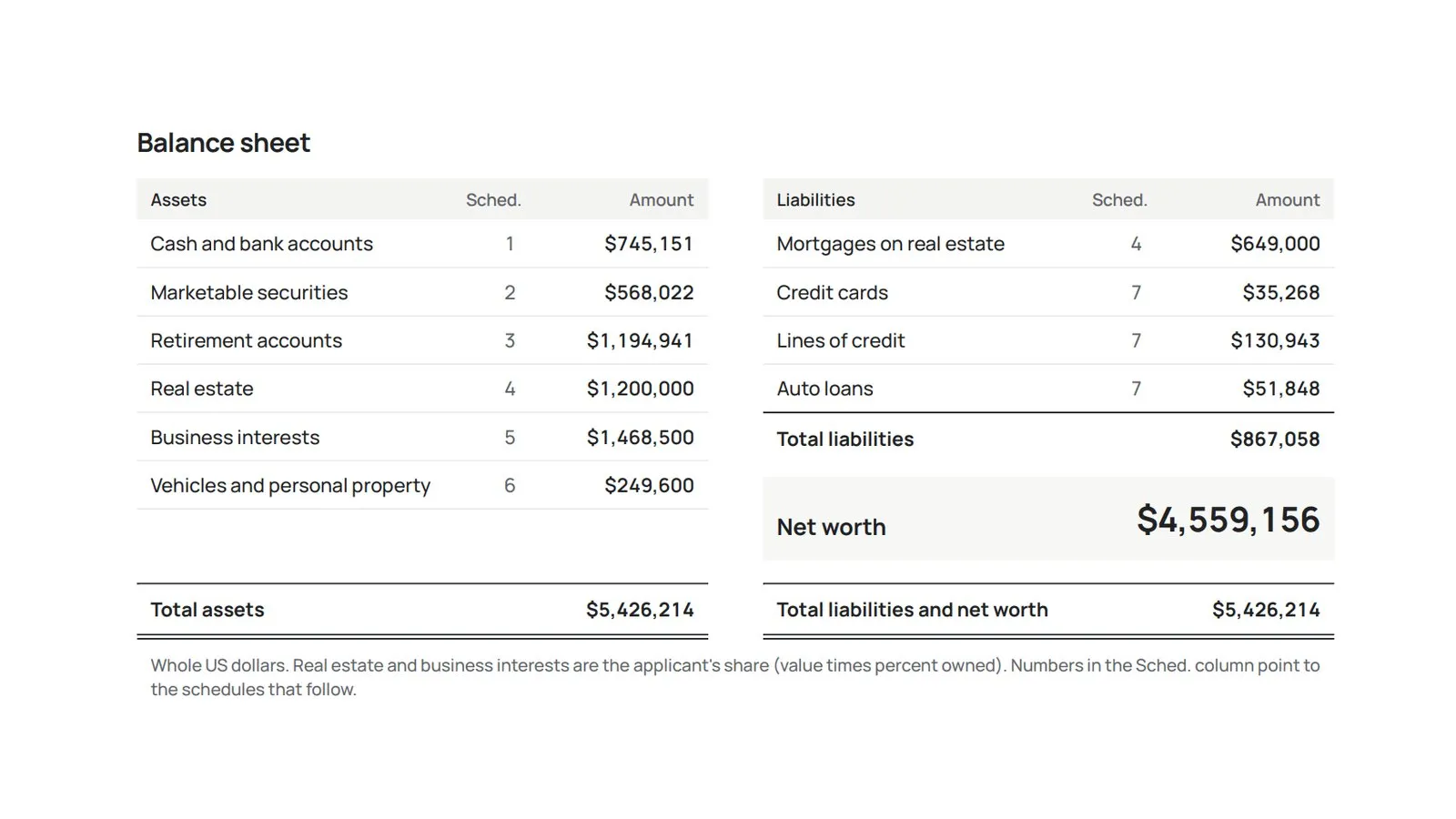
A personal financial statement is a balance sheet for a person. Assets on the left, liabilities on the right, net worth as the difference. The full definition of a personal financial statement covers the general form; the standardized version most borrowers meet is SBA Form 413.
The SBA says it uses Form 413 “to assess repayment ability and creditworthiness” of applicants. The covered programs are 7(a) loans, 504 loans, Disaster loans, surety bond guarantees, the 8(a) Business Development program, and Woman-Owned Small Business certification. Under SOP 50 10 8, an owner financial statement must be “signed and dated within 120 days of submission to SBA, for all owners of 20% or more (including the assets of the owner’s spouse and minor children), and proposed guarantors.” Lenders “may use SBA Form 413 or their own equivalent form,” per the SOP’s technical updates effective June 1, 2025. SOP 50 10 8.1 cuts that window to 90 days for loans submitted on or after October 1, 2026.
Its sections start with the asset and liability columns, Section 1 Source of Income, and a contingent liabilities panel. The supporting schedules run from Notes Payable through Stocks and Bonds, Real Estate Owned, Other Personal Property, Unpaid Taxes, Other Liabilities, and Life Insurance Held. Section 1 asks for annual salary, net investment income, real estate income, and other income. It never asks what you spend.
The contingent liabilities panel is the section with no affidavit counterpart. It captures obligations you are on the hook for without owing them yet. The lines cover amounts you endorse or co-make, legal claims and judgments, provision for federal income tax, and other special debt. Our Section 5 contingent liabilities breakdown explains how a guaranty on a partner’s building lease belongs there.
Form 413 carries its own criminal certification. The signer certifies “under penalty of criminal prosecution that all information on this form and any additional supporting information submitted with this form is true and complete.”
The form’s notice cites 18 U.S.C. §§ 1001 and 3571, 15 U.S.C. § 645, and 18 U.S.C. § 1014 where the statement reaches a federally insured institution.
Build your personal financial statement in minutes
StatementsReady syncs bank balances read-only through Plaid, fills SBA Form 413, and exports a lender-ready PDF on demand.
- SBA Form 413 with every section filled
- Bank sync through Plaid, read-only
- 7 days free, no card
Financial affidavit vs. personal financial statement, head to head
| Dimension | Financial affidavit | Personal financial statement |
|---|---|---|
| Prescribed by | The state court (FL 12.902, CT JD-FM-6, NY Statement of Net Worth, CA FL-150) | The lender, or the SBA for Form 413 |
| Audience | A judge or magistrate, plus opposing counsel | An underwriter and a credit committee |
| Expense schedule | Required; monthly in Florida and California, weekly in Connecticut | Absent from Form 413 |
| Contingent liabilities | Not a standard section | A dedicated panel on Form 413 |
| Oath | Sworn or declared under penalty of perjury; notarized in New York, sworn before a notary, lawyer, or clerk in Connecticut | Certified under penalty of criminal prosecution, not sworn before a notary |
| Governing penalty | State perjury statutes and court sanctions | 18 U.S.C. §§ 1001, 1014, 3571 and 15 U.S.C. § 645 |
| Deadline | Tied to the case calendar (45 days from service in Florida) | Tied to submission (90 days for 7(a) and 504 from October 1, 2026; 90 for Disaster) |
| Who sees it | Filed with the clerk in contested cases and often public | The lenders you give it to, held in their credit file |
| Update duty | Florida Rule 12.285(f)(1) imposes a continuing duty to supplement on a material change in financial status; other states vary | Regenerate when the window expires, and typically at annual review |
Two rows are worth sitting with. The expense schedule is why a lender statement cannot stand in for an affidavit: support is arithmetic on recurring income and recurring need. The contingent liabilities panel is why an affidavit cannot stand in for a lender statement, because a guaranty is what an underwriter prices.
When you need a financial affidavit
- A divorce, legal separation, or annulment where property is divided. Florida makes the affidavit non-waivable in contested cases, and Connecticut requires one before any support or fee hearing.
- A child support or alimony motion, including modification. The expense schedule is the record the judge works from.
- A paternity or custody case with a support component. Same form, same oath, no marriage required.
- Any hearing for temporary financial relief. Florida Rule 12.285(d) sets a shorter list: the affidavit, 3 years of returns, W-2s, 1099s and K-1s where a return is not yet prepared, and 6 months of pay stubs.
Our divorce financial disclosure use case covers the workflow for assembling that package. The personal financial statement for divorce disclosure guide walks the steps from raw statements to a filed form.
When you need a personal financial statement
- An SBA 7(a) or 504 application. The form’s instruction names each proprietor, general partner, managing LLC member, owner of 20% or more, and any person providing a guaranty. SOP 50 10 8 carves out Supplemental Guarantors. The SBA Form 413 walkthrough covers each line.
- A conventional business loan or line of credit. Most banks use their own layout with the same asset and liability structure.
- A commercial real estate loan where you sign a recourse carve-out or a full guaranty. The lender is sizing the person behind the entity.
- An annual loan renewal or covenant certification. Active loans typically require a refreshed statement once a year.
- A surety bond, an 8(a) BD application, or WOSB certification. All of these run on Form 413.
When you need both, and why they meet in the same file
Business owners and real estate investors in a family law case need both, usually within months of each other. Two things follow from that, and neither is obvious until it happens to you.
The lender statement becomes discoverable. Florida Rule 12.285(e)(6) requires each party to produce “all loan applications, financial statements, credit reports, or any other form of financial disclosure, including financial aid forms, prepared or used within the 24 months preceding compliance with these disclosure requirements, whether for the purpose of obtaining or attempting to obtain credit or for any other purpose.”
That is a standing rule, not a discovery request someone has to think to serve. Every Form 413 you signed in the prior two years goes to opposing counsel, and it goes there next to an affidavit you swore. In states without an equivalent standing rule, the same documents are ordinarily reachable through routine discovery instead.
The incentives point in opposite directions. A borrower filling out Form 413 has an incentive to value a business interest generously, since net worth supports the guaranty. A spouse filling out an affidavit has the opposite incentive, because value gets divided. Put those two numbers side by side with nothing explaining the spread, and the credibility problem is bigger than the dollars.
Some spreads are legitimate and easy to defend. Valuation dates differ by state, since a court may value marital property at separation, at filing, or at trial. Form 413 asks instead for present market value as of the date you sign.
Household scope differs too, and it runs both ways. A 20%-or-more owner’s Form 413 covers a spouse and minor children as well. It can therefore show more than one party’s affidavit does. A spouse filing a separate Form 413 divides jointly owned assets per the form’s instruction, so that statement can show less.
Write the reason down when you build the inventory, rather than reconstructing it under cross-examination a year later.
The practical order of operations: build one asset-and-liability inventory with a date on every number, then map it to each form.
Our list of assets and liabilities is a useful checklist for that inventory, and the free net worth calculator runs the arithmetic with no signup. The personal financial statement vs. balance sheet comparison explains why a personal statement is not the same thing as a company’s books.
Is a financial affidavit a public record?
The affidavit is often a public court record. Writing in the Florida Bar Journal piece Sunshine Trumps Privacy, Judge Judith L. Kreeger noted that “detailed personal financial information about parties to most family law cases is freely available to anyone who requests it from the clerk of court.”
That exposure narrowed on November 1, 2023. The Florida Supreme Court then let uncontested couples waive filing while still exchanging affidavits privately, as the Florida Bar News reported. Contested cases still file.
A lender statement does not become a public record through the loan process. It stays inside the credit file of the lender or lenders you gave it to. The asymmetry is worth remembering when you decide how much detail to volunteer on each document. It is one more reason to keep the underlying inventory in a place you control.
What happens if a financial affidavit is wrong
There is a jurisdictional wrinkle behind the two certifications. The federal false-statement statute, 18 U.S.C. § 1001, expressly does not apply to “a party to a judicial proceeding, or that party’s counsel, for statements, representations, writings or documents submitted by such party or counsel to a judge or magistrate in that proceeding.”
Court filings answer to state perjury law and the judge’s contempt and sanctions power. Lender statements answer to the federal statutes printed on Form 413. Same signature, two different enforcement systems.
What to do next
Identify which document is actually due, and on what date. If a judge decides the outcome, get your state’s approved affidavit form from the court’s website and build the expense schedule. That section is the one you cannot borrow from anywhere else. If a lender decides, confirm the Form 413 edition and the recency window before you sign anything.
If both are in front of you, build the inventory once. StatementsReady generates a lender-ready statement on the current SBA Form 413 layout, with read-only Plaid bank sync pulling current balances. The same asset and liability figures are what you transcribe onto the court’s form with your attorney.
The SBA Form 413 template and the general PFS template both start from that inventory. The full Form 413 guide covers the lender side end to end. More of this material sits in the personal finance archive.
For the court document itself, work with a family law attorney in your state. The forms differ by jurisdiction, the valuation date rules differ, and the oath is real.
Skip the spreadsheet
A lender-ready personal financial statement from synced balances, in about 8 minutes.
- 7 days free
- No credit card
- PDF, SBA Form 413, Word, or Excel
Build your personal financial statement in minutes
StatementsReady syncs bank balances read-only through Plaid, fills SBA Form 413, and exports a lender-ready PDF on demand.
- SBA Form 413 with every section filled
- Bank sync through Plaid, read-only
- 7 days free, no card