
A personal financial statement and a balance sheet are close cousins: each lists what you own, subtracts what you owe, and reports the difference. They part ways on three things: whose finances they describe, how the assets are valued, and which one a lender asks for at which point in a deal. Get those three straight and the loan checklist that asks for both stops looking redundant.
Key takeaways
- A balance sheet describes a business entity; a personal financial statement describes a person or married couple.
- A balance sheet uses historical cost; a PFS uses estimated current value, so the same building can show a higher number on a PFS than on the company’s books.
- A balance sheet stops at assets, liabilities, and equity; a PFS folds income and contingent liabilities into the same document.
- “Net worth” on a PFS and “equity” on a balance sheet are the same calculation under two names.
- SBA and most commercial-real-estate lenders want both: the balance sheet for the business, the PFS for the guarantor.
What a personal financial statement is
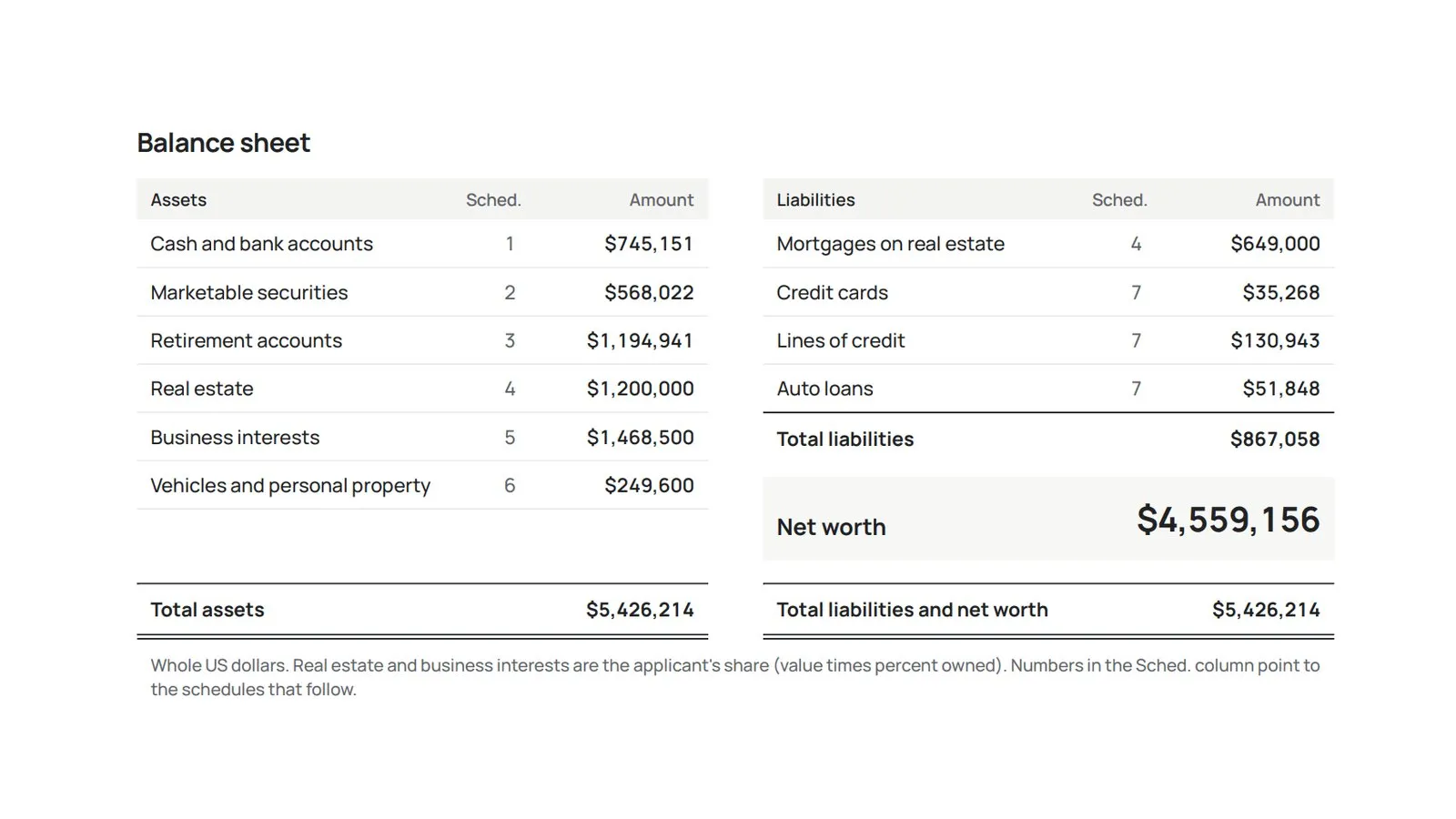
A personal financial statement is a one-date snapshot of an individual’s or married couple’s finances: assets at estimated current value, liabilities at the amount owed, and the difference reported as net worth. Unlike a balance sheet, it also discloses income sources and contingent liabilities, which is why a lender uses it to size up the person standing behind a loan.
The reference version most borrowers meet is SBA Form 413, the personal financial statement the SBA prescribes for its loan programs. Its front page is a two-column list of assets and liabilities with a net-worth line; the back pages add schedules for real estate owned, stocks and bonds, notes payable, source of income, and contingent liabilities. The form runs end to end in our SBA 413 guide, and the concept itself gets the long treatment in what a personal financial statement is.
The accounting profession sets the measurement rule, and it is the part that surprises people. Under AICPA guidance (Statement of Position 82-1, now codified as FASB ASC 274), a personal financial statement presents assets at estimated current value and liabilities at their estimated current amounts. There is even a line for the income taxes you would owe if you sold every asset at those values and settled every debt on the statement date. The CPA Journal summarizes the standard: the residual after that tax provision is your net worth, and the whole statement is built on what things are worth now rather than what you paid. That provision for estimated income taxes has no equivalent on a business balance sheet.
What a balance sheet is
A balance sheet is a point-in-time report of a business entity’s assets, liabilities, and equity, built on the accounting equation Assets = Liabilities + Equity. Most assets are carried at historical cost rather than current value, and it covers the company alone, never its owners’ personal finances.
It is one of the three core financial statements a business produces, alongside the income statement and the statement of cash flows. Corporate Finance Institute frames it as a report of a company’s financial position at a specific point in time, with assets on one side and the claims against them on the other:
Assets = Liabilities + Equity
The two sides always balance, which is where the name comes from: debts owed to lenders come first, then the owners’ residual equity.
A business balance sheet generally carries assets at historical cost, meaning what the company paid, less accumulated depreciation. A warehouse bought for $800,000 in 2010 sits on the books near its depreciated cost even if it would sell for $2 million today. That convention prizes verifiability over relevance, and it is the sharpest break from a personal financial statement, which is built on current value. The other break is scope: a balance sheet covers only the entity. Your personal house, your personal car, and your retirement accounts never appear on your company’s balance sheet, and the company’s equipment never appears on your PFS.
You can also build a personal balance sheet: the same three-section layout of assets, liabilities, and net worth applied to a household. A personal balance sheet is essentially the net-worth core of a PFS without the income and contingent-liability sections. If you only want to track your own net worth over time, that core is enough; our net-worth statement template builds exactly that, and our sister site NetWorthCalculator.com calculates it for free, with a tracker app on the way. A lender weighing a guaranty wants the fuller PFS.
Personal financial statement vs. balance sheet, head to head
| Dimension | Personal financial statement | Balance sheet |
|---|---|---|
| Whose finances | An individual or married couple | A business entity |
| Valuation basis | Estimated current value (AICPA ASC 274) | Historical cost for most assets |
| What it includes | Assets, liabilities, net worth, plus income and contingent liabilities | Assets, liabilities, equity only |
| Residual is called | Net worth | Equity |
| Tax line | Provision for estimated income taxes on built-in gains | Deferred taxes from book-vs-tax timing |
| Standard form | SBA Form 413 in lending | The company’s own GAAP-format statement |
| Refresh cadence | For each application; Form 413 dated within 90 days of an SBA 7(a)/504 submission (SOP 50 10 8.1, from October 1, 2026) | Each reporting period (quarter or year) |
The row that trips people up is valuation. Because a PFS uses estimated current value, the same real estate can post a larger number on your personal statement than on the business balance sheet that still carries it at depreciated cost. Neither is wrong; they answer different questions.
When a lender wants a personal financial statement
A lender asks for a personal financial statement whenever a person’s own finances back the loan. The clearest case is an SBA loan. On a 7(a) or 504 deal, SBA Form 413 is required from each proprietor, each general partner, each managing member of an LLC, every owner of 20% or more, and anyone else providing a guaranty. The 20% line is not arbitrary: it comes straight from the SBA’s personal-guaranty rule.
20%+
Ownership stake that triggers a required, unlimited personal guaranty (and an SBA Form 413) from each owner on a 7(a) or 504 loan, per SBA Form 148, Unconditional Guarantee.
The other situations follow the same logic, since the lender is underwriting you, not just the business or the property:
- A commercial-real-estate acquisition. When you sign a personal guaranty on a multifamily or owner-occupied purchase, the lender wants your PFS alongside the property’s numbers. The commercial real estate investor use case covers the full document set.
- A conventional small-business loan. Banks collect the same data on their own form whenever an owner signs a personal guaranty, which is the default on term loans, lines of credit, and most equipment financing. The thresholds underwriters quietly apply are in personal financial statement for a business loan.
- Life events. A jumbo mortgage, a divorce financial disclosure, or estate planning each call for a PFS-style snapshot, usually a streamlined version rather than Form 413.
Build your personal financial statement in minutes
StatementsReady syncs bank balances read-only through Plaid, fills SBA Form 413, and exports a lender-ready PDF on demand.
- SBA Form 413 with every section filled
- Bank sync through Plaid, read-only
- 7 days free, no card
When a lender wants a balance sheet
A lender wants a balance sheet when it is underwriting the business, not the person behind it. The company’s balance sheet shows the assets the business owns, the debts it owes, and the owners’ equity left over. Those are the raw material for leverage and liquidity ratios. For an operating company or a commercial-real-estate borrower, the bank reads it alongside the income statement and the cash-flow statement. It keeps reading it after closing, too: the OCC’s commercial real estate lending booklet describes loan covenants that compare a borrowing base against the balance sheet on a recurring basis.
The two documents tell parallel stories about different subjects, and underwriters read them that way.
Personal financial statements, which include personal tax returns and the personal financial statement (PFS) (the equivalent of the business balance sheet), look different from business financial statements and tell a different story.
So when a checklist asks for “financial statements,” read it closely. A request aimed at the business means the company’s balance sheet, income statement, and cash-flow statement. A request aimed at the owner means a personal financial statement: Form 413 on an SBA deal, the bank’s own form otherwise.
When you need both
On most real small-business and commercial-real-estate deals, the question is not which document but how fast you can produce both. An SBA 7(a) file typically carries a Form 413 from every 20%+ owner, the company’s balance sheet and profit-and-loss statement, and two to three years of business and personal tax returns. A multifamily acquisition adds the property’s pro forma and a debt-service-coverage calculation on top of the sponsor’s PFS.
$5 million
Maximum SBA 7(a) loan to one borrower; the SBA guarantees up to 85% on loans of $150,000 or less and up to 75% above that. Form 413 is required from every 20%+ owner at any loan size.
That stack gets heavier when credit tightens. The Federal Reserve’s Senior Loan Officer Opinion Survey tracks how banks raise or ease their lending standards each quarter; when standards tighten, underwriters ask for fresher and fuller documentation on both the business and the guarantor. Keeping a current PFS and a clean balance sheet on hand is the difference between answering a lender request in a day and scrambling for a week.
Neither document wins. The balance sheet tells the business’s story; the personal financial statement tells yours, in the valuation basis a lender actually uses to weigh a guaranty. That is why the two so often land on the same checklist. More on the personal half lives in our personal-finance archive; the business loan applications use case covers how to draft and re-draft a Form 413 without retyping it into three different forms.
Related reading
- What is a personal financial statement?
- Personal financial statement for a business loan
- The personal financial statement template guide
- More posts in the personal finance and SBA lending archives.
If you would rather build the personal half of the package from a structured form than retype it into a lender’s PDF, the SBA Form 413 template and the general personal financial statement template are the place to start.
Skip the spreadsheet
A lender-ready personal financial statement from synced balances, in about 8 minutes.
- 7 days free
- No credit card
- PDF, SBA Form 413, Word, or Excel
Build your personal financial statement in minutes
StatementsReady syncs bank balances read-only through Plaid, fills SBA Form 413, and exports a lender-ready PDF on demand.
- SBA Form 413 with every section filled
- Bank sync through Plaid, read-only
- 7 days free, no card