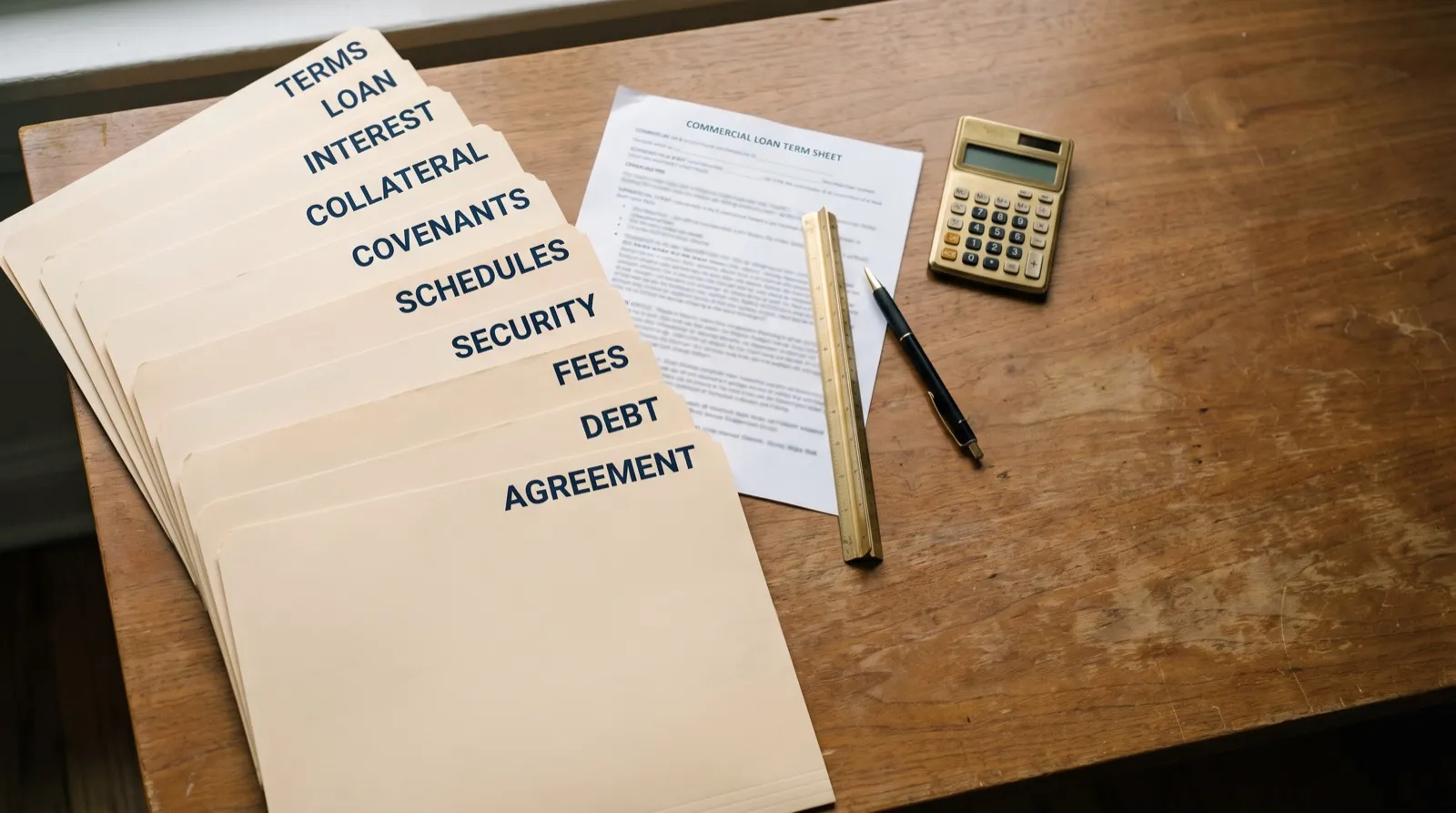


Commercial real estate loan terms are the specific conditions a lender attaches to a property mortgage: the loan term, amortization schedule, loan-to-value cap, debt-service-coverage covenant, recourse, interest-rate structure, and fees. Together those lines decide your monthly payment, the exact date a balloon comes due, and whether your personal assets are on the hook if the deal goes sideways. This guide walks through each term the way it appears on a real term sheet, so you know what you are agreeing to before you sign.
Key takeaways
- A “10-year commercial loan” almost never means 10 years of equal payments. It means a 10-year term with a 20- to 25-year amortization and a balloon at the end.
- DSCR and LTV are the two covenants that gate approval. Miss either and the loan gets resized or declined, regardless of your rate.
- Recourse decides whether the property secures the loan or you do. Most bank and SBA loans are recourse; CMBS and life-company loans usually are not.
- The rate you are quoted is only one line. Amortization, prepayment penalties, and reserve requirements move your real cost and risk more than a quarter-point on the coupon.
What are commercial real estate loan terms?
Commercial real estate loan terms are the full set of conditions a lender sets on a loan secured by income-producing or owner-occupied commercial property. They include the loan term (how long the loan runs before the balance is due) and the amortization period (the schedule used to size the payment). They also cover the maximum loan-to-value, the required debt-service-coverage ratio, whether the loan is recourse or non-recourse, the interest-rate structure, and the fees and reserves. These terms are negotiated deal by deal and vary widely by lender type and property.
Residential borrowers rarely think in these terms because a 30-year fixed mortgage collapses most of them into one number: you make the same payment for 30 years and the loan is gone. Commercial lending pulls those variables apart. The lender wants its money back faster than the property fully pays off, wants a cushion between the property’s cash flow and the payment, and often wants your signature standing behind the debt. Each of those wants shows up as a separate line on the term sheet.
Term vs. amortization: the line that creates the balloon
This is the single most misread part of a commercial loan, so it goes first.
The loan term is how long the loan contract is active. The amortization period is the schedule used to calculate the monthly payment. On a home loan these are the same number. On a commercial loan they almost never are; our commercial real estate loan calculator shows the monthly payment and the balloon balance side by side.
Most stabilized CRE loans pair a 5-, 7-, or 10-year term with a 20- to 25-year amortization. The Federal Reserve Bank of St. Louis describes the structure this creates:
Unlike residential real estate, which has longer maturities and payments that amortize over the life of the loan, CRE loans typically have shorter maturities and balloon payments. At maturity, the borrower normally refinances the remaining balance rather than paying off the lump sum.
The gap has a concrete effect. Take a $1,000,000 loan at 7% interest. On a 25-year amortization, the monthly payment is about $7,067. Shorten the amortization to 10 years and the payment jumps to roughly $11,611, a 64% increase. The long amortization is what keeps the deal cash-flowing. But it means that when a 10-year term ends, you have barely dented the principal.
You will hear lenders shorthand this as a “5/25” or “10/25”: the first number is the term, the second is the amortization. A 5/25 loan amortizes as if you had 25 years but comes due in full at the end of year 5.
Two loan structures break the balloon rule, and both matter for owner-occupants. The SBA 7(a) real-estate loan fully amortizes over its term of up to 25 years with no balloon. The SBA 504 CDC debenture fully amortizes over 10, 20, or 25 years, also with no balloon on the SBA portion. For a business planning to hold its building for decades, that removes the refinance risk that defines most CRE debt. It is the main reason owner-occupants weigh SBA against a conventional loan, a comparison covered in SBA 7(a) vs. 504.
The five terms that decide your deal
Beyond term and amortization, five conditions do the real work on a commercial term sheet.
Loan-to-value (LTV)
LTV is the loan amount divided by the property’s appraised value. It sets your down payment. Conventional bank and CMBS loans typically cap LTV at 65% to 75%, so you bring 25% to 35% in equity.
SBA 504 reaches roughly 90% financing (10% down) on owner-occupied property. DSCR investor loans often go to 75% to 80%. Life-company lenders are the most conservative, frequently 55% to 70%. The appraisal, not the purchase price, sets the denominator: if the appraisal comes in low, your loan shrinks even though the price did not.
Debt-service-coverage ratio (DSCR)
DSCR is the covenant that most often resizes or kills a deal. The formula is simple:
DSCR = net operating income (NOI) ÷ annual debt service
A property with $300,000 of NOI and $240,000 of annual mortgage payments has a DSCR of 1.25x: it throws off $1.25 of income for every $1 of debt service. Most conventional commercial lenders want at least 1.20x to 1.25x. Higher-risk property types (hotels, restaurants, gas stations) often require 1.30x or more. The SBA’s SOP 50 10 8.1 sets a lower floor, 1.15x business coverage on a standard 7(a) loan and 1:1 on the global ratio, but most SBA lenders overlay their own 1.25x requirement in practice.
If you want to see the calculation worked in detail, how to calculate DSCR runs several property examples, and you can test your own deal in the free DSCR calculator before you approach a lender.
1.15x
SBA's minimum business debt-service-coverage ratio on standard 7(a) loans under SOP 50 10 8.1 (1.10x on 7(a) Small loans of $350,000 or less that are not business purchases, 1.25x on most business purchases from October 1, 2026), though most SBA lenders overlay their own 1.25x floor on top of it
Source: SBA, SOP 50 10
Recourse vs. non-recourse
This term decides whether the property secures the loan or you do.
On a full-recourse loan, you sign a personal guarantee. If the property forecloses and the sale does not cover the debt, the lender can pursue the deficiency from your personal assets: bank accounts, other real estate, investments. Most bank loans and all SBA loans are recourse; the SBA requires a personal guarantee from every owner of 20% or more.
On a non-recourse loan, the lender agrees to look only to the property for repayment. CMBS, life-company, and larger agency loans are typically non-recourse. The catch is that every non-recourse loan carries bad-boy carve-outs: specific acts that spring the loan back to full personal recourse. As the law firm Arent Fox Schiff explains, these carve-outs “are intended to incentivize the borrower to preserve the lender’s collateral,” and the triggers include fraud, misapplication of rents, voluntary bankruptcy, unpermitted transfers of the collateral, and single-purpose-entity violations. Commit one of those and the non-recourse shield drops.
Build your personal financial statement in minutes
StatementsReady syncs bank balances read-only through Plaid, fills SBA Form 413, and exports a lender-ready PDF on demand.
- SBA Form 413 with every section filled
- Bank sync through Plaid, read-only
- 7 days free, no card
Interest-rate structure
Commercial rates come fixed or floating. A floating rate is quoted as a spread over an index (commonly SOFR, the prime rate, or a Treasury yield) so your payment moves when the index moves. A fixed rate locks for a set period, often matching the loan term.
SBA 504’s CDC debenture is fixed for the full 10-, 20-, or 25-year term, pegged to the 10-year U.S. Treasury at closing. SBA 7(a) is usually variable and prime-based. Whichever you get, read the index and the spread separately: a “SOFR + 275” quote tells you far more about your future payment than a single headline rate.
Prepayment penalties
Commercial loans usually charge you to pay off early, because the lender priced the loan expecting a set stream of interest. Three structures dominate:
- Step-down: a declining penalty, e.g., 5% in year 1, 4% in year 2, and so on. Common on bank and DSCR loans.
- Yield maintenance: you make the lender whole for lost interest, often the most expensive to break early.
- Defeasance: you substitute a portfolio of securities for the property as collateral. Standard on CMBS.
SBA 504 debentures carry a declining prepayment premium over roughly the first half of the term. If you expect to sell or refinance before maturity, the prepayment line can cost more than the rate. Price it in before you sign.
Commercial real estate loan terms by lender type
The same property can carry very different terms depending on who lends.
| Loan type | Typical term | Amortization | Max LTV | Recourse? | Rate |
|---|---|---|---|---|---|
| Conventional bank (portfolio) | 5–10 yr (balloon) | 20–25 yr | 65–75% | Usually full recourse | Fixed or floating over SOFR/prime |
| SBA 7(a) | Up to 25 yr (real estate) | Fully amortizing, no balloon | ~85–90% | Full recourse (personal guarantee) | Variable, prime-based (or fixed) |
| SBA 504 | CDC debenture 10/20/25 yr; bank note often 10 yr | CDC fully amortizes, no balloon; bank note may balloon | ~90% (10% down) | Full recourse (personal guarantee) | CDC fixed (10-yr Treasury peg); bank set separately |
| CMBS / conduit | 5, 7, or 10 yr (balloon) | 25–30 yr | 65–75% | Non-recourse + bad-boy carve-outs | Fixed |
| Life company | 5–25 yr | 25–30 yr | 55–70% | Non-recourse (typically) | Fixed |
| DSCR / investor | 30 yr (some 5–10 yr) | 30 yr (some interest-only) | 75–80% | Recourse or non-recourse varies | Fixed or ARM |
The SBA 504 is worth a closer look for owner-occupants because its structure is unusual. It splits a project three ways: a bank lends 50% in first position, a Certified Development Company (CDC) lends 40% through an SBA-guaranteed debenture, and you contribute 10% (15% for a startup or special-purpose property, 20% if both). The CDC debenture is fixed and fully amortizing with no balloon, which is the draw. The bank’s 50% first mortgage sits on its own terms and may still carry a balloon, so you can end up with one piece of the deal that never reprices and another that does.
$5.5M
Maximum SBA 504 CDC debenture for major fixed assets; the bank's first mortgage on top can push total project financing much higher
To qualify for a 504, the business must have tangible net worth under $20 million and average net income under $6.5 million after federal taxes for the two prior years, and it must occupy at least 51% of an existing building (60% for new construction). The full head-to-head with the 7(a) is in SBA 7(a) vs. 504, and for DSCR-underwritten investor debt, what is a DSCR loan covers how those terms differ.
Fees, reserves, and the costs nobody quotes upfront
The rate and the term dominate the conversation, but the closing costs and ongoing reserves are where borrowers get surprised.
- Origination and lender fees: typically 0.5% to 1% of the loan, sometimes more on smaller deals.
- SBA fees: 7(a) charges a guaranty fee based on loan size and term; 504 fees total roughly 3% of the debenture and can be financed into the loan.
- Escrows and reserves: lenders commonly collect monthly for property taxes and insurance, and larger loans add replacement reserves plus tenant-improvement and leasing-commission (TI/LC) reserves for multi-tenant property.
- Third-party reports: a commercial appraisal and a Phase I Environmental Site Assessment are standard, and you pay for both up front, often before the loan is approved.
None of these change the headline rate, but they change the cash you need at closing and the cash the property must throw off every month. Ask for a full fee schedule early: a clean deal on rate can carry an ugly reserve structure.
What the 2026 market means for your terms
Loan terms are not set in a vacuum; they tighten and loosen with the lending cycle. The Federal Reserve’s January 2026 Senior Loan Officer Opinion Survey found that CRE lending standards were “basically unchanged” for most property types, with a modest net share of banks easing on multifamily. The survey also flagged a split: large banks eased standards while smaller banks tightened. Where you shop can matter as much as your deal.
The bigger backdrop is the refinance calendar. The Federal Reserve’s Financial Stability Report estimated that about 20% of all outstanding CRE loans were set to mature in 2025, just shy of $1 trillion. The Mortgage Bankers Association put the figure at roughly $957 billion, and the wall extends into 2026 and 2027. Because most of that debt is balloon debt, the borrowers behind it face the exact event this guide opened with: a balance due, and a refinance into a higher-rate, more selective market. The term and amortization you accept today schedule your next negotiation.
~$957B
Commercial real estate debt (about 20% of all outstanding CRE loans) set to mature in 2025, most of it balloon debt that must refinance or sell
Source: Federal Reserve Financial Stability Report, Spring 2025
How to read a commercial loan term sheet well
Having watched borrowers sign these on both sides of a closing table, the mistakes cluster in a few places. A term sheet rewards the borrower who reads past the rate.
Match the balloon to your hold period. If you plan to hold the property for seven years, a 5-year term forces a refinance you did not plan for, into whatever market exists in year 5. Line the term up with your actual plan, or negotiate an extension option.
Read the recourse language before the rate. A half-point lower rate on a full-recourse loan can be a worse deal than a slightly higher non-recourse quote, depending on how much of your personal net worth is exposed. Know which one you are signing.
Price the prepayment penalty against your exit. If there is any chance you sell or refinance early, yield maintenance or defeasance can dwarf the rate savings that made the loan look attractive.
Bring a clean personal financial statement. On any recourse loan (which is most bank and all SBA loans) the lender underwrites your personal balance sheet alongside the property’s, because your guarantee stands behind the debt. A current, well-organized statement showing your assets, liabilities, net worth, and especially your post-close liquidity is what moves a recourse file forward. SBA lenders require Form 413 specifically; you can start from the SBA personal financial statement template rather than a blank page. For the broader workflow of keeping that statement current across a portfolio, see the commercial real estate investor use case, and for conventional deals, business loan applications.
More on how lenders read your numbers is in the commercial real estate archive and the SBA lending archive.
Skip the spreadsheet
A lender-ready personal financial statement from synced balances, in about 8 minutes.
- 7 days free
- No credit card
- PDF, SBA Form 413, Word, or Excel
Build your personal financial statement in minutes
StatementsReady syncs bank balances read-only through Plaid, fills SBA Form 413, and exports a lender-ready PDF on demand.
- SBA Form 413 with every section filled
- Bank sync through Plaid, read-only
- 7 days free, no card