
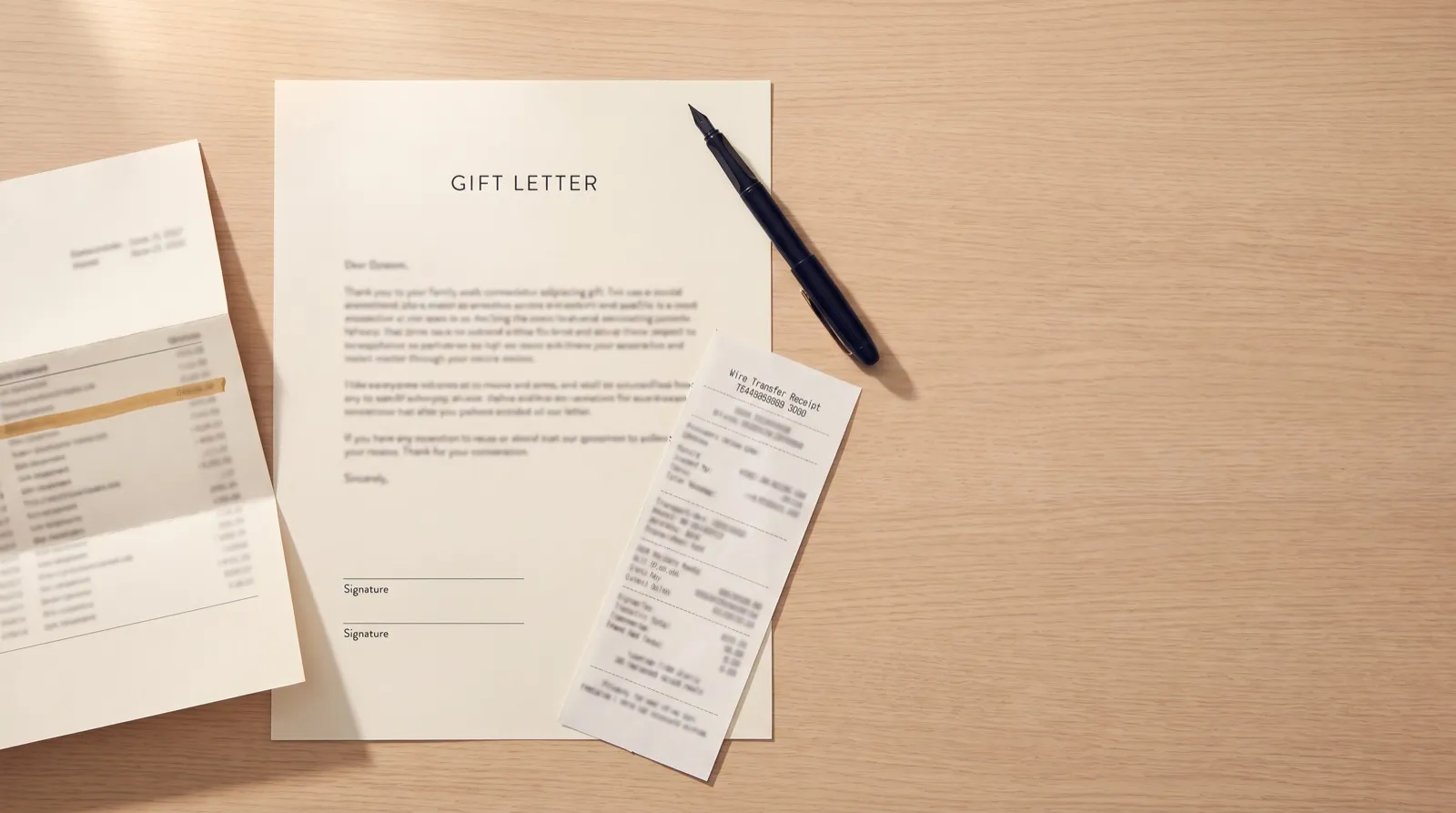
An underwriter treats every large deposit as a possible undisclosed loan until something in the file says otherwise. When a parent wires you $40,000 for a down payment, the gift letter is the document that says otherwise. It is short, the donor signs it, and it goes in the loan file next to the records that prove the money moved.
What a gift letter is
A gift letter is a signed statement from the person giving a homebuyer money. It confirms the amount, the relationship between the two parties, and that no repayment is expected in any form. Agency rulebooks let a borrower qualify on someone else’s money only when that money carries no repayment obligation, and the letter is the evidence of it.
The reason underwriters care so much is arithmetic. A $40,000 gift and a $40,000 private loan produce identical bank statements and very different debt-to-income ratios. The letter is the only thing separating them, which is why lenders read it for what it says and then go looking for whether the money behaved like a gift.
22%
of first-time buyers used a gift or loan from a relative or friend for their down payment in 2025
That same National Association of Realtors survey put the median first-time-buyer down payment at 10%, the highest reading since 1989. Personal savings came in at 59% and financial assets at 26%.
Before you start
Collect these before the donor writes anything. The letter takes ten minutes; assembling what sits behind it is the part that adds days.
- The donor’s full legal name, current address, and phone number. Lenders do call.
- The account the money will leave, plus recent statements for it if your lender asks.
- The exact amount, or a stated maximum if the final figure is not settled.
- The property address under contract.
- Your lender’s own gift letter form, if they have one. Most do, and using theirs saves a revision cycle.
Plan on one afternoon end to end if the donor banks online and can pull statements. Closer to a week if the donor needs a branch visit, or has to move money between accounts first.
Who can give you gift funds for a down payment
Donor eligibility is where files die, because the rules differ by program and the borrower usually finds out after the money has already moved.
| Program | Acceptable donors | Source |
|---|---|---|
| Fannie Mae | Relative by blood, marriage, adoption, or legal guardianship; domestic partner or their relative; fiance or fiancee; former relative; someone with a long-standing familial-like or mentorship relationship | Selling Guide B3-4.3-04 |
| Freddie Mac | A Related Person, plus a business owned by a Related Person, a trust established by one, or their estate | Guide Section 5501.4 |
| FHA | Family member; employer or labor union; close friend with a clearly defined and documented interest in the borrower; charitable organization; government agency running a homeownership assistance program | HUD Handbook 4000.1 |
Everyone excludes the same people. Fannie Mae bars the builder, the developer, the real estate agent, and “any other interested party to the transaction” as donors. A gift from the listing agent or the builder fails on donor eligibility, and a better letter does not fix it.
The seller is the exception worth knowing. Fannie Mae allows an acceptable donor who is also the seller of the subject property, provided that donor is not affiliated with another interested party to the deal. That is what makes a parent-to-child sale workable, and it is the structure covered below under gifts of equity.
What the gift letter must say, line by line
Fannie Mae’s requirement is three bullets long. Lender forms are longer because they fold in FHA’s rules and their own overlays, and a letter that satisfies the strictest program satisfies all of them.
The donor identity block
What it asks for: the donor’s name, address, and telephone number, per Fannie Mae B3-4.3-04. Freddie Mac asks for the mailing address and telephone number as well.
Who fills it out: the donor, using the address on their bank records. A mismatch between the address on the letter and the address on the donor’s statement is a routine callback.
Worked example: Margaret Ellison, 4418 Sycamore Lane, Boise, ID 83704, (208) 555-0147.
The relationship line
What it asks for: the donor’s relationship to the borrower, stated in plain kinship terms.
The common mistake: writing “family friend” on a conventional file. Fannie Mae’s non-relative category covers a domestic partner, a fiance or fiancee, a former relative, or a long-standing familial-like or mentorship relationship. “Family friend” does not obviously land in any of them. If the relationship is a mentorship or a decades-long one, say so in the letter rather than leaving the underwriter to guess.
Worked example: I am the borrower’s mother.
The dollar amount
What it asks for: Fannie Mae permits “the actual or the maximum dollar amount of the gift.”
That word “maximum” is worth using. Final cash-to-close moves between the loan estimate and the closing disclosure, and a letter that reads $40,000 has to be re-signed when the number lands at $41,260. A letter that reads up to $45,000 covers the drift without a second trip to the donor. Freddie Mac’s loan-file messaging uses the same actual-or-maximum framing.
Worked example: A gift of up to $45,000 toward the purchase of the property below.
The no-repayment statement
What it asks for: the donor’s statement that no repayment is expected. This is the sentence the whole document exists for.
Write it without hedging. Words like “when able,” “eventually,” or “as a family arrangement” convert the gift into a liability in an underwriter’s reading, and a liability changes the debt-to-income calculation. Most lender forms also add that the donor holds no ownership interest in the property, which is worth keeping even where the agency does not demand it.
Worked example: This is a gift. No repayment is expected or implied, in cash, services, or any other form, and I retain no interest in the property.
The property address and signatures
What it asks for: Fannie Mae does not require the subject property address in its three bullets, and nearly every lender form asks for it anyway. Include it.
FHA is explicit that the letter is “signed and dated by the donor and Borrower,” so on an FHA file both signatures are required. Wet signatures are still preferred by some closers; most lenders accept e-signatures through their own portal.
A sample gift letter
The pieces assembled, in the order most lender forms use them. Adapt the facts; keep the shape.
Gift Letter
Date: September 8, 2026
Borrower: Daniel Ortiz Property: 1207 Camas Street, Boise, ID 83702
I, Margaret Ellison, of 4418 Sycamore Lane, Boise, ID 83704, telephone (208) 555-0147, am making a gift of up to $45,000 to Daniel Ortiz, who is my son.
The funds will be wired from my Idaho Central Credit Union savings account ending 8823 to the borrower’s account, or directly to the closing agent, on or before September 22, 2026.
This is a gift. No repayment is expected or implied, in cash, services, or any other form. I hold no ownership interest in the property and will acquire none. I am not the seller, the builder, the real estate agent, or any other party with an interest in this transaction.
Margaret Ellison September 8, 2026
Daniel Ortiz September 8, 2026
On an FHA file, both signatures shown above are required. On a conventional file the donor’s signature is the one the guide asks for, and lenders collect the borrower’s anyway.
How much of the down payment can be a gift
The share of your own money a lender requires is set by property type and loan-to-value, not by how generous the donor is.
| LTV, CLTV, or HCLTV | Property type | Minimum from the borrower’s own funds |
|---|---|---|
| 80% or less | One- to four-unit principal residence, or second home | None |
| Greater than 80% | One-unit principal residence | None |
| Greater than 80% | Two- to four-unit principal residence, or second home | 5% |
Source: Fannie Mae Selling Guide B3-4.3-04, last updated February 4, 2026. Freddie Mac applies a comparable 5% borrower down payment condition on a second home above 80% LTV.
On the ordinary case, a one-unit primary residence, the entire down payment can be gifted at any LTV. FHA reaches the same place from a different direction: a family member gift is an acceptable source for the borrower’s Minimum Required Investment, which is the 3.5% down payment. Lenders sometimes impose an overlay requiring borrower funds anyway, and that overlay is the lender’s policy rather than the agency rule. Ask which one you are being held to.
The 12-month co-residency exception
The most useful line in the whole topic sits in a footnote at the bottom of Fannie Mae’s gift section, and it rarely comes up. If the gift comes from an acceptable donor who has lived with the borrower for the last 12 months, the money counts as the borrower’s own funds. It can then satisfy the minimum borrower contribution. Both people have to occupy the new home as their principal residence.
That turns a blocked file into a closeable one. A borrower buying a duplex at 90% LTV owes a 5% contribution from their own money. A partner who has shared the current address for a year, and is moving into the duplex, can supply it.
The file needs a donor certification covering those 12 months, plus documents showing shared residency at a matching address. A driver’s license, a utility bill, or a bank statement all work.
Build your personal financial statement in minutes
StatementsReady syncs bank balances read-only through Plaid, fills SBA Form 413, and exports a lender-ready PDF on demand.
- SBA Form 413 with every section filled
- Bank sync through Plaid, read-only
- 7 days free, no card
Documenting the transfer
The letter is the claim. These documents are the proof, and Fannie Mae accepts any one of the following:
- A copy of the donor’s check and your deposit slip.
- A copy of the donor’s withdrawal slip and your deposit slip.
- Evidence of an electronic transfer from the donor’s account to yours or to the closing agent.
- A copy of the donor’s check made out to the closing agent.
- A settlement statement showing receipt of the donor’s check.
Where funds are not transferred before settlement, the lender must document how the donor delivered them to the closing agent. Electronic transfer, certified check, cashier’s check, or other official check all qualify.
FHA used to hold the donor tighter, and that older version is still repeated across most of the internet. Handbook 4000.1 Update 15, effective for case numbers assigned on or after August 19, 2024, replaced the mandatory donor bank statement with a choice.
For gifts verified before settlement, the lender obtains any one of these:
- the donor’s bank statement showing the withdrawal, plus evidence of the deposit;
- a copy of the donor’s canceled check, plus evidence of the deposit;
- a copy of the donor’s withdrawal receipt, plus evidence of the deposit; or
- evidence of an electronic transfer from the donor’s account to yours.
For gifts verified at settlement, the lender obtains any one of these, evidencing payment to the settlement agent:
- evidence of an electronic transfer from the donor’s account;
- a bank certified check;
- a cashier’s check; or
- another official bank check.
Two things follow. A clean wire now satisfies FHA on its own. A lender still demanding two months of donor statements on an FHA file is applying an overlay rather than the handbook. Ask which one you are being held to before the donor starts pulling paperwork.
Two practical points follow from all of that.
Wire the money; do not hand over cash. FHA states outright that cash on hand is not an acceptable source of donor gift funds. A donor who withdraws cash and redeposits it into your account has broken the trail in a way no letter repairs.
Send one clean transfer for the exact letter amount. Three transfers of $15,000 produce three deposits an underwriter has to tie back to a single letter. Each mismatch turns into a condition. When a deposit still needs narrative context, that is what a letter of explanation is for.
The friction in a gift file is rarely the borrower’s paperwork. It is asking a 74-year-old parent to hand over bank statements, then discovering an unexplained $60,000 deposit from a CD that matured. The sourcing exercise restarts on someone else’s finances. That is why the donor conversation belongs before the offer, not after the appraisal.
Do gift funds need to be seasoned?
Seasoning and sourcing are two routes to the same destination. Funds that have sat in your account across two full statement cycles read as yours, and the lender stops asking where they came from. Funds that arrive during the loan get sourced instead, which is the entire gift-letter process.
A documented gift can land the week of closing. It does not need to age first. The reason so many articles claim otherwise is that individual lenders write overlays requiring seasoning, and borrowers reasonably assume an overlay is the rule. Ask your loan officer to point at the guideline; if they cannot, it is their policy.
Money that arrives with no letter and no sourcing is the case that actually fails. If you plan to season a gift instead of documenting it, the money has to be in the account before the statements the lender pulls, not before the closing date.
Gifts of equity
A gift of equity is a gift provided by the seller of a property to the buyer, delivered as a discount to the sale price instead of as cash. A parent sells a house appraised at $500,000 for $440,000; the $60,000 difference becomes the buyer’s equity at closing.
Fannie Mae permits it on principal residence and second home purchases. It can fund all or part of the down payment and closing costs, including prepaid items, and it cannot be used for financial reserves. The acceptable donor and minimum borrower contribution rules from the cash-gift section apply unchanged. Documentation is a signed gift letter plus the settlement statement listing the gift of equity.
One structural note. When an acceptable donor provides a gift of equity, Fannie Mae does not treat that donor as an interested party. The transaction escapes the interested-party contribution caps that would otherwise apply to seller-paid amounts. Freddie Mac reached the same position for a Related Person, a business they own, a trust they established, or their estate under Guide Section 5501.6.
Can you use gift funds for an SBA loan down payment?
Business borrowers hit the same question from the other side. Gifted money is an accepted source of the equity injection on an SBA 7(a) loan, and the evidentiary bar is higher than on a mortgage.
Promissory notes or gift letters alone are not sufficient evidence.
Under SOP 50 10 8.1, lenders are expected to retain copies of checks and wire transfers. They also keep account statements showing available funds for at least 30 days. Settlement statements or paid invoices then document how the money was used.
A gifted injection therefore travels as a package: the gift letter, the donor’s account statements, the transfer record, and the receiving account statement. Our SBA down payment guide covers how the injection requirement is calculated. The 2026 7(a) requirements cover what else changed under the current SOP.
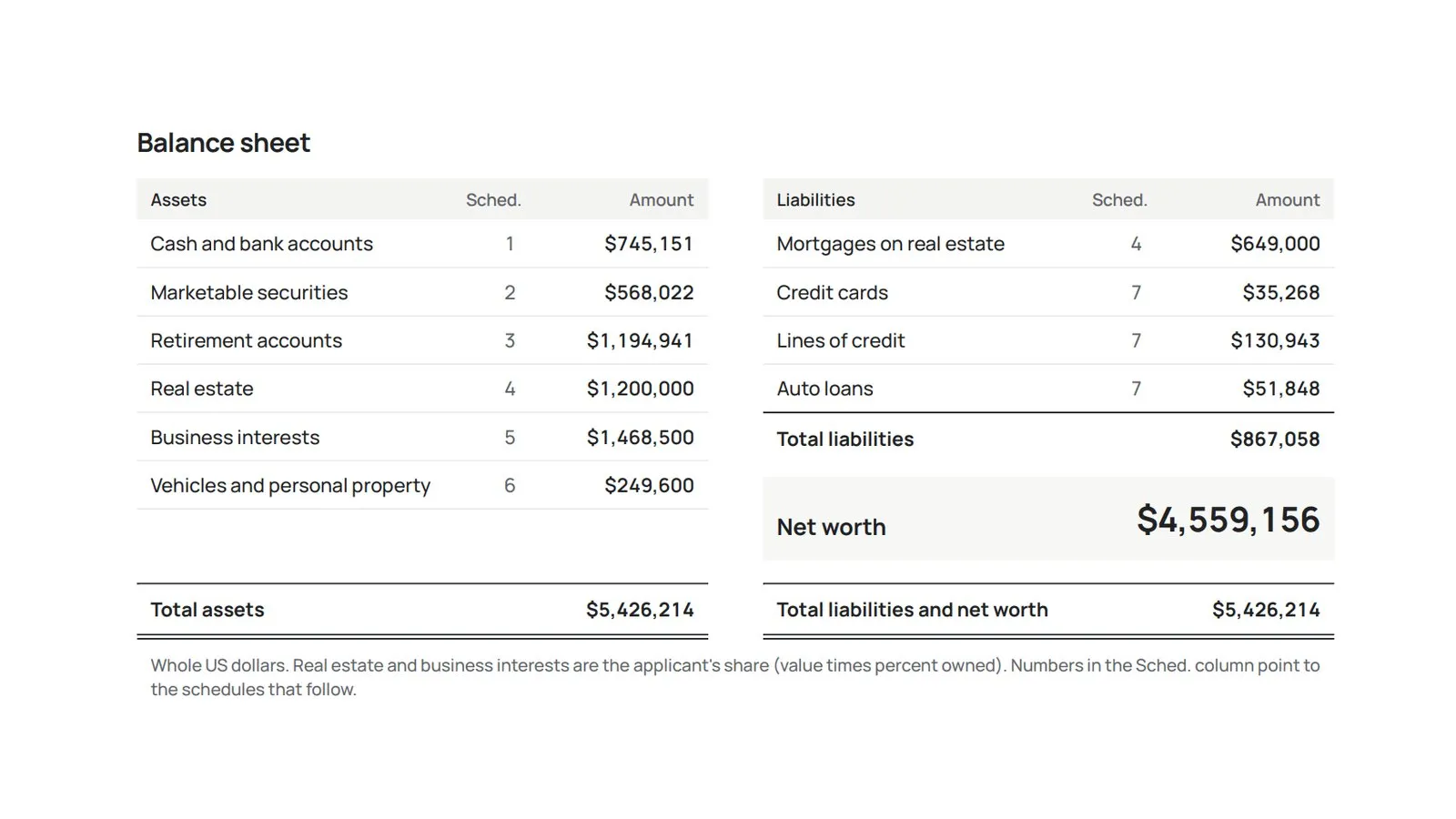
The same lender will also want SBA Form 413 from every 20% owner, and a gift that has landed in your personal account shows up there as cash. Keep the two documents consistent; a Form 413 that predates the gift and a bank statement that includes it is a question you will be asked to answer. The Form 413 template is the fastest way to produce a current one.
What the gift means at tax time
The person receiving a gift owes no federal income tax on it. Reporting falls on the donor.
For calendar year 2026 the annual gift tax exclusion is $19,000 per recipient, unchanged from 2025, and the basic exclusion amount for gift and estate tax is $15,000,000 per person, per IRS Revenue Procedure 2025-32. A donor giving more than $19,000 to one recipient in a year generally files IRS Form 709. The excess then draws against that lifetime exclusion rather than generating a check to the IRS.
Two parents gifting a married couple can move $76,000 in one calendar year without a single Form 709, because each of the four donor-recipient pairs gets its own $19,000. Splitting a gift across December and January doubles the annual room again. This is general information rather than tax advice, and a donor with a large or unusual estate should route the question to their CPA.
What happens after you submit
Expect these callbacks, in roughly this order of frequency.
- “The letter says $40,000 and the deposit is $40,015.” Wire fees and rounding. Resolved by a corrected letter, or avoided by stating a maximum amount up front.
- “We need the donor’s statement.” The most common holdup, and the one that depends on a third party’s schedule.
- “What is the $60,000 deposit in the donor’s account?” Sourcing moves upstream. The donor supplies their own paper trail for it.
- “The relationship on the letter is not an acceptable donor category.” The hardest one to fix late, because the money has usually already moved.
- “The donor’s address does not match the account statement.” Usually a stale address on file rather than a real problem.
None of these are judgment calls about you. They are an underwriter tying a number in one document to the same number in another, which is also the discipline behind every other document in the file. Keeping your own asset picture current between requests makes each round faster, and our net worth calculator and personal financial statement template are built for exactly that. For borrowers assembling a first mortgage file from scratch, the first-time homebuyer walkthrough covers what else the lender will ask for.
Skip the spreadsheet
A lender-ready personal financial statement from synced balances, in about 8 minutes.
- 7 days free
- No credit card
- PDF, SBA Form 413, Word, or Excel
More on documenting the money behind a loan file is in our personal finance archive.
Build your personal financial statement in minutes
StatementsReady syncs bank balances read-only through Plaid, fills SBA Form 413, and exports a lender-ready PDF on demand.
- SBA Form 413 with every section filled
- Bank sync through Plaid, read-only
- 7 days free, no card