

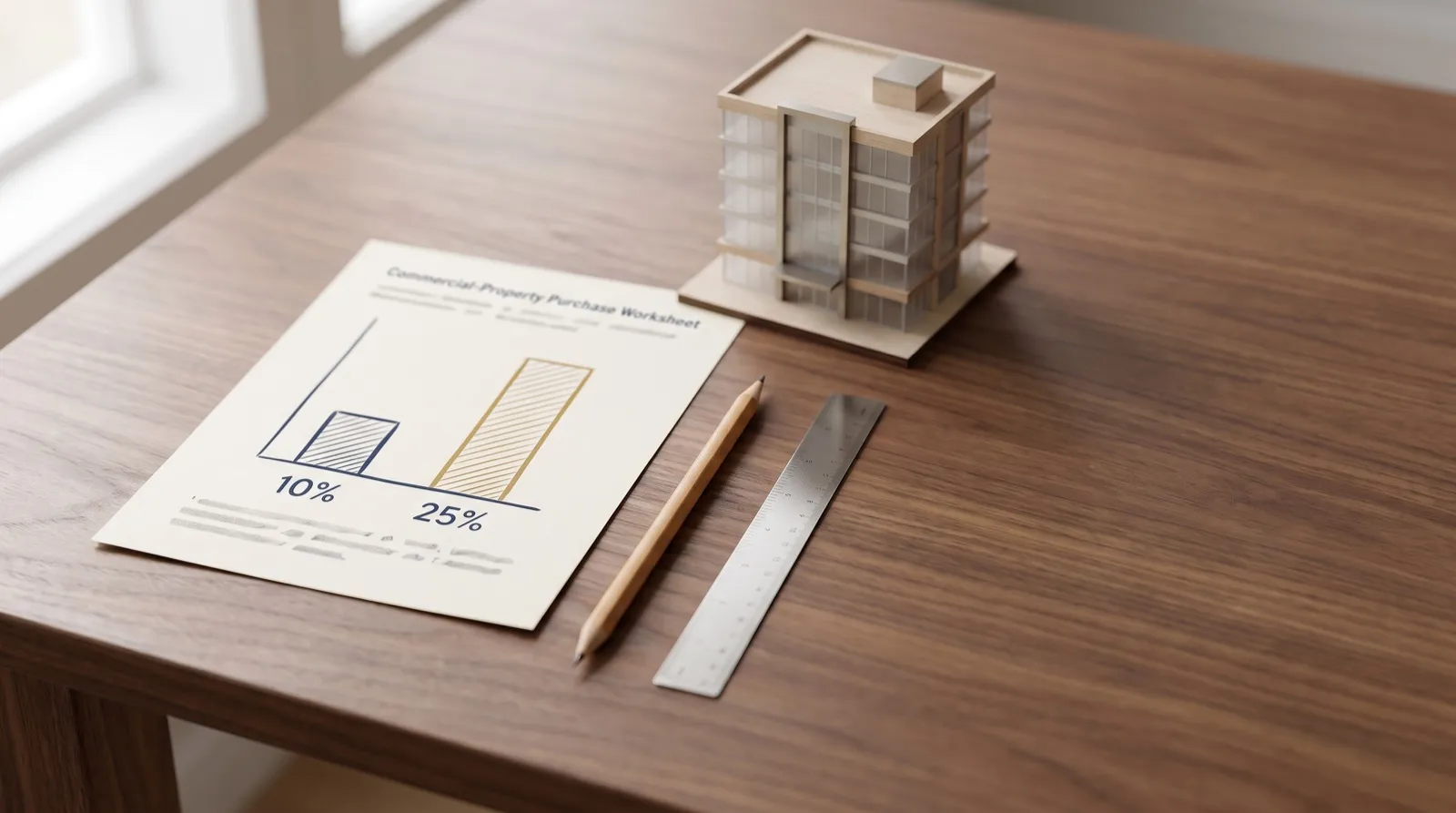
Two numbers decide how much cash you bring to an SBA closing: the program you use and the kind of deal you’re doing. An SBA 504 loan is built around a 10% borrower down payment; an SBA 7(a) loan has no universal down payment but requires a minimum 10% equity injection on business startups and most business purchases. Everything else is about which dollars the lender will actually count.
Key takeaways
- 504 has a structural 10% down payment. The 50/40/10 split isn’t negotiable, and a CDC can’t close if you can’t meet your contribution.
- 7(a) requires 10% equity injection on startups and most business purchases, not on working-capital or equipment loans for established businesses. From October 1, 2026, the 10% on an initial acquisition (a new owner buying a business) can’t be reduced.
- A seller note counts toward at most half your injection, and only if it’s on full standby for the life of the SBA loan. From October 1, 2026, that half is shared with other standby debt and minority investors.
- Conventional CRE loans want 20% to 30% down. The SBA gap is the whole reason owner-users pick 504 or 7(a) for real estate.
- The lender verifies your down payment against SBA Form 413 and checks your post-closing liquidity: depleting every account to close can weaken the file.
What “down payment” means on an SBA loan
On an SBA loan the down payment is called the equity injection, and the wording matters because the SBA cares less about a percentage of the purchase price than about genuine, traceable money you put at risk.
Equity injection is the borrower’s own contribution to a financed project: cash or acceptable equivalents that are not themselves borrowed against the business’s future cash flow. The SBA uses it as evidence of “skin in the game,” calculated against total project cost (purchase price plus working capital, fees, and closing costs), and it must come from sources the lender can document with checks, wires, and account statements.
That definition changed in practice on June 1, 2025, when SOP 50 10 8 — the Standard Operating Procedure that governs how lenders originate SBA loans — replaced the looser pandemic-era guidance. The prior SOP let lenders largely “do what you do” on sourcing equity. SOP 50 10 8 ended that and put back hard numeric floors and an enumerated list of acceptable sources.
With the issuance of SOP 50 10 8, effective June 1, 2025, the SBA will be returning to well-established principles of equity injection. The Borrower once again will need to show that it has “skin in the game.”
I’ve watched a preapproved acquisition nearly fall apart two weeks before closing because the buyer’s “down payment” was a seller note structured on a two-year standby, not full standby, so the lender wouldn’t count a dollar of it toward the injection. The buyer had to find real cash on short notice. Get the structure right at the letter-of-intent stage, not at the closing table.
SBA 7(a): when 10% down is required, and when it isn’t
The 7(a) program has no down payment requirement that applies to every loan. Instead, SOP 50 10 8 reintroduced a minimum 10% equity injection of total project cost for two higher-risk transaction types, as SBA lender counsel Starfield & Smith summarizes the rule:
- Business startups: a business in operation one year or less.
- Complete changes of ownership: a transaction where 100% of the business transfers to a new owner.
10%
Minimum equity injection SOP 50 10 8 requires on an SBA 7(a) startup or complete change of ownership, calculated against total project cost, the floor the SBA restored on June 1, 2025 after relaxing it during the pandemic.
Source: Starfield & Smith, P.C., review of equity injection under SOP 50 10 8
“Total project cost” is the full budget, not just the purchase price. On a $1,000,000 business acquisition that includes $50,000 of working capital and $50,000 in fees and closing costs, the 10% floor is $100,000, regardless of how the pieces are allocated.
Several common 7(a) uses carry no SBA-mandated injection, or let the lender waive it:
- Working capital or equipment for an established business: no SBA-mandated injection; equity is left to the lender’s discretion under SOP 50 10 8’s credit standards.
- A business expansion into the same six-digit NAICS code, where both entities are co-borrowers with identical ownership. A September 30, 2025 procedural notice (5000-872764) confirmed no equity injection was required under SOP 50 10 8. For loans submitted from October 1, 2026, SOP 50 10 8.1 treats this as a Business Expansion: 10% by default, which the lender may reduce or waive under the liquidity and net-worth test above.
- Partner buyouts among existing owners, where, under SOP 50 10 8, the remaining owner had held the same or higher stake for at least 24 months and the business’s debt-to-worth was 9:1 or better before the change. Miss those conditions and the remaining owners contributed cash equal to the lesser of the amount needed to reach 9:1 or 10% of the purchase price. SOP 50 10 8.1 drops the 9:1 test for loans submitted from October 1, 2026: an Owner Buyout starts at 10% of the purchase price, and the lender may waive it under the liquidity and net-worth test.
- ESOPs purchasing a controlling interest (51% or more) are explicitly exempt from the injection requirement.
For an established business buying owner-occupied commercial real estate with a 7(a), there’s no numeric SBA floor, but most lenders still want around 10% down to hold a conservative loan-to-value. Many 7(a) real estate loans run near 90% financing, secured by the property being purchased. If you’re weighing this against a 504, our SBA 7(a) vs. 504 comparison lays out which program fits which deal.
SBA 504: the 50/40/10 split and the step-ups
The 504 program is the one built specifically for owner-occupied commercial real estate and heavy equipment, and its down payment is baked into the structure. A standard 504 project is financed three ways: a bank first mortgage covering about 50%, a CDC/SBA debenture covering about 40%, and the borrower’s 10% equity contribution. That 10% is the down payment, and it’s non-negotiable: a CDC cannot close the loan if you can’t meet your contribution.
The borrower share steps up for higher-risk deals:
| Deal profile | Borrower down payment | Financed |
|---|---|---|
| Established business, standard-use property | 10% | 90% |
| New business (under two years) or special-purpose property | 15% | 85% |
| New business and special-purpose property | 20% | 80% |
A worked example on a $2,000,000 project makes the tiers concrete. An established business buying a standard office building injects $200,000 (10%). A startup buying that same office injects $300,000 (15%). An established business buying a hotel (a special-purpose property) also injects $300,000 (15%). A startup buying a hotel injects $400,000 (20%).
Special-purpose properties are ones with limited alternative uses, which makes collateral recovery harder in a default. Examples include hotels and motels, gas stations, car washes, golf courses, funeral homes with crematoriums, bowling alleys, wineries, and amusement parks. If your property is one of these, budget for the 15% tier from the start.
Where the down payment can come from
Under SOP 50 10 8 the amount is only half the question; the source has to be on the approved list and documented. Acceptable sources of equity injection include:
- Unborrowed cash from personal savings, business reserves, or liquid investments.
- Documented gifts: with a gift letter and bank statements showing the transfer, never a gift letter alone.
- A full-standby seller note for up to half the required injection (more on the mechanics below).
- ROBS (Rollovers for Business Startups): retirement funds rolled into a C-corporation that sponsors a qualified plan, when properly structured under IRS and DOL rules.
- HELOC or personal-loan proceeds, but only when repayment comes from outside the business (your household income), not the business’s cash flow.
- Non-cash assets with proper valuation, and, for 504, equity in land or a building you already own that becomes part of the project.
- Verified prepaid expenses that represent genuine upfront contributions.
What the SBA won’t count: a promissory note or gift letter with no supporting bank evidence, borrowed money whose only repayment source is the business itself, and proceeds meant to refinance a merchant cash advance or factoring agreement. The through-line is that equity has to be real, traceable, and at risk.
The seller-note trap
Seller financing is a workhorse in acquisitions, but SOP 50 10 8 tightened exactly how it counts. A seller note can be applied to your equity injection only if it is on full standby for the entire life of the SBA loan, meaning no principal and no interest paid during the term. Even then it can cover no more than half of the required injection. For loans submitted from October 1, 2026, SOP 50 10 8.1 counts standby seller debt, other standby debt, and equity from minority investors (under 20% ownership and no control) against that same half, so a seller note and an outside investor can’t each claim 50%.
Run it on a $1,000,000 acquisition. The minimum injection is $100,000. A full-standby seller note can supply up to $50,000 of that, documented with a Standby Creditor’s Agreement subordinating it to the SBA debt. You bring the other $50,000 in cash the lender can verify. A seller note that only defers payments for two years (the structure a lot of buyers and sellers still reach for) does not qualify as equity under the current SOP.
Build your personal financial statement in minutes
StatementsReady syncs bank balances read-only through Plaid, fills SBA Form 413, and exports a lender-ready PDF on demand.
- SBA Form 413 with every section filled
- Bank sync through Plaid, read-only
- 7 days free, no card
How the lender checks your down payment against Form 413
Your equity injection doesn’t live in a vacuum; the lender reads it against your personal financial statement. Every owner of 20% or more files SBA Form 413. The lender uses it to confirm three things about your down payment: that you have the liquid assets to make it, that the money’s origin traces to an acceptable source, and that funding it won’t leave you dangerously illiquid.
To verify the injection itself, lenders now retain copies of checks and wire transfers, account statements showing the funds available for at least 30 days, and settlement statements documenting where the money went. Promissory notes and gift letters alone don’t clear the bar. Getting the Form 413 right (reconciled to the bank statements and tax returns behind it) is the part of this entirely within your control; the full field-by-field walkthrough is in our guide to filling out SBA Form 413.
Then there’s post-closing liquidity: the cash and liquid assets you have left after the injection and closing costs. Say you hold $300,000 in liquid assets, contribute $150,000 as your injection, and pay $25,000 in closing costs; your post-closing liquidity is $125,000. SOP 50 10 8 doesn’t set a required cushion, but lenders judge whether what remains is enough given your income, household expenses, and the business’s risk. Drain every account to hit the down payment and you can weaken the file even while technically meeting the injection minimum. To confirm the net-worth and liquidity figures an underwriter will read off the form, our net worth calculator and the how to calculate net worth for an SBA loan walkthrough show the exact math.
SBA vs. conventional: the down-payment gap
The reason owner-users tolerate SBA paperwork is the cash it saves at closing. A conventional commercial real estate lender, funding with its own at-risk capital and no government guaranty, prices that risk into a bigger down payment.
20–30%
Typical down payment a conventional commercial real estate lender requires (a 70% to 80% loan-to-value), versus the 10% equity injection an SBA 504 asks of an established borrower on a standard-use property.
Source: Axiant Partners, SBA 504 vs. Conventional Commercial Real Estate Loan
On a $2,000,000 owner-occupied purchase, that gap is real money: 25% conventional down is $500,000, while a standard 504 asks $200,000. The SBA loan also usually comes with a longer amortization and a rate the SBA caps: on a 7(a) over $350,000 the ceiling is the base rate plus 3.0%, or about 9.75% with Prime at 6.75% in mid-2026. Conventional loans can approve faster with fewer program rules, so the trade is cash and terms against speed and flexibility. If you’re modeling whether a property’s income covers the debt at either leverage level, run it through the free DSCR calculator and the what is a DSCR loan explainer before you talk to a lender.
If you’re short on the down payment
Being short on cash is a structuring problem more often than a dead end. A few moves, in rough order of how often they work:
- Layer a full-standby seller note for up to half a 7(a) injection (a half shared with any minority investors from October 1, 2026). It’s the cleanest way to cut your cash requirement in an acquisition, as long as it’s full standby, not a two-year deferral.
- Use ROBS or a HELOC where the rules allow, with the HELOC repaid from household income rather than the business.
- Choose the program that fits the asset. For owner-occupied real estate, a 504’s 10% often beats a 7(a) lender’s real-estate overlay. Our SBA 7(a) vs. 504 comparison walks the decision.
- Document a gift properly instead of assuming a family loan will count: the gift letter needs bank evidence behind it.
- Wait a quarter and rebuild reserves if the only way to close is to zero out your liquidity. A thin post-closing cushion can sink a file that otherwise pencils.
If the deal still doesn’t fund, the broader document set for an owner-user purchase is mapped in our business loan applications use case and the commercial real estate investors workflow. More posts on both programs live in the SBA lending and commercial real estate archives.
The one piece you can finish today is the paperwork. StatementsReady builds your SBA Form 413 from read-only bank-sync through Plaid, so the cash and securities behind your equity injection populate the statement directly. StatementsReady never sees your bank login and doesn’t pull your credit; the features page lists what the tool handles.
Related reading
- SBA 7(a) vs. 504 loan: how to choose in 2026
- SBA 7(a) loan requirements in 2026: a borrower’s checklist
- SBA 7(a) personal financial statement requirements
- More posts in the SBA lending and commercial real estate archives.
Get the source of your down payment structured and documented before you’re under contract, and the equity injection stops being the thing that surprises you at closing. Have the Form 413 current and reconciled, keep a real reserve after you fund the injection, and the money you put down becomes the easy part of the file.
Skip the spreadsheet
A lender-ready personal financial statement from synced balances, in about 8 minutes.
- 7 days free
- No credit card
- PDF, SBA Form 413, Word, or Excel
Build your personal financial statement in minutes
StatementsReady syncs bank balances read-only through Plaid, fills SBA Form 413, and exports a lender-ready PDF on demand.
- SBA Form 413 with every section filled
- Bank sync through Plaid, read-only
- 7 days free, no card