

A personal financial statement (PFS) is a dated, one-page summary of everything you own, everything you owe, and the net worth left over once you subtract the second from the first. Lenders, divorce courts, estate planners, and SBA loan officers read it to size up an individual the same way a balance sheet sizes up a company. This guide covers the accounting definition, what goes on the statement, who is required to produce one, and how a PFS differs from the business balance sheet people often confuse it with.
Key takeaways
- A PFS reports assets at estimated current value (today’s market worth), not what you originally paid for them.
- Net worth = assets − liabilities. The accounting version subtracts one more line: the estimated tax you would owe if you sold everything.
- For SBA 7(a) and 504 loans, the PFS is SBA Form 413, required from every owner with a 20% or larger stake.
- It has to be current: within 90 days of submission for 7(a)/504 from October 1, 2026, and for SBA disaster loans.
- You do not need a CPA. You sign Form 413 yourself, under penalty of criminal prosecution.
What is a personal financial statement?
A personal financial statement is a financial report for an individual, couple, or family. It presents assets at their estimated current values and liabilities at the estimated amounts needed to settle them. It then adds a provision for the income taxes that would come due if everything were sold and the debts paid off, and the resulting net worth as of a stated date. The accounting standards call the core document a statement of financial condition.
The formal rules come from the American Institute of CPAs. AICPA Statement of Position 82-1, now codified as FASB ASC 274, sets estimated current value and the accrual basis as generally accepted accounting principles for personal financial statements. That is the single biggest thing that separates a PFS from a casual net-worth tally: the home you bought for $250,000 fifteen years ago goes on the statement at what it would sell for today, not at its purchase price.
Two other presentation rules follow from the standard. Assets are listed in order of liquidity, so cash and brokerage accounts come before real estate and a closely held business. Liabilities are listed in order of maturity. There is no current-versus-long-term split the way a corporate balance sheet has, because an individual has no operating cycle.
A personal financial statement also folds in a line most people leave out of their own math: the estimated income tax on built-in gains. If a rental property is worth $500,000 against a $300,000 tax basis, that $200,000 of appreciation carries a latent capital-gains bill, and the accounting version of the statement nets it out before arriving at net worth. For a borrower with appreciated real estate or a large traditional IRA, that line is the difference between a paper number and the cash the assets would actually yield.
This is the basic personal financial statement. It presents the estimated current values of assets, the estimated current amounts of liabilities, the estimated income taxes on the difference between the estimated current value of assets and the estimated current amounts of liabilities and their tax bases, and the net worth of the individual(s) at a specified date.
What goes on a personal financial statement
Every version of the document, from the AICPA standard to SBA Form 413 to a bank’s own intake form, captures the same four things.
Assets: what you own
A full inventory of everything with economic value, each item at its estimated current value. SBA Form 413 lays out the line items most forms follow. They run from cash on hand and in banks, savings accounts, IRA and other retirement accounts, and accounts and notes receivable, through the cash surrender value of life insurance, stocks and bonds, real estate, automobiles, other personal property, and other assets. Marketable securities use current quotes; real estate uses an appraisal or comparable sales; personal property uses resale value, not the replacement cost on your homeowner’s policy.
Liabilities: what you owe
Every personal obligation, measured at the current balance needed to settle it. On Form 413 that means accounts payable, notes payable to banks and others, installment accounts for autos and other purchases, loans against life insurance, mortgages on real estate, unpaid taxes, and other liabilities. Your mortgage goes on at the principal balance from the lender’s most recent statement, not the original loan amount.
Net worth: the bottom line
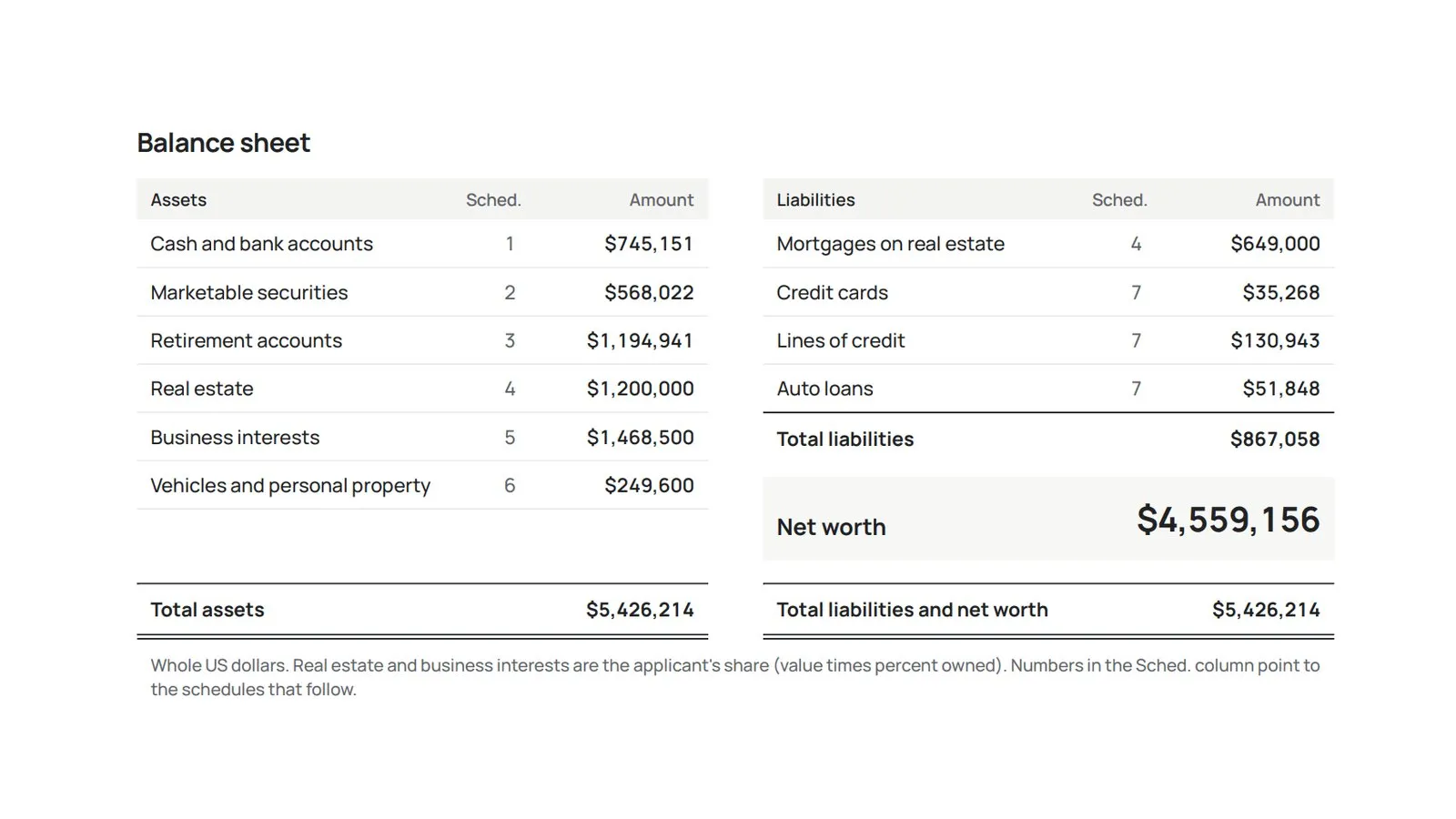
Total assets minus total liabilities. On Form 413 the figure sits directly under total liabilities, and the form requires that total assets equal total liabilities plus net worth, the same identity a balance sheet uses. The AICPA framework refines it by subtracting the estimated tax on built-in gains as well, which gives a more conservative number for anyone holding heavily appreciated assets.
Income and contingent liabilities
Form 413 reserves Section 1 for annual income (salary, net investment income, real estate income, other income) and for contingent liabilities: amounts you owe only if something happens. Personal guarantees on a co-owned LLC’s debt, co-signed loans, and pending legal claims all belong here. These do not change your net worth directly, but they tell a lender what could land on your plate later.
Who needs a personal financial statement
The PFS is the document that evaluates you as an individual, separate from any business you own. The people who are routinely asked for one:
- Small-business owners and their guarantors applying for SBA or conventional financing.
- Real estate investors financing or refinancing property in their own name.
- Jumbo-mortgage and private-bank borrowers whose loan size triggers a full look at reserves and assets.
- Anyone in a divorce or legal separation, where the court requires a full financial disclosure.
- People building an estate plan, where the personal balance sheet is the starting point for wills, trusts, and beneficiary design.
When a personal financial statement is required
- SBA 7(a) and 504 loans. Under 13 CFR 120.160, holders of at least a 20% ownership interest generally must guarantee the loan, and each one files SBA Form 413. General partners, LLC managing members, and any guarantor file one too, even below 20%. The full section-by-section breakdown is in our SBA Form 413 guide and the how to fill out SBA Form 413 walkthrough.
- Conventional business loans with a personal guarantee. When a bank relies on an owner’s personal guarantee, it collects a PFS on its own form. The data is the same as Form 413’s. We cover what those underwriters look for in personal financial statement for a business loan.
- Jumbo mortgages. A jumbo loan exceeds the conforming limit — $832,750 for a one-unit home in most counties in 2026, per the FHFA figure reported by Rocket Mortgage. Loans that large often come with reserve and asset documentation that amounts to a personal financial statement, even when the lender does not use that name.
- Divorce financial disclosure. Both spouses must disclose what they own, owe, earn, and spend. California’s courts, for example, require this disclosure within 60 days of filing, and incomplete disclosure carries real penalties. See our divorce financial disclosure use case.
- Estate planning and wealth management. A current personal balance sheet is the foundation for trust and beneficiary decisions; our estate planning financial statement use case covers the workflow.
Personal lines of credit are the main place a full PFS is usually not required — those lean on your credit score and income instead, unless the line is large or part of a private-banking relationship.
Build your personal financial statement in minutes
StatementsReady syncs bank balances read-only through Plaid, fills SBA Form 413, and exports a lender-ready PDF on demand.
- SBA Form 413 with every section filled
- Bank sync through Plaid, read-only
- 7 days free, no card
Personal financial statement vs. balance sheet
People reach for “balance sheet” to describe a PFS, and the two are cousins, but they answer different questions. Cornell’s legal dictionary defines financial statements as reports about a business entity; a personal financial statement adapts that idea to a person. The practical differences:
| Dimension | Personal financial statement | Business balance sheet |
|---|---|---|
| Reporting entity | An individual, couple, or family | A legal entity (corporation, partnership, LLC) |
| Measurement basis | Estimated current value (today’s market worth) | Mostly historical cost, with some fair-value exceptions |
| Bottom-line label | Net worth | Shareholders’ or owners’ equity |
| Asset ordering | By liquidity; no current vs. long-term split | Current vs. non-current, by operating cycle |
| Income-tax line | Estimated tax on built-in gains if liquidated | Deferred tax assets and liabilities |
| Your business | One line: your ownership interest at estimated value | The entity’s own assets and liabilities, line by line |
The most useful way to hold the distinction: your business has a balance sheet, and you have a personal financial statement, and on your PFS the whole business collapses into one asset. When you apply for an SBA loan, the lender reads both documents side by side. The longer build-it walkthrough lives in the personal financial statement template guide.
How your net worth compares
The number at the bottom of your statement means more once you see where it sits nationally. The Federal Reserve’s Survey of Consumer Finances, the most authoritative read on U.S. household balance sheets, defines net worth the way SBA Form 413 does: total assets minus total liabilities.
$215,900
Median U.S. family net worth in 2025, up 2% from 2022 in real terms, per the Federal Reserve's Survey of Consumer Finances (published October 2026).
Source: Federal Reserve, Changes in U.S. Family Finances from 2022 to 2025
Median and mean tell different stories. The same Fed report puts mean family net worth at $1,241,500, nearly six times the median, because a small number of very wealthy households pull the average up. A net worth of $500,000 is well above the typical family and still below the average. Housing drives a lot of it: median net housing value for families that own a home rose to $230,000 in 2025.
$230,000
Median net housing value (home value minus home-secured debt) for U.S. homeowners in 2025, up from $218,900 in 2022 in 2025 dollars, per the Federal Reserve Survey of Consumer Finances.
Source: Federal Reserve, Changes in U.S. Family Finances from 2022 to 2025
You can run your own figure in our free net worth calculator before you commit it to a form.
Do you need a CPA to prepare one?
No. SBA Form 413 is filled out and signed by the individual, who certifies its accuracy under penalty of criminal prosecution. There is no requirement that a CPA prepare or sign it, and the same is true of the bank-proprietary forms.
A CPA earns the fee in specific situations. When a lender or a court wants added assurance, a CPA can compile, review, or audit a personal financial statement under AICPA standards. And if you hold assets that are genuinely hard to value, like a closely held business interest or a concentrated private holding, a CPA’s valuation work makes the statement defensible. For a salaried borrower with a home, retirement accounts, and a car loan, none of that is necessary.
How to prepare a personal financial statement well
Start by gathering the source documents, because every number on the statement should trace to one: the most recent statement for each bank, brokerage, and retirement account, your latest mortgage and loan statements, and a current value for any real estate. The statement is only as good as the evidence behind it, and a lender who pulls your credit report will notice when the two disagree.
Value assets at what they would sell for today, not what you paid. That is the rule the accounting standard sets, and it is also what a lender expects to see. The exception is the appreciated-asset tax question: if you are presenting a serious statement of net worth, knowing the latent tax on your gains keeps you from overstating what your portfolio is really worth.
Disclose every contingent liability, even the ones you would rather forget. A personal guarantee on a co-owned LLC’s lease, a loan you co-signed for a relative, a pending claim — they belong on the statement, and a lender sees most of them on a credit report anyway. Leaving them off turns a math question into a credibility question.
Finally, keep it current and consistent. Form 413 has to be dated within 90 days of an SBA 7(a) or 504 submission (from October 1, 2026) and of a disaster-loan submission, and many lenders enforce a tighter window. If you expect to need a statement more than once, start from a structured personal financial statement template or the SBA Form 413 template rather than rebuilding it from a blank page each time.
Related reading
- How to fill out SBA Form 413: a section-by-section guide
- Personal financial statement for a business loan
- The personal financial statement template guide
- SBA Form 413, Section 5: contingent liabilities
- More in the personal finance and SBA lending archives.
If you would rather generate a clean, lender-ready statement than assemble one in a spreadsheet, that is what StatementsReady does: sync read-only bank balances through Plaid, and it produces a PDF that mirrors SBA Form 413, formatted and current.
Skip the spreadsheet
A lender-ready personal financial statement from synced balances, in about 8 minutes.
- 7 days free
- No credit card
- PDF, SBA Form 413, Word, or Excel
Build your personal financial statement in minutes
StatementsReady syncs bank balances read-only through Plaid, fills SBA Form 413, and exports a lender-ready PDF on demand.
- SBA Form 413 with every section filled
- Bank sync through Plaid, read-only
- 7 days free, no card