

Most first-time buyers who go looking for a “personal financial statement” don’t actually need a separate one. For a standard home loan, the asset, debt, and net-worth disclosure a lender wants is built into the mortgage application itself: Sections 2 and 3 of the Uniform Residential Loan Application. Where a personal financial statement earns its keep is earlier, before you ever sit with a loan officer. Built for yourself first, it tells you your net worth, your debt-to-income ratio, and your cash to close, so you already know which loan programs you qualify for instead of finding out halfway through underwriting.
Key takeaways
- A personal financial statement nets your assets against your debts to a single net-worth figure. You build it for yourself before a lender ever sees it.
- For a normal home purchase, the lender collects the same information inside the mortgage application, not on a separate form the way SBA business lending uses Form 413.
- Three numbers decide your approval: cash to close, debt-to-income ratio, and credit score. A PFS surfaces all three in one place.
- Down payment minimums are lower than most first-timers assume: 3% conventional, 3.5% FHA. The median first-time buyer still put down 10% in 2025.
- A standalone PFS does get requested for jumbo loans, self-employed bank-statement loans, and purchases made through an LLC or with seller financing.
What a personal financial statement does for a homebuyer
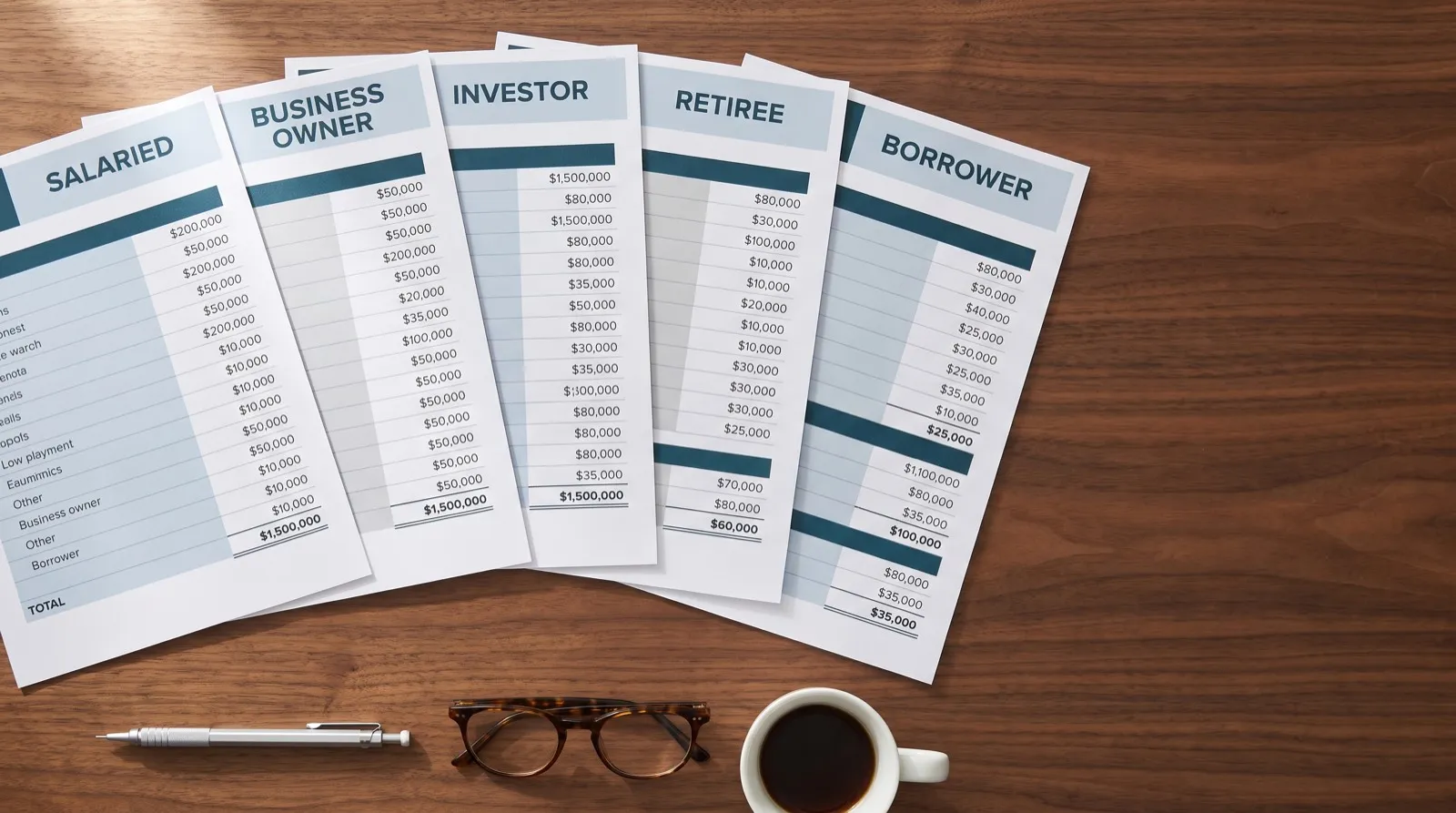
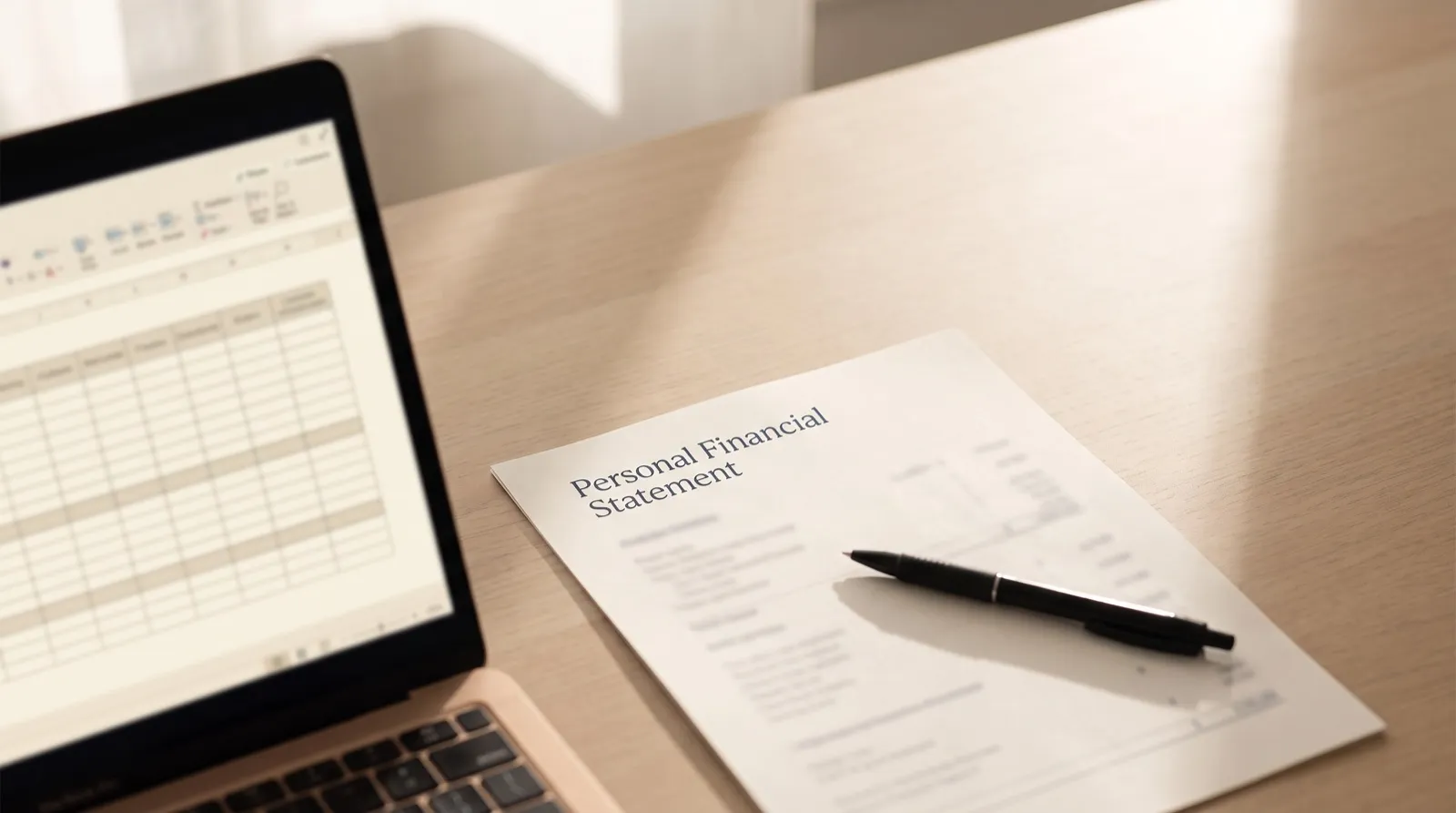
A personal financial statement is a one-page summary of an individual’s assets, liabilities, and net worth at a single point in time. Assets minus liabilities equals net worth. For a homebuyer, it doubles as a readiness check: it shows whether you have the cash to close, how much debt you carry against your income, and where your down payment will come from.
The value of building one before you shop is that it converts a vague question (“can I afford a house?”) into three specific numbers a lender will calculate anyway. You run the math first, on your own terms, with no application on file and no credit inquiry attached. If the numbers don’t work yet, you learn that in private, with months to adjust, instead of inside a live deal. The definition of a personal financial statement carries over directly here; the homebuying context just changes what you do with it.
A homebuyer’s PFS vs. the mortgage application
This is where most of the confusion lives. When you apply for a mortgage, you fill out the Uniform Residential Loan Application, known by its form numbers: Fannie Mae Form 1003 and Freddie Mac Form 65. That application already contains your personal financial statement. Section 2 collects your assets and liabilities, down to each bank account, retirement balance, and monthly debt. Section 3 collects every property you own and the loans against it. The lender then verifies all of it against statements and tax returns.
I work mostly on the commercial side, where a standalone personal financial statement, the SBA Form 413, is mandatory and a business loan won’t move without one. Residential is lighter. A W-2 buyer with one bank account and a car payment rarely fills out a separate statement at all; the loan officer keys those same numbers straight into the 1003. The homebuyer version also skips the heaviest parts of a business PFS, like the contingent-liability schedule for debts you’ve personally guaranteed, unless you’re self-employed or guaranteeing company debt.
$429,300
Median U.S. existing-home sale price in May 2026, up 1.3% year over year and the 35th straight month of annual price gains
Source: National Association of Realtors
That median price is the reason the prep matters. At those values, the gap between qualifying for 3% down and needing 10% is tens of thousands of dollars, and you want to know which side of that line you’re on before you start touring houses.
Before you start
Gather the records before you fill in a single number. At a minimum, pull the most recent statement for every bank, brokerage, and retirement account, plus your two most recent pay stubs and last year’s W-2s or tax returns. You also need the current balance and monthly payment on every debt you carry: student loans, auto loans, credit cards, and any personal loans. Check your credit score too, since it sets your loan options.
Plan on an hour if your finances are simple and a single sitting won’t cover it if you have multiple accounts and a few debts to chase down. Either way, do it before the first lender conversation, not during it.
Step 1. Inventory every asset at current value
List what you own at today’s value, account by account: checking and savings, brokerage accounts, retirement balances, the value of any vehicle you own outright, and any other real assets. A net-worth statement template or the free net-worth calculator gives you the structure so nothing slips through. Done looks like a single column where every asset has a name, a current value, and the statement date it came from. The common miss is treating a retirement balance as fully available cash; a lender discounts it for penalties and taxes when counting it toward reserves, so flag it separately from your liquid down-payment money.
Step 2. List every debt and find your DTI
Now list what you owe, then calculate the number underwriters lean on hardest: your debt-to-income ratio. DTI is your total monthly debt payments divided by your gross monthly income. Add up the minimum monthly payments on every loan and card, then divide by what you earn before taxes.
Work an example. Say you earn $90,000 a year, which is about $7,500 a month before taxes. A 43% back-end DTI leaves room for roughly $3,225 in total monthly debt, including the future mortgage payment. At 50%, that ceiling rises to about $3,750. Every $200 car payment or student-loan minimum eats directly into the mortgage you can carry, which is why paying down a card before you apply can matter more than saving another month of down payment. If you’re self-employed, run your figures through an income calculator first, because lenders average your documented income rather than taking your best month.
Build your personal financial statement in minutes
StatementsReady syncs bank balances read-only through Plaid, fills SBA Form 413, and exports a lender-ready PDF on demand.
- SBA Form 413 with every section filled
- Bank sync through Plaid, read-only
- 7 days free, no card
Step 3. Find your cash to close
Cash to close is the real affordability test, and it has three parts: down payment, closing costs, and reserves. Down payment is the headline, and the minimums are lower than the 20% myth suggests. On the $429,300 median home, 3% conventional down is about $12,900, FHA’s 3.5% is about $15,000, and the 10% that first-time buyers actually put down at the median runs about $42,900.
Closing costs come next; your lender itemizes the exact figure on the Loan Estimate, so don’t guess at it. Reserves are the part buyers forget. Fannie Mae measures reserves in months of your full housing payment (principal, interest, taxes, insurance, and any association dues, or PITIA), and for a one-unit primary residence its automated underwriting often requires no minimum reserves at all. Even when none are required, a few months of payments left in the bank after closing turns a borderline file into a clean one.
10%
Median down payment for first-time buyers in 2025, the highest share recorded since 1989
Step 4. Source and document your down payment
Underwriters want to see where your down payment came from, traced to a documented source. Most first-time buyers fund it three ways: personal savings (59%), financial assets such as a 401(k) or stocks (26%), and gifts or loans from family (22%). Each source needs a paper trail.
Gift money is allowed on a primary residence, and Fannie Mae lets gift funds cover the down payment, closing costs, or reserves. The catch is documentation: the donor signs a gift letter that states the dollar amount, confirms no repayment is expected, and lists their name, address, and relationship to you. Gift funds are not allowed on an investment property, only on a home you’ll live in.
Step 5. Match your numbers to a loan program
With your net worth, DTI, and cash to close in hand, the loan options sort themselves out. Two paths carry most first-time buyers:
- Conventional 3% down. Fannie Mae’s HomeReady loan allows as little as 3% down with a minimum 620 credit score and a DTI up to 50%, though it’s income-limited to 80% of your area’s median income. For files run through Fannie Mae’s automated underwriting, there’s no fixed credit-score floor at all; the system weighs your whole profile.
- FHA. FHA loans require 3.5% down for borrowers with a credit score of 580 or higher, and 10% down for scores between 500 and 579. Below 500, FHA won’t insure the loan.
On debt-to-income, the old 43% number still gets quoted, and there’s a reason. The federal Qualified Mortgage rule once capped a General QM at a 43% DTI. The CFPB removed that hard cap in 2021 and replaced it with a price-based test, which is why programs now stretch to 50%. Treat 43% as the comfortable zone, not the wall.
We’re seeing buyers with significant housing equity making larger down payments and all-cash offers, while first-time buyers continue to struggle to enter the market.
That pressure is exactly why a sharp financial picture helps. First-time buyers have fallen to 21% of the market, the lowest share since 1981, and many are competing against cash. You won’t out-cash a downsizing retiree, but you can show up pre-approved with a clean, documented file, which is the part you control.
Step 6. Carry your PFS into the application
When you’re ready to apply, your personal financial statement becomes the source document you transcribe onto the 1003. Your asset list maps to Section 2, your property and any existing mortgages map to Section 3, and your debts feed the DTI the lender recalculates. Because you built the statement first, the application becomes data entry instead of a scavenger hunt.
Know the cases where a lender does want a standalone statement on top of the application. Jumbo and portfolio loans, self-employed bank-statement loans, a purchase made through an LLC, and seller or private financing all commonly ask for a separate PFS, because the borrower’s overall balance sheet matters more than a single pay stub. If you’re in one of those lanes, the statement you built up front is exactly the document the lender will ask for.
What “done” looks like
You have a one-page personal financial statement that nets your assets against your debts to a net-worth figure, a calculated DTI you can state from memory, and a clear cash-to-close number split into down payment, closing costs, and reserves. You know which loan program your credit score and down payment qualify you for, and your down-payment funds are deposited and documented. When you fill out the 1003, every number already exists and ties to a statement.
What to do next
Start with the asset inventory, because your net worth and cash to close both hang off it. Build it in a personal financial statement template or generate it from your synced accounts, then calculate your DTI and your cash to close before you call a single lender. The full workflow for buyers, including how to keep the statement current while you shop, lives in our first-time homebuyer use case. For more on the underlying document, see the personal finance archive and the guide to building a net worth statement.
Related reading
- What is a personal financial statement?
- Net worth statement template guide
- Personal financial statement for a business loan
- More in the personal finance archive and the foundational what is a personal financial statement resource.
Skip the spreadsheet
A lender-ready personal financial statement from synced balances, in about 8 minutes.
- 7 days free
- No credit card
- PDF, SBA Form 413, or Word export
Build your personal financial statement in minutes
StatementsReady syncs bank balances read-only through Plaid, fills SBA Form 413, and exports a lender-ready PDF on demand.
- SBA Form 413 with every section filled
- Bank sync through Plaid, read-only
- 7 days free, no card