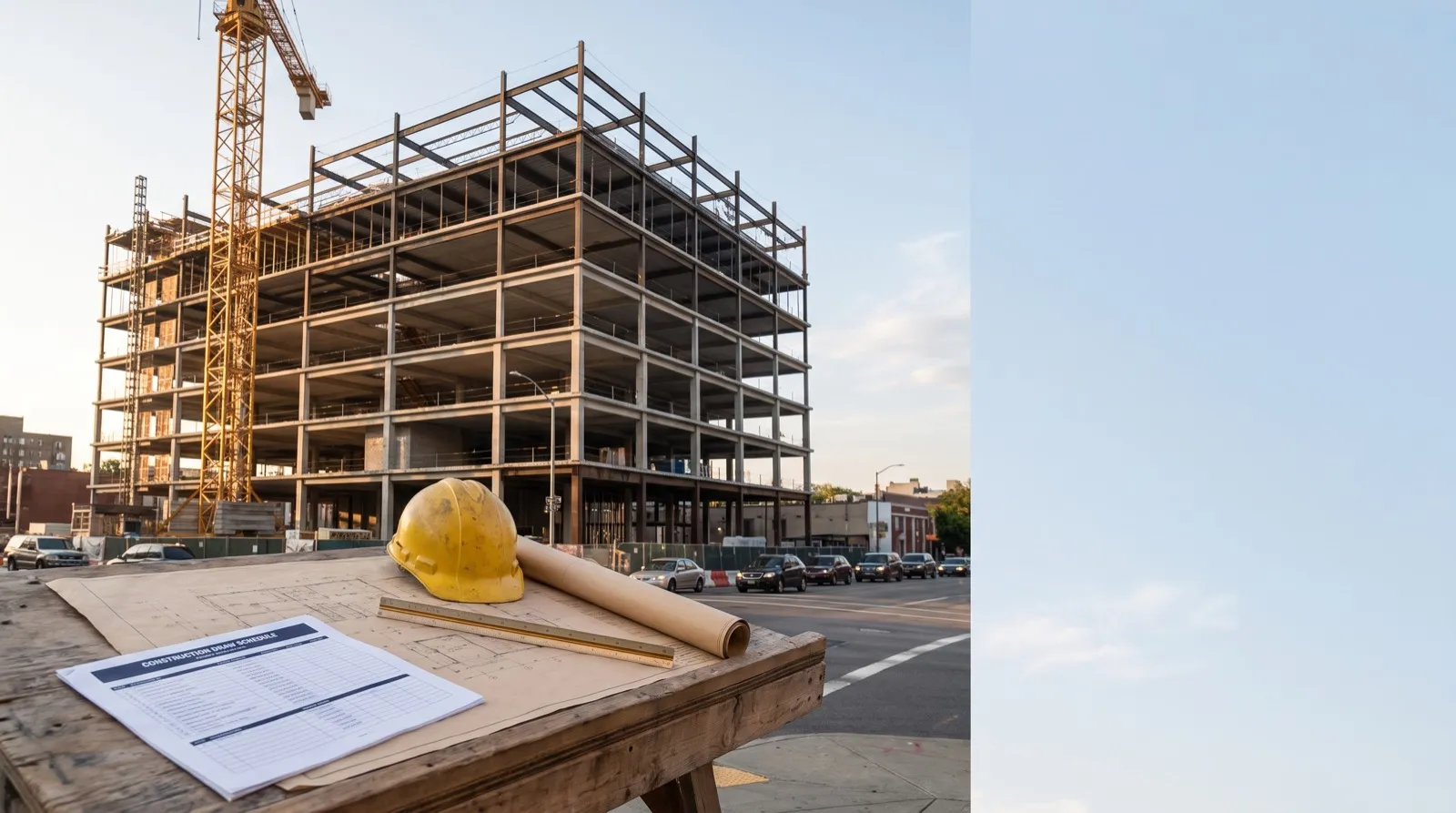


The loan-to-cost ratio is the loan amount divided by the total cost of a project, shown as a percentage. Construction and value-add lenders size deals with it because a building under construction has no stabilized value to lend against. The share the ratio leaves over is the check you write.
What is the loan-to-cost ratio?
The loan-to-cost ratio is the size of a loan expressed as a percentage of the total cost to complete a project. The denominator is the developer’s budget, covering land or acquisition, hard construction costs, soft costs, contingency, and financing costs. Lenders apply it where there is no stabilized operating value to underwrite against, which is why it governs construction, rehab, and value-add lending.
The distinction that trips people up is the denominator. Loan-to-value measures the same loan against an appraiser’s opinion of what the finished property is worth. Loan-to-cost measures it against a budget you wrote and the lender verified. One number comes from a third party, the other comes from you.
LTC is a way of gauging how much leverage a lender will lend a borrower before the value of a property is stabilized.
How to calculate the loan-to-cost ratio
LTC = loan amount ÷ total project cost × 100
Take an 18,000-square-foot flex-industrial building on land you are buying at closing. The budget the lender underwrites:
| Budget line | Amount |
|---|---|
| Land acquisition | $600,000 |
| Hard construction costs | $3,900,000 |
| Soft costs (architecture, engineering, permits, legal, third-party reports) | $470,000 |
| Contingency (10% of hard costs) | $390,000 |
| Interest reserve | $290,000 |
| Lender fees and closing costs | $75,000 |
| Total project cost | $5,725,000 |
At a 70 percent LTC cap, the arithmetic runs both directions:
- Maximum loan: $5,725,000 × 0.70 = $4,007,500
- Required equity: $5,725,000 − $4,007,500 = $1,717,500
Sizing a loan is the same formula read backward. Multiply the fully built budget by the lender’s cap and the answer is your proceeds, with everything above it coming out of your own account.
One quirk worth knowing before you model this yourself. The interest reserve is a function of the loan size, the loan is a function of total cost, and total cost includes the reserve. Those three have to be solved together, so a spreadsheet that sets the reserve first and the loan second lands slightly off.
What counts as total project cost
Lenders build the denominator from a documented budget, not from the purchase price. The lines that typically qualify:
- Land or acquisition cost, often at documented basis rather than current market value, though the treatment varies by lender and by which test is being run.
- Hard costs — foundation, framing, mechanical, electrical, site work, and the general contractor’s fee.
- Soft costs: architecture, engineering, permits, legal, insurance during construction, and third-party reports.
- Contingency, commonly 5 to 10 percent of hard costs on well-defined ground-up work.
- Interest reserve, sized on an assumed average outstanding balance across the construction term.
- Lender fees and closing costs on the construction facility itself.
Who uses LTC, and where the caps sit
Construction lending has been the tightest corner of commercial real estate for a while, and the caps reflect it. The July 2026 Senior Loan Officer Opinion Survey captured it plainly. A significant net share of banks told the Federal Reserve that standards for construction and land development loans sat at the tighter end of their range. A moderate net share reported weaker demand for those loans.
$457.4 billion
Construction and land development loans held by U.S. commercial banks, week ending August 12, 2026
Source: Federal Reserve H.8 via FRED
That balance has drifted down over the year, from $459.3 billion in the week ending August 13, 2025. Where the caps land by lender type:
- Banks and credit unions generally top out between 65 and 75 percent LTC, lower on hospitality, special-use, and first-time sponsors.
- Debt funds and private lenders stretch to 75 or 80 percent, occasionally higher, at meaningfully wider pricing.
- Fix-and-flip and bridge lenders quote as a pair of numbers, such as 90 percent of purchase plus 100 percent of rehab. Run that through the formula and it clears 90 percent LTC on any deal with real work in it. A $200,000 purchase plus $80,000 of rehab is a $260,000 loan against $280,000 of cost, or 92.9 percent.
- SBA 504 reaches 90 percent of project cost on a standard owner-occupied deal, which is covered below.
Those LTC numbers are internal credit policy rather than regulation, which is worth keeping straight. The published supervisory ceilings are LTV-based. The Interagency Guidelines for Real Estate Lending Policies instruct banks that their own internal limits should not exceed these:
| Loan category | Supervisory LTV limit |
|---|---|
| Raw land | 65% |
| Land development | 75% |
| Construction: commercial, multifamily, other nonresidential | 80% |
| Construction: one- to four-family residential | 85% |
| Improved property | 85% |
A bank may lend above those limits. The guidelines cap the aggregate of loans that do at 100 percent of total capital, with the non-one-to-four-family share held to 30 percent. So a bank quoting you 65 percent LTC is expressing its own risk appetite, with an 80 percent LTV supervisory ceiling sitting behind it. Ask which of the two binds your deal.
Recourse matters as much as the percentage. A non-recourse quote at 65 percent and a full-recourse quote at 75 percent are not the same deal. The terms attached to a commercial real estate loan usually move together with leverage.
Build your personal financial statement in minutes
StatementsReady syncs bank balances read-only through Plaid, fills SBA Form 413, and exports a lender-ready PDF on demand.
- SBA Form 413 with every section filled
- Bank sync through Plaid, read-only
- 7 days free, no card
Loan-to-cost vs. loan-to-value
A construction lender runs both tests and funds the smaller result. Same building as above, with an as-completed appraisal of $6,300,000 and a lender that caps LTC at 70 percent and as-completed LTV at 65 percent:
| Test | Ceiling | Maximum loan |
|---|---|---|
| Loan-to-cost | 70% of $5,725,000 | $4,007,500 |
| Loan-to-value (as completed) | 65% of $6,300,000 | $4,095,000 |
| Loan funded | Lesser of the two | $4,007,500 |
LTC binds by $87,500 here. Now suppose the appraiser comes back at $5,800,000 instead. The LTV test allows $3,770,000, the LTC test still allows $4,007,500, and the loan drops to $3,770,000. Your equity moves from $1,717,500 to $1,955,000 without a single line of the budget changing.
| Dimension | Loan-to-cost | Loan-to-value |
|---|---|---|
| Denominator | Total documented project cost | Appraised value, or purchase price if lower |
| Set by | Your budget, verified by the lender | A third-party appraiser the lender engages |
| Known | At application, subject to budget review | Only after the appraisal is delivered |
| Governs | Construction, heavy renovation, value-add bridge | Stabilized acquisitions, refinances, permanent debt |
| Main borrower risk | Cost overruns raise the denominator, not the loan | The appraisal lands low and proceeds fall |
Larger institutional lenders stack a third and fourth test on top: debt service coverage and debt yield on the projected permanent loan. The proceeds are the lowest number any of those four produces. Our DSCR calculator and commercial real estate loan calculator run the coverage and payment sides without a signup. Check the DSCR math against your pro forma before you take a term sheet seriously.
Loan-to-cost on an SBA 504 project
Page-one explainers on LTC skip the SBA 504 program almost entirely. That is a shame, because 504 is the one place where the ratio is set by federal regulation instead of credit policy. The whole program is sized against project cost.
The SBA describes a typical 504 project on its lender page as three pieces:
- A private-sector loan with a senior lien “covering up to 50% of the project cost.”
- A CDC loan backed by a 100 percent SBA-guaranteed debenture, with a junior lien “covering up to 40% of the total cost.”
- “A contribution from the borrower of at least 10% equity of the total project cost.”
Add the first two and the maximum LTC is 90 percent. No conventional construction lender is quoting that.
The equity tiers are federal regulation
13 CFR 120.910 sets the borrower contribution as a percentage of project cost, excluding administrative costs:
| Situation | Borrower contribution | Maximum LTC |
|---|---|---|
| Standard owner-occupied project | 10% | 90% |
| Business operating two years or less | 15% | 85% |
| Limited or single-purpose property | 15% | 85% |
| Both conditions apply | 20% | 80% |
The extra equity comes out of the debenture, so a 15 percent injection produces a 50/35/15 structure rather than 50/40/10. Our walkthrough of SBA loan down payment requirements covers how those tiers play out across both 7(a) and 504, and the 504 requirements post covers eligibility.
What counts as 504 project cost
13 CFR 120.882 lists four categories of eligible project cost:
- Costs directly attributable to the project.
- A contingency reserve for cost overruns on projects involving construction.
- Professional fees “such as title insurance, opinion of title, architectural and engineering costs, appraisals, environmental studies, and legal fees related to zoning, permits, or platting.”
- “Repayment of interim financing including points, fees and interest.”
That last clause is how the permanent debenture takes out the construction loan’s carry.
One detail catches even experienced borrowers. That regulation caps the construction contingency at 10 percent of construction cost. SBA Procedural Notice 5000-872764, effective September 30, 2025, raised the ceiling for 504 projects to 15 percent of project construction costs.
The notice added a residual rule too. Leftover contingency of 2 percent or less of the debenture may be refunded to the business as working capital. Anything above 2 percent means the debenture gets reduced by the unused amount. The CFR text still reads 10 percent, so quoting the regulation alone understates the cushion available to you.
Where LTV sneaks back in
The 504 program sizes on cost, and it still reads the appraisal. Under SOP 50 10 8.1, an appraisal below 90 percent of the estimated value usually shrinks the debenture. The alternative is additional collateral, or an additional contribution added to the required borrower contribution, sufficient to address the gap. If neither is available, strong, consistent cash flow can still get the appraisal approved.
Where neither is available, SBA can still approve the appraisal if the applicant shows strong, consistent cash flow sufficient to support the debt.
That threshold used to be 95 percent. SBA Procedural Notice 5000-835230, effective July 29, 2022, moved it to 90 percent. A 504 project now absorbs up to a 10 percent appraisal shortfall before the structure has to change, and any explainer still quoting 95 percent is four years stale.
A thin appraisal on a 504 construction project raises your equity check, exactly as it would on a conventional deal. Anyone financing owner-occupied space should read the 504 commercial real estate walkthrough alongside this, and run payments through the SBA loan calculator.
How to present a budget that survives the LTC test
The equity number falls out of the budget, so the budget is where the work belongs.
Build the full budget before you request a loan amount. Every omitted line becomes equity. Contingency, interest reserve, third-party reports, and lender fees all belong in the denominator on most construction facilities, and leaving them out shrinks your proceeds without shrinking your bills.
Document the land basis. How land you already own gets credited depends on which test the lender is running, so ask which one applies. Under the 2018 Economic Growth, Regulatory Relief, and Consumer Protection Act, contributed land counts at appraised value toward one specific test. That test is the 15 percent capital contribution that keeps a construction loan out of high-volatility (HVCRE) capital treatment. Before the Act, only the cash paid for the land counted, which penalized anyone who had held a site while it appreciated.
The LTC budget line is a separate question, and commonly runs at documented cost. How long you have held the land, how you acquired it, and what liens sit against it all affect how much equity the lender recognizes.
Ask which tests the lender runs, and get the caps in writing. LTC, as-completed LTV, as-stabilized LTV, DSCR, and debt yield are separate constraints. Knowing which one binds tells you what to stress-test.
Prove the equity before the first draw. Most construction lenders require the sponsor’s equity to go in first, or pro rata with each draw. That means bank statements, wire confirmations, and settlement statements, not a promise. Promissory notes and gift letters generally do not satisfy an SBA lender on their own.
Have the personal side ready at the same time. On an SBA loan, every owner of 20 percent or more files SBA Form 413. The lender reads it to confirm the injection is actually sitting somewhere, and that post-close liquidity survives writing the check. Our SBA Form 413 guide walks the form section by section, and the SBA personal financial statement template is the faster starting point than a blank page.
A borrower who shows up with a complete budget, a documented land basis, and a current personal financial statement gets a straight answer on proceeds in the first conversation. A borrower who shows up with a construction number and a hope gets three weeks of budget revisions and a smaller loan at the end of them.
For the rest of the workflow, including keeping your statement current between draws and renewals, see the commercial real estate investor use case and the construction loan explainer. More on financing structures is in our commercial real estate archive.
Skip the spreadsheet
A lender-ready personal financial statement from synced balances, in about 8 minutes.
- 7 days free
- No credit card
- PDF, SBA Form 413, Word, or Excel
Build your personal financial statement in minutes
StatementsReady syncs bank balances read-only through Plaid, fills SBA Form 413, and exports a lender-ready PDF on demand.
- SBA Form 413 with every section filled
- Bank sync through Plaid, read-only
- 7 days free, no card