

Here are the 7 types of liabilities: current, long-term, contingent, secured, unsecured, joint, and tax. The first three sort debt by when and whether you owe it, the next two by what backs it, and the last two by who owes it and to whom. Below, each type gets its definition, its treatment under the relevant accounting standard, and the exact line it occupies on a personal financial statement.
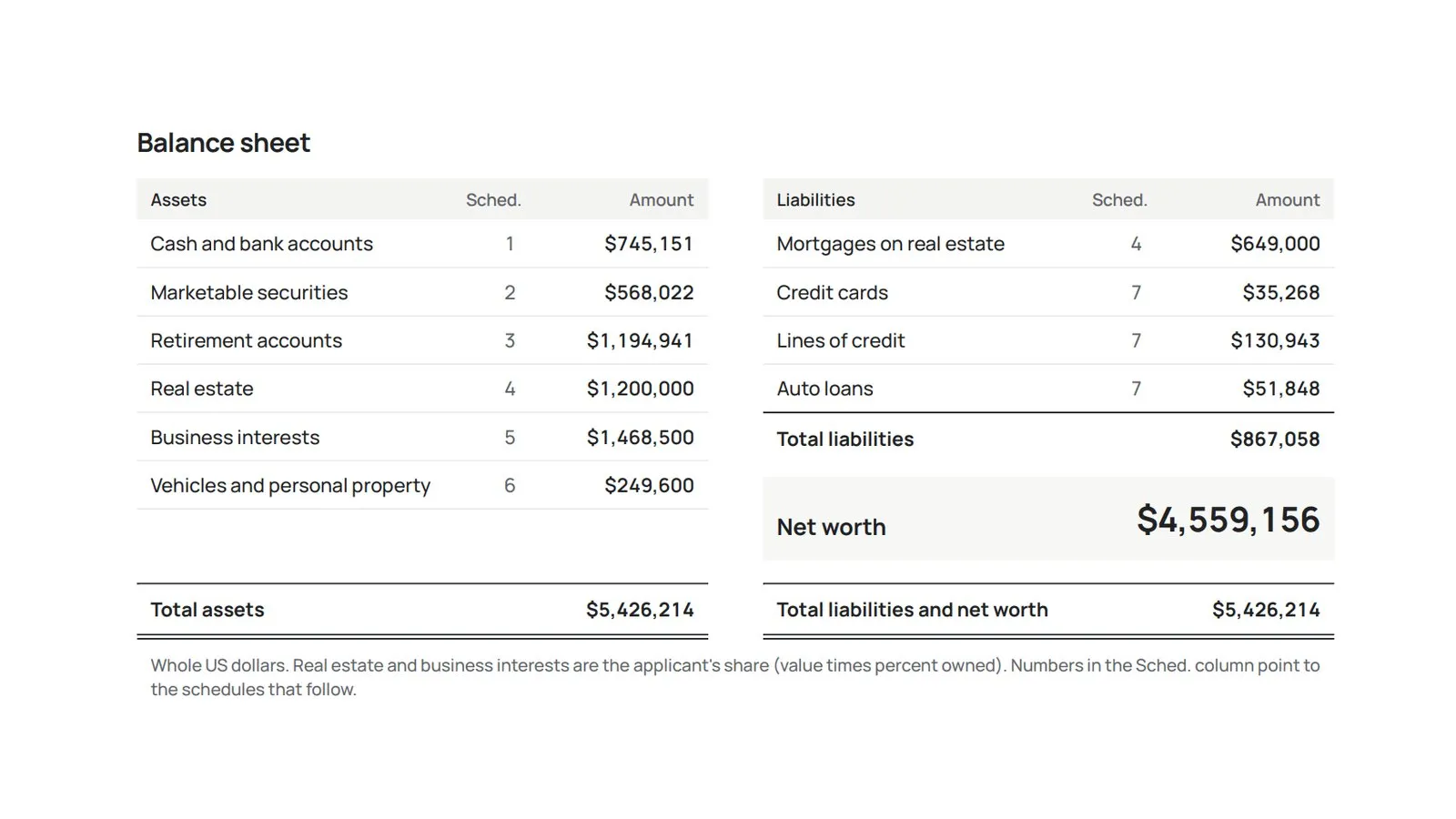
A liability is a present obligation to transfer money, goods, or services to someone else. On a personal financial statement it is reported at the discounted amount of cash to be paid, using the interest rate implicit in the transaction that created the debt, or at the lower figure, if you could settle the debt today for less. Total liabilities subtracted from total assets is your net worth.
The 7 types at a glance
| # | Type | Sorted by | Where it lands on a PFS |
|---|---|---|---|
| 1 | Current | Timing: due within 12 months | No dedicated line; folded into accounts payable, notes payable, and installment accounts |
| 2 | Long-term | Timing: due beyond 12 months | Mortgages line, notes payable line, plus the supporting schedules |
| 3 | Contingent | Certainty: owed only if an event occurs | Its own panel, disclosed but not subtracted |
| 4 | Secured | Security: an asset backs the debt | Notes payable and mortgages, with collateral identified in the schedule |
| 5 | Unsecured | Security: only your promise backs it | Accounts payable, notes payable, installment accounts |
| 6 | Joint | Obligor: you and someone else owe it | The same lines, at the full household amount on SBA Form 413 |
| 7 | Tax | Payee: owed to a taxing authority | Unpaid taxes line, with detail in the tax schedule |
The reason a single debt appears in several rows: these are overlapping classifications, not mutually exclusive buckets. A mortgage on a rental property is long-term, secured, often joint, and partly current all at once. Underwriters read all four attributes; a textbook that gives you only the first one leaves you guessing at the other three.
1. Current liabilities: due within twelve months
A current liability is an obligation that comes due within one year of the statement date. Credit card balances, the principal portion of car and mortgage payments falling due in the next twelve months, accrued unpaid bills, and short-term personal loans all qualify. Interest you have not yet incurred is not part of it.
On a business balance sheet this classification does real work, because current assets divided by current liabilities produces the current ratio a commercial underwriter checks.
On a personal financial statement it largely disappears. The AICPA guidance codified in FASB ASC 274 is plain: personal financial statements make no distinction between current and long-term liabilities. The reason given is that “there is no operating cycle on which to base that distinction in a person’s financial affairs.” Liabilities are presented in order of maturity instead (AICPA SOP 82-1, the source document for ASC 274).
This matters for anyone who arrives at SBA Form 413 expecting a current-liabilities section. There isn’t one. What the form gives you instead is a set of instrument-type lines: accounts payable, notes payable to banks and others, installment account (auto), and installment account (other). Your short-term debt gets distributed across them. The full walkthrough of which balance goes on which line is in our section-by-section Form 413 guide.
Watch out for: reporting a monthly payment where the form asks for a balance. The installment lines ask for both, in separate boxes.
2. Long-term liabilities: due beyond twelve months
A long-term liability runs past the twelve-month horizon: mortgages, most student loans, multi-year equipment notes, and the remaining principal on any amortizing loan after the current year’s portion.
Long-term debt dominates U.S. household balance sheets by a wide margin. Mortgage balances alone accounted for roughly 70% of the $18.8 trillion in total household debt at the end of Q1 2026, with student loans adding another $1.66 trillion (Federal Reserve Bank of New York, Quarterly Report on Household Debt and Credit).
$18.8 trillion
Total U.S. household debt at the end of Q1 2026, including $13.19T in mortgages, $1.69T in auto loans, $1.66T in student loans, and $1.25T in credit card balances
Source: Federal Reserve Bank of New York, Quarterly Report on Household Debt and Credit
Report the full outstanding principal, not the amount you will pay over the life of the loan. A 30-year mortgage with a $400,000 balance is a $400,000 liability, even though the total of the remaining payments is far higher. The interest you have not yet incurred is not an obligation you owe today.
Watch out for: balloon and interest-only structures. A commercial mortgage maturing in eighteen months reports the same way as a 30-year fixed, so the maturity date belongs in the real estate schedule where an underwriter will see it.
3. Contingent liabilities: owed only if something happens
A contingent liability is an obligation that becomes real only on a triggering event. The three that show up most often on personal statements are a personal guarantee on someone else’s business loan, a co-signed obligation like a child’s student loan or a sibling’s car note, and a pending lawsuit naming you as a defendant.
Accounting treatment turns on likelihood. Under FASB ASC 450, a loss contingency is accrued as an actual liability only when a loss is probable and the amount is reasonably estimable; a reasonably possible loss is disclosed without accrual, and a remote one generally needs neither (Deloitte’s ASC 450 roadmap).
Lender forms use a blunter version of the same logic. On SBA Form 413, contingent liabilities occupy their own panel beside Section 1 and are disclosed rather than subtracted, so they never touch the net worth arithmetic. The panel has four named lines: as endorser or co-maker, legal claims and judgments, provision for federal income tax, and other special debt. Where they sit and how to fill them is covered in our contingent liabilities walkthrough.
Watch out for: the guarantee on the loan you are currently applying for. That one is not a pre-existing contingent liability, and it does not go in the panel.
4. Secured liabilities: an asset backs the debt
A secured liability gives the lender a claim on a specific asset if you default. Mortgages, auto loans, loans against the cash surrender value of a whole life policy, and pledged-securities lines are the common personal examples.
Security changes how an underwriter reads the same dollar figure. A $200,000 mortgage against a $500,000 property and a $200,000 unsecured line of credit reduce your net worth identically, but only one of them can force a sale. SBA Form 413’s notes payable schedule asks for exactly this: for each note, the noteholder, original balance, current balance, payment amount, frequency, and how the note is secured or endorsed, including the type of collateral.
Match every secured liability to the asset securing it on the same statement. A mortgage with no corresponding property in the real estate schedule, or a vehicle loan with no vehicle on the asset side, is one of the fastest ways to earn an underwriting callback.
Watch out for: blanket liens. A business line of credit secured by all business assets and personally guaranteed shows up twice: once as the business obligation and once in the contingent panel.
5. Unsecured liabilities: only your promise backs the debt
An unsecured liability has no specific collateral behind it. Credit cards, most personal loans, medical debt, most federal student loans, and money owed to friends or family fall here.
Unsecured consumer debt is the smaller share of household balance sheets but the more volatile one. According to KPMG’s analysis of the New York Fed data, credit card balances contracted 2% in Q1 2026 to $1.25 trillion, while seriously delinquent card balances climbed to 13.1%, approaching levels last seen around the financial crisis (KPMG, Q1 2026 household debt analysis).
13.1%
Share of credit card balances in serious delinquency (90+ days) in Q1 2026, up from 12.7% the prior quarter
Source: KPMG analysis of the Federal Reserve Bank of New York Household Debt and Credit report
Unsecured does not mean uncollectible, and it does not mean invisible. Revolving balances appear on the credit report an underwriter pulls, and the monthly minimums feed the debt-service calculation that decides whether your loan clears. Our post on what a personal financial statement does in a business loan file covers how those payments get read.
Watch out for: a 401(k) loan. It reduces the retirement balance you report as an asset and shows up again as a liability, so netting it in one place and forgetting the other double-counts in your favor.
Build your personal financial statement in minutes
StatementsReady syncs bank balances read-only through Plaid, fills SBA Form 413, and exports a lender-ready PDF on demand.
- SBA Form 413 with every section filled
- Bank sync through Plaid, read-only
- 7 days free, no card
6. Joint liabilities: the debts a second name puts on your statement
A joint liability is one that two or more people owe together. Joint credit cards, jointly titled mortgages, spousal co-borrowing, and community-property obligations all belong here.
The reporting rule is form-specific and easy to get wrong. The current SBA Form 413 directs the owner to include the assets and liabilities of their spouse and any minor children, even when the spouse is not a party to the loan, so the household figure goes on the form, not your half. Other lender statements ask for your proportional share. Read the instructions on the form in front of you before you divide anything.
The related trap is a co-signed debt where you are not the primary obligor. That is not a joint liability on your statement; it is a contingent one, and it belongs in the panel described in item 3. The distinction is whose obligation it is today, not whose credit report it appears on. If you have signed a guaranty for a business entity, our explainer on what a personal guarantee actually obligates you to covers the mechanics.
Watch out for: divorce decrees. A decree assigning a debt to your former spouse does not release you from the lender’s contract, so a jointly titled mortgage stays on your statement until it is refinanced or paid.
7. Tax liabilities: already owed versus merely expected
Tax liabilities split into two categories that lender forms deliberately keep apart.
Tax you already owe and have not paid — past-due federal, state, or property tax, including an open IRS installment-plan balance — goes on the unpaid taxes line, with the type, payee, due date, amount, and any attached lien detailed in the supporting tax schedule.
Tax you merely expect to owe belongs elsewhere. If you plan to sell an appreciated asset, the tax on that future gain is a provision, and it goes in the contingent liabilities panel under provision for federal income tax. Do not report anticipated tax that is not yet due on the unpaid taxes line. GAAP-basis personal financial statements take this further: ASC 274 requires a provision for the estimated income taxes on the difference between the current values of your assets and their tax bases, computed as if everything were liquidated at the statement date. Lender forms don’t ask for that computation, which is one reason a Form 413 net worth and a CPA-prepared net worth can legitimately differ.
Watch out for: a tax lien. A recorded lien is both an unpaid tax and an encumbrance on the property it attaches to, so it belongs in the tax schedule and in the real estate description of the affected parcel.
How to classify your own liabilities
Four questions, in order, resolve almost every liability you will encounter:
- Do I owe this today, or only if something happens? “Only if” sends it to the contingent panel, where it is disclosed and not subtracted. Everything else goes in the liabilities column.
- What instrument is it? Lender forms sort by instrument, not by maturity: accounts payable, notes payable, installment (auto), installment (other), life insurance loans, mortgages, unpaid taxes, other. Find the line that matches the debt and put the balance there.
- What secures it? If an asset backs the debt, that asset should be visible on the same statement, and the collateral gets named in the notes payable or real estate schedule.
- Who else is on it? Joint debt goes on at the amount the form asks for: household total on SBA Form 413. A debt where someone else is the primary obligor is contingent, not joint.
Run those four and the classification takes care of itself. If you want the raw inventory before you start sorting, the companion post list of assets and liabilities has 50+ line-item examples organized the same way, and the free net worth calculator does the subtraction. For the mechanics of a lender-facing form, start with the SBA Form 413 guide or the personal financial statement template.
Personal financial statements should present payables and other liabilities at the discounted amounts of cash to be paid. The discount rate should be the rate implicit in the transaction in which the debt was incurred. If, however, the debtor is able to discharge the debt currently at a lower amount, the debt should be presented at the lower amount.
Assets minus liabilities is the whole exercise. Classifying liabilities correctly is what makes the second half of it defensible to someone reading it for a living. More on the underlying document is in our personal financial statement vs. balance sheet comparison and the rest of the personal finance archive. If you are assembling this for a bank or SBA file, the business loan application use case walks through what else travels with it.
Skip the spreadsheet
A lender-ready personal financial statement from synced balances, in about 8 minutes.
- 7 days free
- No credit card
- PDF, SBA Form 413, Word, or Excel
Build your personal financial statement in minutes
StatementsReady syncs bank balances read-only through Plaid, fills SBA Form 413, and exports a lender-ready PDF on demand.
- SBA Form 413 with every section filled
- Bank sync through Plaid, read-only
- 7 days free, no card