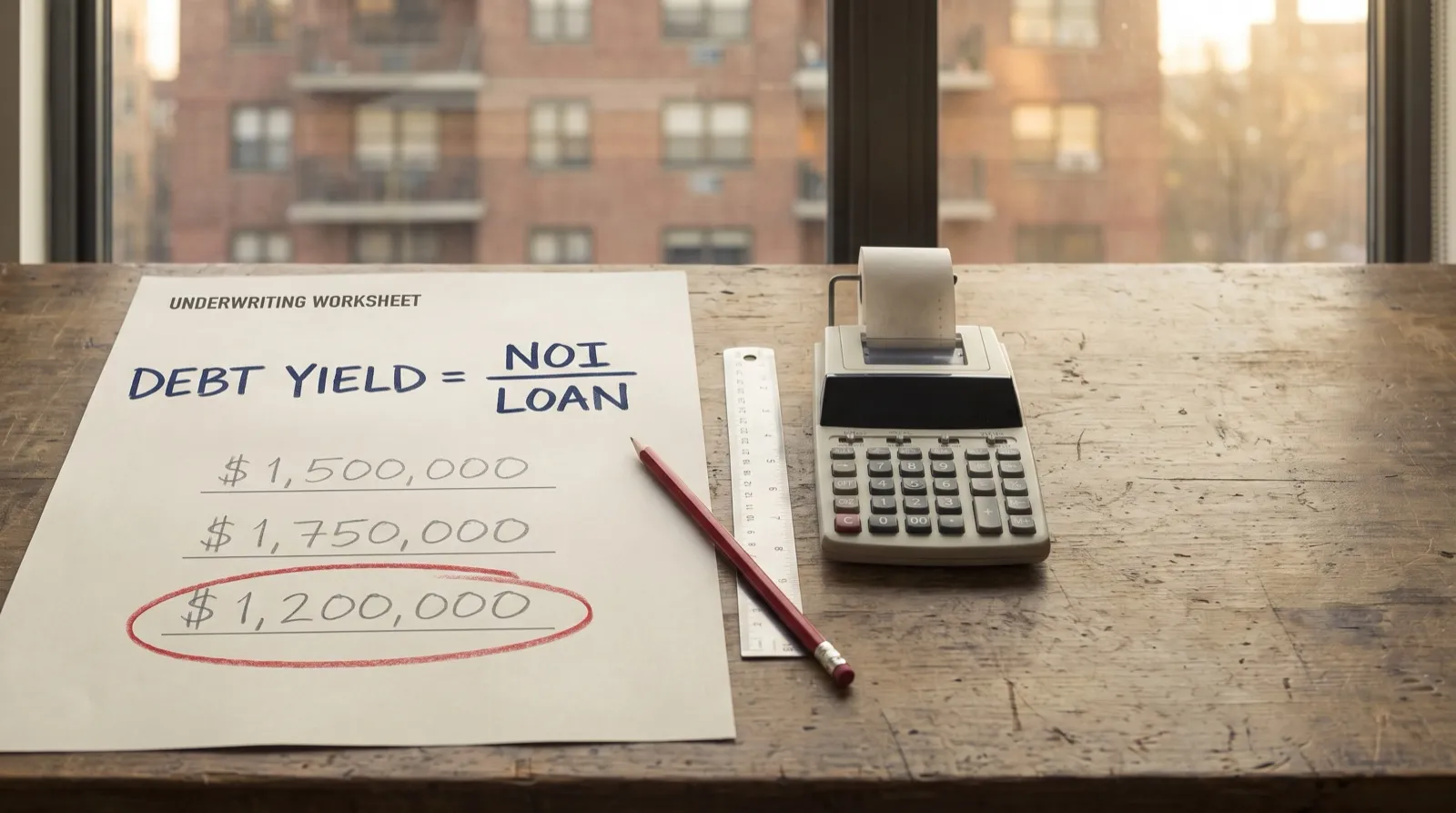


A rent roll is the unit-by-unit table showing who occupies each space at a property, what they pay, and when their lease ends. It is normally the first document a commercial lender asks for, and the number at the bottom of it is not the number that ends up in the loan file. Underwriters take that total apart, apply their own vacancy floor, discount some of the rent, and rebuild it into net operating income before they size any debt.
What is a rent roll?
A rent roll is a dated schedule listing every rentable unit at a property alongside its occupant, contract rent, lease start and end dates, and current occupancy status. Property management systems generate it, and lenders, buyers, and appraisers use it as the primary evidence of a property’s in-place income. When a lender relies on one for underwriting it is normally certified, meaning the borrower and any management agent have formally attested to the figures.
Different lenders name the fields differently. The required set barely changes.
Fannie Mae’s multifamily rent roll template validates every unit row on submission. It requires a rent roll as-of date, a unique unit identifier, bedroom count, tenant contract rent, market comparable rent, a utilities-included flag, and a lease status of occupied, vacant, or employee. Units used as a model apartment or a leasing office have to be reported as vacant. One field is required to be blank: Fannie Mae rejects any file with tenant names filled in, because those names are nonpublic personal information.
What a rent roll includes
Every serious rent roll carries the same spine, whatever software produced it.
- Unit identifier and unit type. Number of bedrooms and bathrooms for residential, square footage for commercial space.
- Tenant name. Present for the lender’s lease audit, stripped before agency delivery.
- Lease start and end dates. The raw material for the rollover schedule.
- Contract rent. What the lease says, which frequently differs from what gets collected.
- Market rent. The appraiser’s or comparable-based asking rent for that unit type.
- Occupancy status. Occupied, vacant, notice given, model, employee, or down for renovation.
- Security deposit. Held funds, which are a liability rather than income.
- Concessions. Free months and move-in credits that reduce effective rent.
- Delinquency. Balances 30, 60, and 90 days past due.
- Ancillary charges. Parking, storage, pet rent, and utility reimbursements.
The Fannie Mae template goes further and asks for move-in and move-out dates, paid-through date, past-due buckets, subsidy type and amount, and any tenant guarantor. That level of detail exists because each of those columns is where a cash-flow surprise hides.
When you need one
- Buying or refinancing multifamily. The rent roll goes into the initial package alongside the trailing-12-month operating statement and your schedule of real estate owned.
- Applying for a DSCR loan on a rental. Even a single-tenant house needs a dated rent roll plus the executed lease. See DSCR loans for investment property for the full document list.
- Financing mixed-use or a building you partly occupy. The leased portion has its own rent roll.
- Reporting during the loan term. Federal regulation at 12 CFR § 1234.17 requires qualifying CRE loan documents to include covenants obligating the borrower to report leasing and rent-roll activity to the servicer no less frequently than quarterly. The document does not stop mattering at closing.
- Selling. A buyer’s lender will re-underwrite whatever rent roll you hand the broker.
7.3%
U.S. rental vacancy rate, second quarter 2026, statistically unchanged from a year earlier
Source: U.S. Census Bureau, Current Population Survey / Housing Vacancy Survey
That national figure is context, not an underwriting input. Your lender uses the property’s own numbers, floored by their program minimum, which is the part borrowers consistently misjudge.
What an underwriter does to your rent roll
This is the point where a rent roll stops being a property-management report and becomes a credit document. Five things happen to it, roughly in this order.
1. It gets date-checked and certified
Thirty days is the common standard across programs. Fannie Mae’s document checklist for Form 4243 asks for a Certified Project Rent Roll dated no earlier than 30 days before the borrower submits a formal application. An older one needs a signed statement that occupancy, income, and concessions have not materially changed since the certification date.
Freddie Mac Small Balance Loan checklists use a similar window, and on FHA-insured multifamily loans HUD’s MAP Guide calls for an updated certified rent roll dated no more than 30 days before endorsement. That same checklist states that to count as a Certified Project Rent Roll, the rent roll must be certified by the borrower, the management agent if there is one, and the lender. Fannie Mae then requires a fresh certification at the loan origination date confirming nothing has materially changed.
2. Vacancy gets floored, whatever your occupancy is
A full building does not underwrite as a full building. Freddie Mac’s Multifamily Seller/Servicer Guide sets a floor: the vacancy and collection-loss rate used in underwriting may not be less than 5%, and it has to rise when property or market conditions warrant.
A June 2024 update to Small Balance Loan lenders puts that in operating terms. Physical vacancy should generally be underwritten to the greatest of 5%, the subject’s current actual physical vacancy, the appraiser’s conclusion, or submarket data.
Fannie Mae reaches the same floor from a different direction. On conventional deals, physical vacancy, concessions, and bad debt together have to equal the greater of the shortfall between annualized trailing-three-month collections and gross potential rent, or 5% of gross potential rent. The combined deduction can run higher than 5%, never lower.
There is a separate occupancy gate underneath that. Fannie Mae requires small mortgage loans on properties with 10 or more units to hold at least 90% physical occupancy by qualified occupants for the 90 days before the commitment date. Properties with fewer than 10 units can have no more than one vacant unit at commitment and must average 90% occupancy over the prior 12 months. A rent roll showing 88% occupancy is not a pricing conversation, it is an eligibility problem.
3. Some of the rent gets discounted
Not every dollar on the rent roll counts at face value.
- Concessions get amortized into effective rent. A tenant at $2,500 a month with two free months on a 12-month lease is underwritten at roughly $2,083.
- Month-to-month tenants are treated as fragile occupancy. They are occupied today and gone in 30 days, so analysts commonly model them at a higher effective vacancy than a lease with a year of term left.
- Related-party and corporate leases get scrutinized. Freddie Mac expanded its lease audit requirements in April 2023 to include leases from inspected corporate units and any lease signed in the previous 60 days, and required corporate leases to be flagged on the rent roll the same way employee, model, and rental-office units already were.
- Ancillary income is haircut or excluded. Parking, laundry, and pet fees rarely underwrite at 100% of trailing actuals.
- Loss to lease is measured. The gap between in-place and market rent tells the lender whether your income is durable or already stretched.
4. It gets reconciled to money that moved
The rent roll is what tenants owe. Bank deposits are what tenants paid. An underwriter compares annualized rent-roll income against the trailing-12-month operating statement and against deposit records. The gap between them is where economic vacancy shows up, along with concessions, bad debt, mid-year rent changes, and timing differences in how income was booked.
The same check runs from the lease side. HUD’s MAP Lender Underwriter’s Narrative for FHA-insured refinances directs the underwriter to discuss conclusions from the lease audit and site inspections. It asks in as many words whether the rent roll lists concessions granted in prior months that reduced rents for the whole lease term.
Where a rent roll totals more than the T-12 collected, every dollar of that difference needs an explanation, whether it is bad debt, vacancy, a concession, or a timing item. Letting the underwriter find an unexplained gap is what costs you credibility on every other number in the file.
5. Big tenants are asked to confirm it themselves
On commercial and larger multi-tenant deals, the lender does not take the landlord’s word for the lease terms. Tenant estoppel certificates ask the tenant to confirm rent, term, deposits, outstanding landlord obligations, and whether anyone is in default. Subject to the certificate’s own terms and exceptions such as fraud, a signed estoppel limits the tenant’s ability to later assert facts inconsistent with what they confirmed, which is why lenders want them before funding.
Estoppel certificates typically confirm the identity of the documents that make up the parties’ written agreement including any amendments and that the signatory to the estoppel has no offsets against or claims of default under such agreement.
Build your personal financial statement in minutes
StatementsReady syncs bank balances read-only through Plaid, fills SBA Form 413, and exports a lender-ready PDF on demand.
- SBA Form 413 with every section filled
- Bank sync through Plaid, read-only
- 7 days free, no card
From rent roll to NOI to DSCR
The chain from your spreadsheet to your loan amount is four steps long.
Start with gross potential rent, which is every unit at market rent with the building 100% full. Subtract loss to lease, concessions, vacancy, and bad debt to get effective gross rental income. Add ancillary income to reach effective gross income. Subtract operating expenses, and what remains is net operating income.
NOI = Effective Gross Income − Operating Expenses
DSCR = NOI ÷ Annual Debt Service
That ratio is the constraint. Freddie Mac’s Small Balance Loan term sheet sets minimum amortizing debt coverage by market tier: 1.20x in top markets, 1.25x in standard, 1.30x in small, and 1.40x in very small markets. LTV caps run 70% to 80% across the same tiers. A property has to clear both tests, so the binding one is whichever produces the smaller loan.
Two rent-roll numbers move that ratio more than anything else: the vacancy deduction the lender applies, and how much of your ancillary income survives their haircut. Run your own version before submission with the free DSCR calculator. Then check the payment against the commercial real estate loan calculator, so you know your coverage before the lender computes it. The full mechanics are in how to calculate DSCR.
Rent roll vs. T-12 operating statement
These two documents get requested together and confused constantly.
| Rent roll | T-12 operating statement | |
|---|---|---|
| What it shows | Contracted rent per unit | Collected income and paid expenses per month |
| Time frame | One date | Trailing 12 months |
| Source | Property management software | Accounting ledger |
| Answers | Who is here and what do they owe | What did this property earn |
| Verified against | Leases and estoppels | Bank statements |
| Feeds | Gross potential rent | Effective gross income and operating expenses |
The rent roll tells the lender what the income should be. The T-12 tells them what it was. Underwriting lives in the distance between the two, and a borrower who can explain that distance before being asked is a borrower whose file moves.
The SBA wrinkle most owner-occupants miss
If you own your building through a holding entity that leases to your operating business, you have a rent roll with one tenant, and there is a rule about what you can put on it. SBA’s SOP 50 10 8.1 requires an Eligible Passive Company to lease 100% of the property to the operating company, and it caps the rent. Lease payments cannot exceed the amount needed to cover the loan payment plus the entity’s direct costs of holding the property: routine maintenance, utilities, insurance, and property taxes.
Writing an inflated rent on that lease to make the holding entity look better does nothing except get cut back in underwriting. The operating company’s cash flow is what carries the loan, and the lender is required to test whether it covers the payment plus those holding expenses. If your business occupies most of the building and leases the rest, the third-party space gets a real rent roll and gets underwritten normally. What SBA financing will not do is fund a pure rental, which is covered in SBA loans for rental property.
How to prepare a rent roll that survives underwriting
Date it, and keep it inside 30 days. A rent roll from last quarter gets returned before the file opens.
Reconcile it to your own bank deposits first. Pull three months of deposits, match them against contract rent, and write a short note explaining every gap. An underwriter will find the variance either way, and finding it themselves is worse than being told.
Label the exceptions. Mark month-to-month tenants as month-to-month, models as models, down units as down, and delinquent tenants with their aged balances. Every one of those categories has a standard underwriting treatment, and the treatment costs you a little. Getting caught hiding one costs you a second look at every other line.
Attach the leases and keep them consistent. Lease audits compare tenant name, unit, dates, concessions, and rent against the rent roll line by line. A rent roll that survives that comparison is one the lender stops questioning.
Have your personal side ready at the same time. Commercial lenders request the property documents and the sponsor documents in one breath, so a current personal financial statement and schedule of real estate owned belong in the same folder. The rest of the sponsor-side requirements are in commercial real estate loan qualifications, and the PFS template covers the personal half.
For the wider workflow across a portfolio, our commercial real estate investor use case walks through keeping property and personal documents current between renewals. More on financing multi-unit assets is in the commercial real estate archive.
Skip the spreadsheet
A lender-ready personal financial statement from synced balances, in about 8 minutes.
- 7 days free
- No credit card
- PDF, SBA Form 413, Word, or Excel
Build your personal financial statement in minutes
StatementsReady syncs bank balances read-only through Plaid, fills SBA Form 413, and exports a lender-ready PDF on demand.
- SBA Form 413 with every section filled
- Bank sync through Plaid, read-only
- 7 days free, no card