
An SBA loan is a business loan made by a private lender (a bank, a credit union, a nonprofit) that follows U.S. Small Business Administration rules and carries a partial government guaranty. The SBA does not write you a check; it promises to repay the lender a slice of the balance if you default, which is what convinces the lender to offer a longer term and a smaller down payment than a conventional loan would. This guide covers the three main programs, how the guaranty works, who qualifies in 2026, what the loan costs, and the borrower paperwork that decides how fast your file moves.
What is an SBA loan?
An SBA loan is a commercial loan originated by a private lender under the rules of the U.S. Small Business Administration, where the SBA guarantees a fixed percentage of the loan to the lender. The borrower applies to and repays the lender, not the SBA. The guaranty reduces the lender’s loss if the loan defaults, which lets lenders extend credit (with longer terms and smaller down payments) to businesses they might otherwise decline.
The distinction that trips people up: the SBA is a guarantor, not your bank. For the flagship 7(a) and 504 programs, you deal with an approved lender the whole way through: application, underwriting, closing, and monthly payments. The SBA sets the eligibility rules, backs a portion of the loan, and audits the lender. Its own 7(a) program page is blunt about this: you “always work with the lender, not the SBA.” (The Microloan program is the exception: there the SBA lends to nonprofit intermediaries, who then relend to you.)
That guaranty is the whole point. Because a federal agency will cover 75% to 85% of the lender’s loss on a defaulted 7(a) loan, the lender can say yes where it otherwise would not. That covers a business with thinner collateral, a shorter operating history, or a real estate deal needing a 25-year amortization no conventional commercial loan would offer. Our SBA loan calculator estimates the monthly payment on a 7(a) or 504 at that term. The guaranty does not, however, let you off the hook: you sign a personal guarantee, and you remain fully liable for the debt even after the SBA pays the lender.
85% / 75%
SBA 7(a) guaranty: the share of a defaulted loan the SBA repays the lender: 85% on loans of $150,000 or less, 75% on larger loans up to the $5 million cap
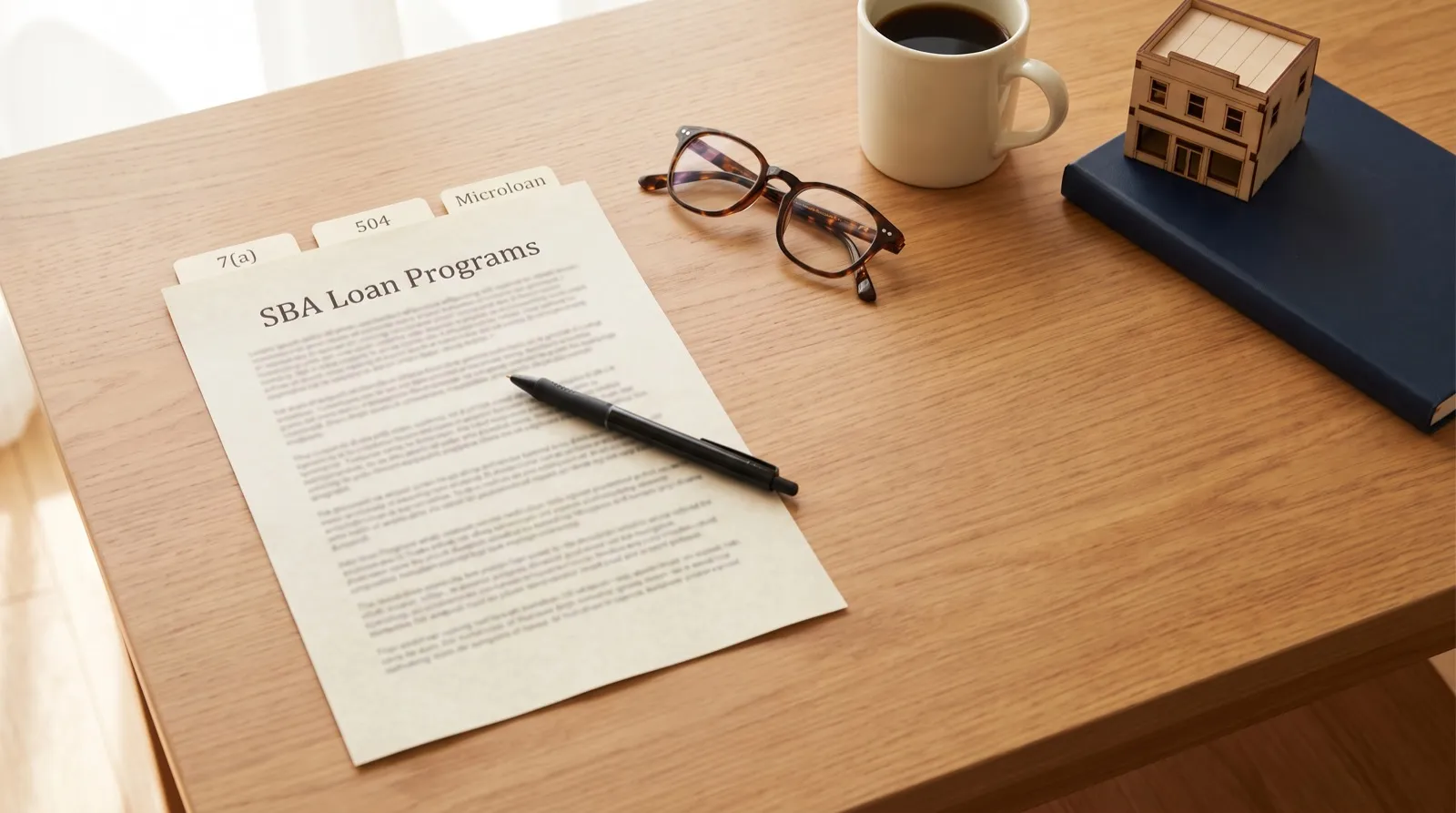
The three main SBA loan programs
Most people who say “SBA loan” mean the 7(a). But there are three core programs, and they solve different problems.
| Program | Maximum SBA-backed amount | Best for | Typical terms |
|---|---|---|---|
| 7(a) | Up to $5 million | Working capital, equipment, real estate, business acquisition, debt refinance | Up to ~10 years (working capital, equipment); up to 25 years (owner-occupied real estate) |
| 504/CDC | Up to $5 million debenture ($5.5M for small manufacturers) | Owner-occupied commercial real estate and long-life equipment | Fixed-rate, 10-, 20-, or 25-year debentures pegged to Treasury rates |
| Microloan | Up to $50,000 (averages ~$13,000) | Startups and very small firms needing modest capital | Up to 7 years; rates generally 8%–13% |
The 7(a) is the general-purpose program: broad use of proceeds, up to $5 million, and the one most acquisition and working-capital borrowers use. The 504 is narrower and structured differently: a conventional first mortgage plus an SBA-backed second-mortgage debenture issued through a Certified Development Company, aimed squarely at owner-occupied real estate and heavy equipment with long-term fixed rates. The Microloan fills the gap under $50,000 for startups, delivered through community lenders that often bundle in business counseling.
One 2026 change is worth knowing before you plan a large project. The SBA historically capped a single borrower’s combined 7(a) and 504 balance at $5 million. Effective July 4, 2026, it decoupled the two programs, so the two ceilings now stack.
$10 million
Combined 7(a) + 504 SBA-backed financing a qualified borrower can now carry, after the SBA decoupled the two programs effective July 4, 2026, double the prior $5 million cumulative cap
For a capital-intensive business, that means you can pair a $5 million 504 loan for the building with a separate $5 million 7(a) loan for working capital and equipment. The balances no longer offset each other. The per-program maximums ($5 million on the 7(a), $5–5.5 million on the 504 debenture) did not change; only the way they combine did. If you’re deciding between the two for a property purchase, the 7(a) vs. 504 breakdown walks through which fits which deal.
Who qualifies for an SBA loan
SBA eligibility is a gate you pass before a lender ever looks at your numbers. The core requirements come from SOP 50 10 8, the rulebook that took effect June 1, 2025, and the notices that have amended it since.
The baseline: your business must be for-profit, operate in the United States, and be small under the SBA size standard for its industry (a receipts or employee-count threshold keyed to your NAICS code). You also have to clear the “credit elsewhere” test: SBA financing is meant for businesses that can repay but cannot get comparable credit from a conventional source without the guaranty.
Two eligibility rules catch borrowers off guard:
- The owner-occupancy rule. If you’re using an SBA loan to buy or improve real estate, your business has to occupy at least 51% of an existing building (60% for new construction). SBA loans cannot finance passive rental real estate; the 504 program says so directly. If you want to buy a building and lease most of it to unrelated tenants, an SBA loan is the wrong tool; a DSCR or conventional commercial loan fits that instead.
- The 2026 citizenship rule. Effective March 1, 2026, the SBA revised SOP 50 10 8 to require that 100% of the direct and indirect owners of an applicant be U.S. citizens or U.S. nationals whose principal residence is in the United States. The prior narrow allowance for up to 5% foreign ownership was rescinded, and, in a significant change, lawful permanent residents (green-card holders) are no longer eligible to hold any ownership interest in the borrower. The agency extended this to the Microloan and Surety Bond programs on March 9, 2026.
The Trump SBA is committed to driving economic growth and job creation for American citizens.
If your ownership structure includes a green-card holder or a partial foreign owner, address it early: a deal that was eligible in 2025 may need restructuring to close in 2026. Beyond these gates, the lender assesses creditworthiness the ordinary way: cash flow, collateral, and your personal credit and financial strength. (The SBA sunset its old FICO Small Business Scoring Service minimum for 7(a) small loans in 2026, pushing lenders back toward full credit analysis rather than a single score.) The full qualifying bar for the flagship program is in our SBA 7(a) requirements guide.
What an SBA loan costs
The cost of an SBA loan is a rate plus a set of fees. Both are capped by the SBA, which is a real borrower protection.
For a 7(a) loan, the interest rate is a base rate plus a lender spread, and the spread can’t exceed the SBA’s maximum. Most lenders use the Wall Street Journal Prime Rate as the base, 6.75% as of July 2026. The maximum variable-rate spreads run by loan size:
| Loan amount | Maximum spread over base | Ceiling at 6.75% prime |
|---|---|---|
| $50,000 or less | Base + 6.5% | 13.25% |
| $50,001 – $250,000 | Base + 6.0% | 12.75% |
| $250,001 – $350,000 | Base + 4.5% | 11.25% |
| Over $350,000 | Base + 3.0% | 9.75% |
Those are ceilings, not quotes. A strong file — solid cash flow, real collateral, good credit — usually prices below the cap. Larger loans get lower maximum spreads because the SBA wants big financing to stay affordable. 504 loans work differently: the SBA portion is a fixed-rate debenture pegged to 10-year Treasury yields, with total fees and costs of roughly 3% of the debt, and that fixed rate is a big reason borrowers choose 504 for a long-hold building.
On top of the rate, the SBA charges the lender an upfront guaranty fee, which lenders typically pass through to the borrower. There is also an annual service fee on the outstanding guaranteed balance. The lender pays that one and, by SBA rule, cannot charge it back to you. Both scale with loan size; the upfront guaranty fee also varies by maturity. A notable wrinkle for fiscal year 2027 (loans approved from October 1, 2026): the SBA waives the upfront fee on 7(a) loans of $700,000 or less to manufacturers (NAICS 31–33), certain food supply chain businesses, and businesses in rural areas. It also waives both 504 fees for the same three groups at any loan size.
The documents you actually prepare
Most “what is an SBA loan” explainers skip the next part, and it determines whether your loan closes in six weeks or three months. An SBA loan is a document exercise. The credit decision matters, but files rarely stall in the credit box; they stall on owner-level paperwork that nobody told the borrower to prepare.
Two SBA forms anchor the owner side of the application, and both are required from every individual who owns 20% or more of the business:
- SBA Form 1919, the Borrower Information Form, collects owner background, the loan request, existing debt, and the disclosures that trigger SBA’s eligibility and character checks. It’s required on every 7(a) loan.
- SBA Form 413, the Personal Financial Statement, lists your assets, liabilities, net worth, and contingent liabilities. This is how the lender sizes up who stands behind the loan and whether your personal guarantee has real value.
Around those, the lender wants three years of business and personal tax returns, current business financial statements (balance sheet, profit and loss, projections), and a business plan for a startup or acquisition. A startup or business purchase usually needs proof of a minimum 10% equity injection into the project. That last one is strict under SOP 50 10 8 and its October 2026 update, SOP 50 10 8.1: a promissory note or a gift letter alone won’t do it. Lenders have to verify the cash with checks, wire confirmations, and bank statements showing the funds were available for at least 30 days.
The operator’s-eye view, from watching these files move: two self-inflicted delays come up more than any others. The first is a 20% owner who didn’t realize they personally had to file a Form 413 and 1919. Each qualifying owner does, not just the majority owner.
The second is a Form 413 that’s gone stale. The 7(a) and 504 programs expect the personal financial statement dated within 90 days of submission for loans submitted from October 1, 2026, and some preferred lenders enforce a tighter 60-day window. Fill it out too early, let underwriting drag, and you’re regenerating it, often right when the lender wants to close. Keeping a current, accurate personal financial statement for every 20%+ owner is the cheapest thing you can do to keep an SBA file moving.
That’s the workflow StatementsReady is built for: a clean, lender-ready personal financial statement on the current SBA Form 413 layout, that you can update in minutes when underwriting runs long instead of re-typing the whole thing. If you want to see the form section by section first, the SBA Form 413 guide and the Form 413 template break down exactly what goes in each box.
Build your personal financial statement in minutes
StatementsReady syncs bank balances read-only through Plaid, fills SBA Form 413, and exports a lender-ready PDF on demand.
- SBA Form 413 with every section filled
- Bank sync through Plaid, read-only
- 7 days free, no card
SBA loan vs. a conventional business loan
Both are loans from a bank. They differ in who backs the risk and what that changes for you.
| Dimension | SBA loan | Conventional business loan |
|---|---|---|
| Backed by | Private lender + SBA guaranty (75%–85% on 7(a)) | Private lender alone |
| Down payment | Often lower (as little as 10% equity injection) | Usually higher |
| Term length | Longer (up to 25 years on real estate) | Typically shorter |
| Rate | Capped by the SBA (prime + limited spread) | Set entirely by the lender |
| Paperwork | Heavier: SBA forms, eligibility gates, personal guarantee | Lighter, lender-defined |
| Real estate | Must be 51%+ owner-occupied | No occupancy rule |
The honest read: a conventional loan is faster and lighter when you qualify for it cleanly. An SBA loan is what makes a deal possible when you don’t — a business acquisition with limited collateral, an owner-occupied building purchase that needs a 25-year term, a newer business a conventional lender would decline. You trade paperwork and eligibility rules for terms you couldn’t otherwise get. For the specific case where an SBA loan replaces a bank line, our business loan applications use case shows how the document set comes together, and the broader SBA lending archive covers the individual programs in depth.
Get your owner documents ready first
The fastest way to keep an SBA file moving is to walk in with a clean personal financial statement for every 20%+ owner. Build yours on the current SBA Form 413 layout with StatementsReady, check your net worth before the lender does, and read the section-by-section Form 413 walkthrough so nothing in the file surprises you.
Skip the spreadsheet
A lender-ready personal financial statement from synced balances, in about 8 minutes.
- 7 days free
- No credit card
- PDF, SBA Form 413, Word, or Excel
Build your personal financial statement in minutes
StatementsReady syncs bank balances read-only through Plaid, fills SBA Form 413, and exports a lender-ready PDF on demand.
- SBA Form 413 with every section filled
- Bank sync through Plaid, read-only
- 7 days free, no card