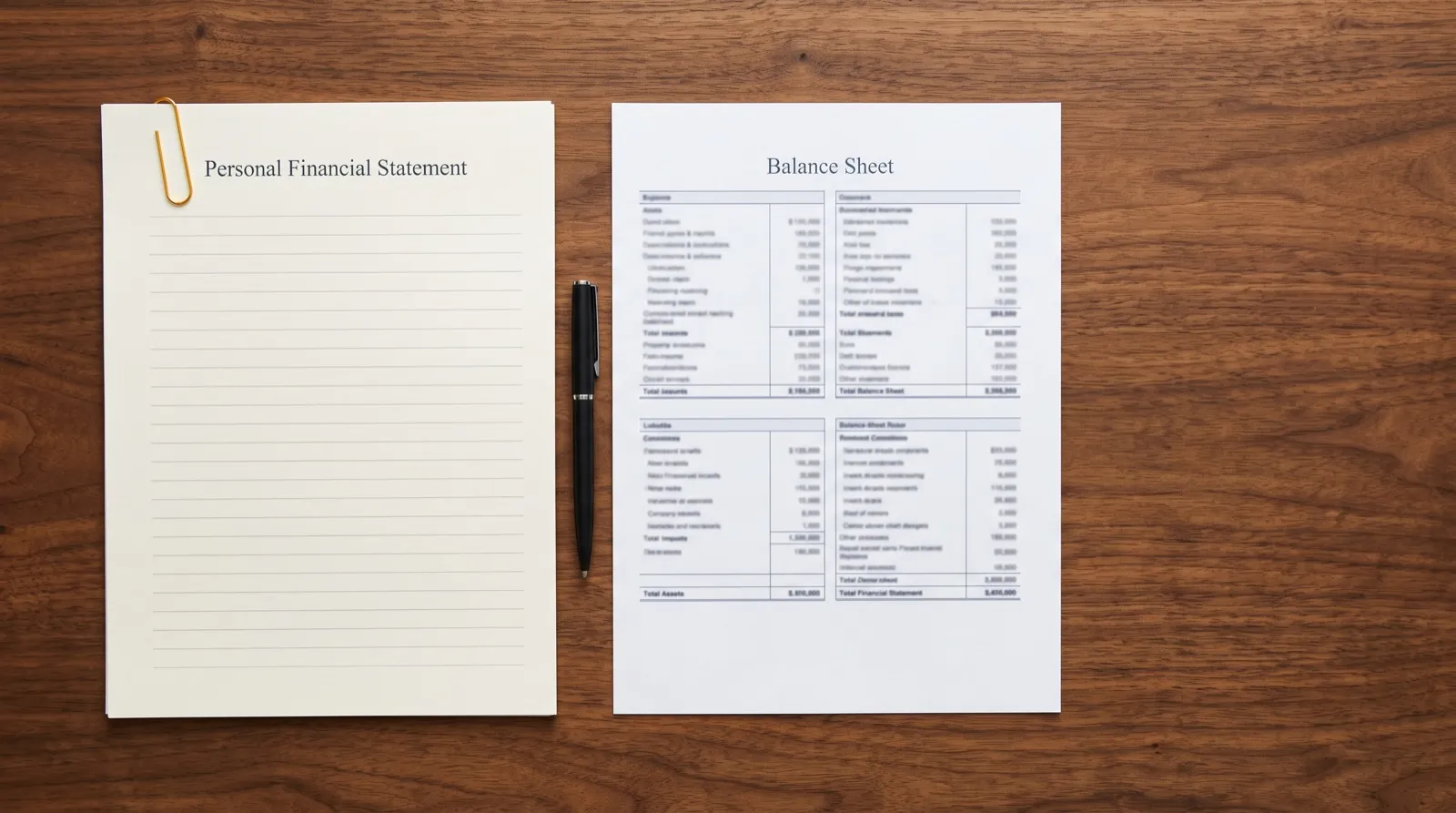


To calculate net worth, add up the current value of everything you own, add up the payoff balance of everything you owe, and subtract the second number from the first. The formula is net worth = total assets − total liabilities. The subtraction takes a minute. Valuing each line correctly is the real work, and it is where most home-made net worth numbers drift away from the truth.
The value of everything you own (assets) minus everything you owe (liabilities), measured on a single date. The Federal Reserve uses this same definition in its Survey of Consumer Finances: the difference between a family’s assets and its liabilities.
This guide is for working out your own number. If you are filling in a personal financial statement for a lender, the method is the same, but the forms add rules of their own. How to calculate net worth for an SBA loan covers those.
Before you start
Set aside about 30 to 45 minutes the first time. You need:
- The latest statement or app balance for every bank, brokerage, and retirement account
- The payoff balance on your mortgage, car loan, student loans, and credit cards (the loan servicer’s website shows it, and it is usually a little higher than the statement balance because of accrued interest)
- A current estimate of what your home and vehicles would sell for
- One date to measure everything on. Use today.
The single-date rule matters more than it looks. If you take your checking balance before payday and your credit card balance after you paid it off, the two numbers describe two different households.
Step 1: List every account at today’s balance
Write down each account and its balance as of your chosen date:
- Checking and savings
- Certificates of deposit and money market accounts
- Taxable brokerage accounts, at market value
- Retirement accounts: 401(k), 403(b), IRA, Roth IRA
- Health savings accounts
- The cash surrender value of any whole-life or universal-life insurance
Done looks like: every account you receive a statement for is on the list. Open your email and search for “statement” if you are unsure you have them all.
Common mistake: listing a life insurance policy at its death benefit. A $500,000 policy pays $500,000 to your heirs. What you own today is the cash surrender value, and a term policy has none. SBA Form 413 makes the same distinction: its life insurance line takes the cash surrender value only.
Step 2: Put a sale price on what you own
Next come the assets without a statement balance: your home, any other real estate, vehicles, and anything else worth real money if sold (a boat, jewelry, collectibles).
Value each one at what it would sell for today:
- Home: use recent sales of similar homes nearby, or an average of two or three online estimates. Don’t use the price you paid or the county’s assessed value. Assessed values often trail the market by years.
- Vehicles: look up the car in Kelley Blue Book or Edmunds. Trade-in value is the conservative choice; private-party value is fair if you would actually sell it yourself.
- Everything else: only include items you could sell, at the price someone would pay. Furniture and clothing are worth far less used than new, so most people leave them out.
Done looks like: each asset has one number next to it, and you could explain where that number came from.
Common mistake: writing your home equity on the asset line instead of the full market value. Step 4 shows why that hides something important.
Step 3: List every debt at its payoff balance
Now the other column. For each debt, write down what it would take to pay it off today:
- Mortgage and home equity line of credit
- Car loans and leases with a buyout
- Student loans
- Credit card balances
- Personal loans and buy-now-pay-later plans
- Taxes you owe but haven’t paid
Done looks like: every loan servicer and card company you pay is on the list with a payoff number next to it.
Common mistake: entering the monthly payment. A mortgage with a $2,150 monthly payment can carry a $301,000 balance, and the balance is the debt. Typing payments instead of balances is the fastest way to produce a net worth that is hundreds of thousands of dollars too high. The types of liabilities guide lists the less obvious debts people forget.
Build your personal financial statement in minutes
StatementsReady syncs bank balances read-only through Plaid, fills SBA Form 413, and exports a lender-ready PDF on demand.
- SBA Form 413 with every section filled
- Bank sync through Plaid, read-only
- 7 days free, no card
Step 4: Subtract, and keep the mortgage separate
Here is a worked example for a household with a house, a car, a 401(k), and the usual debts:
| Assets | Value | Liabilities | Balance |
|---|---|---|---|
| Checking | $8,400 | Mortgage | $301,000 |
| Savings | $22,000 | Car loan | $14,200 |
| Brokerage account | $41,000 | Student loan | $27,600 |
| 401(k) | $118,000 | Credit card | $3,100 |
| Home (market value) | $465,000 | ||
| Car (trade-in value) | $19,500 | ||
| Total assets | $673,900 | Total liabilities | $345,900 |
$673,900 − $345,900 = $328,000 net worth.
Keep the mortgage on its own line. Suppose this household skips the mortgage and lists its home equity ($465,000 − $301,000 = $164,000) as the asset instead. Net worth still comes out to $328,000.
But total assets drop to $372,900 and total liabilities to $44,900, so the household looks like it carries debt equal to 12% of its assets. Counted in full, the figure is 51%: $345,900 of debt against $673,900 of assets.
Same net worth, a very different picture of leverage. That second number, the debt-to-asset ratio, is one that lenders often look at, and it tells you how exposed you are if home prices fall. Most personal financial statement forms, including SBA Form 413, list a property’s market value and its mortgage separately for this reason.
Step 5: Decide how to count retirement accounts
Two assets cause most of the arguments: retirement accounts and the house you live in. Neither has a single right answer, so pick a rule and apply it the same way every time.
Retirement accounts. The Federal Reserve counts 401(k) and IRA accounts at their full balance in its survey, and so do most personal financial statements. For mortgages, Fannie Mae’s Selling Guide lets lenders count vested 401(k) and IRA funds toward reserves without requiring you to withdraw them.
For your own planning, remember that a traditional 401(k) balance isn’t all yours. In the example above, if withdrawals would be taxed at 22%, the $118,000 401(k) is worth about $92,000 to spend. Qualified Roth withdrawals are tax-free, though taking earnings out early can trigger tax and penalties.
Some people track both versions. If you do, label which one you are using.
Pensions and Social Security. Leave them out. The Fed excludes defined-benefit pensions and Social Security from net worth because putting a present value on a future income stream “depends critically on assumptions” about earnings, inflation, and life expectancy. Treat them as income you will receive in retirement.
Your home. Count it. The Fed’s survey includes your home in net worth, and so do personal financial statements, which list the home’s value and its mortgage separately.
Just remember it is illiquid: you can’t spend it without selling, refinancing, or borrowing against it. That is why some people also track liquid net worth, which leaves the house out.
Step 6: Compare your result
A net worth number means more next to a benchmark.
$192,900
Median U.S. family net worth in 2022, the most recent Survey of Consumer Finances published
Source: Federal Reserve, Changes in U.S. Family Finances from 2019 to 2022
In that survey the median U.S. family net worth was $192,900 and the mean was $1,063,700. The gap between those two figures shows how much a small number of very wealthy households pull the average up. The median is the fairer comparison for one household.
The example household’s $328,000 sits above the national median. Age changes the picture a lot, though. The net worth calculator compares your result with the Fed’s median for your age group, which is a fairer comparison than the national figure.
Common mistake: comparing your household against a single-person figure, or the other way around. The Fed’s numbers are per family, so compare your household total to them.
Step 7: Date it, save it, repeat
Write the date at the top and save the sheet. A single net worth number tells you where you stand. The same number measured every month or quarter tells you which way you are moving, which is the more useful fact.
Pick a fixed day (the first of the month works), update every balance, and record the new total next to the old one. Three habits keep the series honest:
- Use the same valuation method for the house and car every time, so a change in the number reflects a change in your finances.
- Update the debts too. Paying $500 of principal from checking leaves net worth unchanged, because cash and debt both fall by $500. Skip the debt update and your net worth looks $500 lower than it is.
- Note one-off events (an inheritance, a big medical bill) next to the month they happened.
A net worth statement template gives you the two-column layout with room for a date, and the net worth tracker keeps balances current by syncing read-only with your bank accounts through Plaid.
What “done” looks like
You have one sheet with a date at the top. Every account and asset sits in the left column at today’s value, and every debt sits in the right column at its payoff balance, with the mortgage on its own line. The figure at the bottom equals total assets minus total liabilities. You know which way you counted your 401(k), and you can say where each estimated value came from.
If someone asked you to produce the same number again in three months, you could do it in 15 minutes.
What to do next
- If a lender asked for the number, turn it into a signed personal financial statement. The SBA loan version of this guide covers SBA Form 413 line by line.
- If you want to see the full menu of what belongs in each column, the list of assets and liabilities goes item by item.
- More posts on tracking your own finances are in the personal finance category.
Skip the spreadsheet
A lender-ready personal financial statement from synced balances, in about 8 minutes.
- 7 days free
- No credit card
- PDF, SBA Form 413, Word, or Excel
Build your personal financial statement in minutes
StatementsReady syncs bank balances read-only through Plaid, fills SBA Form 413, and exports a lender-ready PDF on demand.
- SBA Form 413 with every section filled
- Bank sync through Plaid, read-only
- 7 days free, no card